







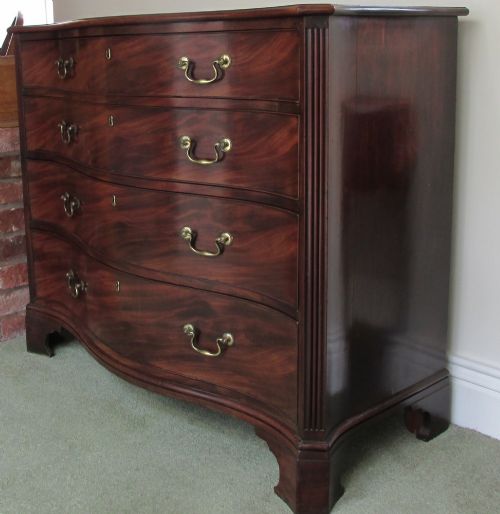

Ogee Drawer Chest
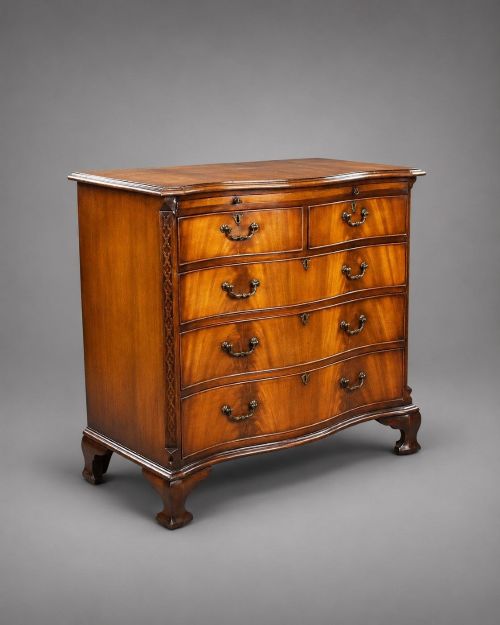
An ogee drawer chest brings architectural grace to a room through its characteristic S-shaped bracket feet or moulded profiles.
Ogee Drawer Chest
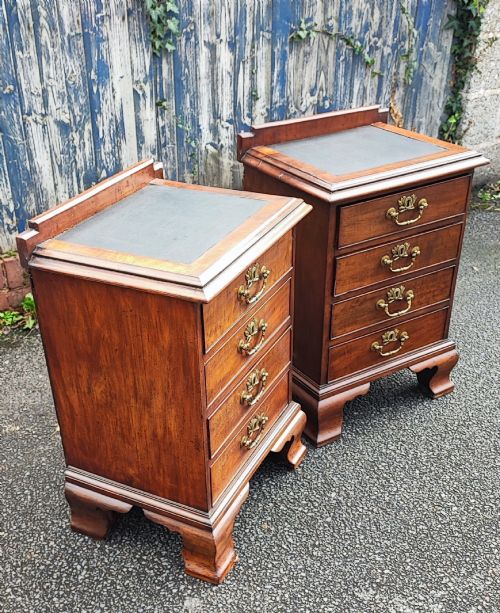
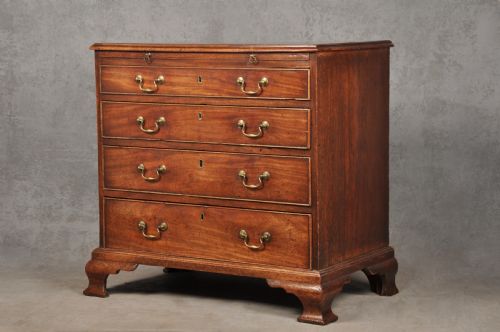
An ogee drawer chest is a substantial storage piece defined by its distinctive double-curved ogee moulding, appearing most frequently in mahogany or oak across Georgian and Victorian periods. Buyers examining this page will encounter various forms, ranging from standard chests of drawers and mule chests to miniature chests and chest on chest configurations.
The pieces on this page span the eighteenth century and the late nineteenth century, reflecting both high-style Georgian cabinet-making and vernacular Welsh traditions. Mahogany predominates alongside oak, pine, and occasional fruitwood inlay, creating forms that serve as functional bedroom or living space storage.
Georgian examples often display precise proportions with brushing slides or serpentine fronts, whilst Victorian interpretations utilise pine. Miniature versions, known as coffor bach, demonstrate the same attention to detail on a smaller scale.
How they were made
Cabinet-makers constructed these pieces primarily using solid mahogany or oak, shaping the distinctive ogee profiles directly from the timber or applying finely carved mouldings to the base and cornices. Drawer construction relied on traditional dovetail joints, ensuring durability for daily use over centuries.
Secondary timbers such as pine frequently appear in drawer linings and backboards, particularly in Georgian and Victorian examples. Surface finishes were achieved through hand-applied polishing methods that highlighted the natural grain and colour of the primary woods.
Ogee Drawer Chest Retail Price Guide 2026
Typical asking prices for ogee drawer chest among the pieces listed under this phrase on Sellingantiques today, from the lower quarter to the upper quarter. They describe what is for sale here now, not the wider market.
Miniature chests allowed master craftsmen to practice complex joinery while creating charming storage for miniature treasures.
What varies in quality
The distinction between standard and exceptional pieces rests upon the crispness of the timber mouldings and the retention of original ogee feet. Superior examples exhibit harmonious proportions, choice mahogany grain, and minimal timber replacement.
Internal construction reveals the maker's hand through the fineness of the dovetailing and the selection of secondary woods. Pieces retaining original brass hardware and working brushing slides command greater regard among collectors.
The Ogee Drawer Chest Glossary
- Ogee
- A moulding profile consisting of a double curve, combining a concave arc flowing into a convex arc. This distinctive line frequently defines the bracket feet or cornices of these chests.
- Brushing slide
- A pull-out shelf integrated above the top drawers of a chest, historically used for folding clothes or writing. It sits flush with the casework when closed.
- Mule chest
- A storage piece combining drawers in the base with a lift-top trunk compartment above. Georgian examples in mahogany or oak represent traditional vernacular furniture.
- Serpentine front
- A furniture front curving outward in the centre and inward at the sides. This configuration requires advanced woodworking skill to match the grain across the drawers.
Ogee Drawer Chest: Frequently Asked Questions
What is an ogee foot?
An ogee foot is a shaped bracket foot featuring a distinctive S-curve profile that lifts the cabinet body off the floor. It provides architectural stability and visual elegance to eighteenth and nineteenth-century case furniture.
Cabinet-makers carved these feet directly from solid timber or mitred them at the corners to maintain continuous grain flow around the base of the chest.
How do I date a mahogany chest?
Dating relies on observing construction methods, timber selection, and hardware styles across different eras. Georgian pieces often display fine dovetailing and secondary pine linings, while Victorian examples show machine assistance.
Changes in handle fixings and drawer depth also help distinguish mid-eighteenth-century pieces from later nineteenth-century revivals.
What is a brushing slide used for?
A brushing slide served as a temporary horizontal surface for folding garments or placing items while selecting attire from the drawers below. It pulls out smoothly from the upper section of the chest framework.
In period rooms, these surfaces offered practical utility without occupying permanent floor space.
Are miniature chests authentic?
Miniature chests, such as Welsh coffor bach, were authentic period pieces created as apprentice pieces, samples, or special commissions for personal use. They replicate the exact proportions and joinery of full-sized furniture.
Makers utilised the same quality hardwoods, including oak and mahogany, scaled down for smaller domestic settings.