
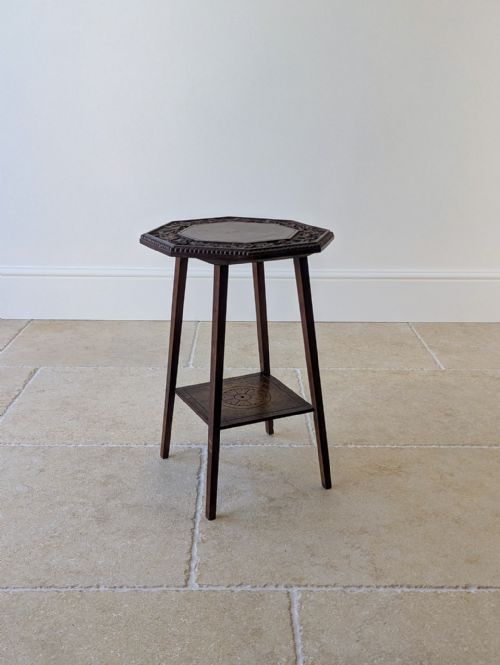
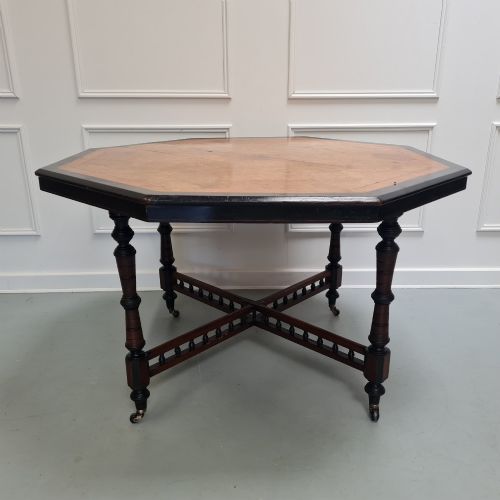
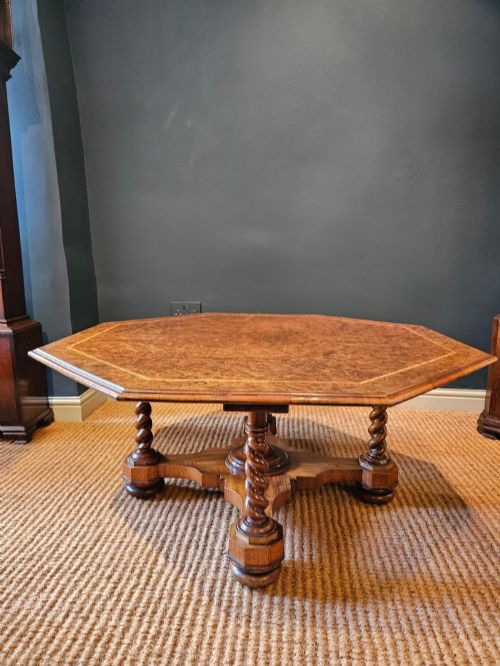


Octagonal Walnut Tea Table
These octagonal walnut tea table pieces offer geometric surfaces of burr and plain timber, built for Victorian and Edwardian parlours.
Octagonal Walnut Tea Table
An octagonal walnut tea table provides an eight-sided timber surface used traditionally for serving tea or displaying ornaments in nineteenth and twentieth-century interiors. The selection on this page ranges from Victorian centre tables and Edwardian side pieces to later Art Deco coffee designs.
The primary form relies on a central pedestal or four-legged support holding the geometric top. Many examples date from the Victorian and Edwardian eras, incorporating stylistic influences from the Aesthetic Movement, Arts and Crafts, and Moorish Revival traditions.
Materials and construction
Makers utilised solid walnut and walnut veneer, frequently selecting burr walnut to create figured grain patterns across the wide eight-sided tops. Secondary details involve marquetry and inlay work utilising boxwood, ebony, olive wood, and various specimen timbers.
Structural variety includes tilt-top mechanisms, two-tier formats with cross-stick bracing, and sturdy pedestal supports. Inlaid surfaces often display geometric Sorrento or Arabic motifs alongside traditional British cabinetmaking joints.
Listings span periods from the Victorian era and 1860 through Edwardian designs up to 1930 Art Deco coffee tables.
Assessing quality and craftsmanship
Quality rests in the choice of timber veneer and the precision of the marquetry inlay across the octagonal top. Finer examples display carefully matched burr walnut sections and intricate contrasting stringing rather than plain, unfigured surfaces.
Construction stability defines the better pieces, particularly in the joinery of pedestal bases, tripod legs, and tilt-top mechanisms. Tables featuring complex multi-wood parquetry or specialised regional inlay work generally represent higher levels of workshop execution.
The Octagonal Walnut Tea Table Glossary
- Burr walnut
- A prized timber harvested from walnut tree growths, producing swirling and knotted grain patterns across furniture surfaces. It adds considerable visual depth to table tops.
- Marquetry
- Decorative patterns formed by fitting small pieces of veneer into a scored wood base. Craftsmen utilise various coloured timbers to create floral or geometric designs.
- Tilt-top
- A hinged table mechanism allowing the surface to swivel vertically for storage against a wall when not in use. This was common in nineteenth-century domestic settings.
- Cross-stick bracing
- Intersecting wooden stretchers positioned between table legs to provide structural rigidity. It appears frequently on lower tiers of occasional tables.
- Specimen wood
- Furniture tops composed of multiple native and exotic timbers arranged in geometric mosaics. Each wood type retains its natural colour and grain.
Octagonal Walnut Tea Table: Frequently Asked Questions
What is an octagonal walnut tea table used for today?
These tables function well as central display surfaces in sitting rooms or as compact coffee tables beside seating. Their eight-sided geometry allows them to fit comfortably into room corners or angled spaces.
The flat timber tops provide adequate space for lamps, books, or tea services, continuing their original domestic utility within modern rooms.
How do I identify a Victorian example?
Victorian pieces often feature darker walnut tones, robust pedestals, and decorative details like Aesthetic Movement carving or Arts and Crafts simplicity. Construction methods typically involve heavier timber frames and traditional joinery.
Looking underneath reveals the age of the wood and the manual construction techniques characteristic of nineteenth-century workshops.
Are Edwardian tables different from Victorian ones?
Edwardian versions generally display lighter proportions, finer inlay work, and simpler lines compared to earlier nineteenth-century models. They frequently serve as occasional or window tables with slender legs.
The use of walnut veneer and geometric stringing remains popular across both periods, though Edwardian pieces often feel airier in form.
How should I care for walnut veneer?
Walnut benefits from occasional polishing with traditional beeswax to nourish the timber and protect the delicate veneer surface. Avoid placing these tables in direct sunlight or near heat sources to prevent the wood from drying out.
Using coasters and dry cloths for dusting will preserve the polished finish and the intricate inlay work over time.