






North Wales Landscape
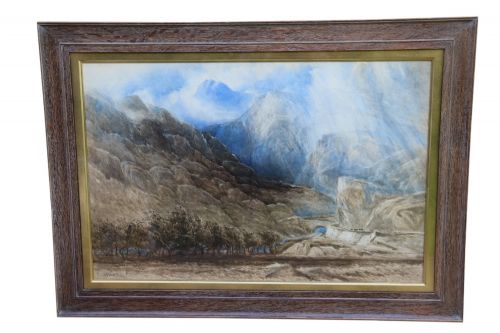
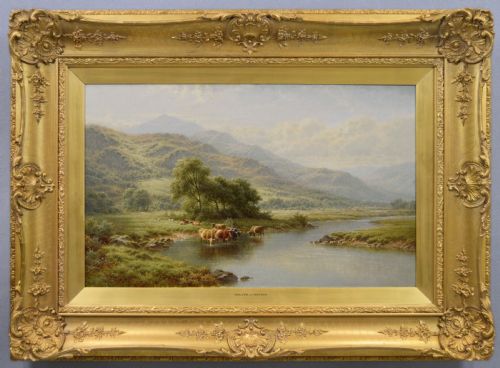
These north wales landscape works capture rugged mountain passes, rivers and castles through nineteenth-century oils and watercolours.
North Wales Landscape
A north wales landscape brings nineteenth-century views of Snowdonia, rivers and historic sites into your home. These portrayals record scenic spots like the pass of Llanberis, the river Llugwy and Gwydir Castle through traditional fine art media.
Most pieces on this page are nineteenth-century works, spanning oil on canvas and watercolour paintings. Victorian artists favoured these dramatic terrains, capturing cattle by riverbanks, wooded glens and figures beside water.
You will encounter both expansive oils in giltwood frames and smaller decorative earthenware plaques painted with local Welsh scenes. These diverse formats preserve the region's topography as documented by Victorian artists.
How they were made
Painters applied oil on canvas or watercolour on paper to capture these Welsh scenes. Many works feature decorative giltwood and gesso frames that complement the traditional subjects.
Makers also painted earthenware plaques, exemplified by Copeland pottery pieces decorated with local topographical views. These methods combine fine art brushwork with ceramic decoration.
North Wales Landscape Retail Price Guide 2026
Typical asking prices for north wales landscape among the pieces listed under this phrase on Sellingantiques today, from the lower quarter to the upper quarter. They describe what is for sale here now, not the wider market.
Donkeys and cattle frequently pause by Welsh rivers while Victorian artists paint them.
What varies in quality
Quality rests in the precision of the brushwork and the artist's ability to render light across mountain passes and river valleys. Skilled compositions balance topographical accuracy with atmospheric depth.
The finish of the framing, particularly original giltwood and gesso moulding, adds distinction to the paintings. Hand-painted ceramic plaques depend on the crispness of the porcelain decoration and clear artist signatures.
Henry Martin Pope·Copeland Pottery·William Yale·Thomas Spinks·Clarence Henry Roe·William Mellor·Walter J Watson·J Barclay·John Cuthbert Salmon·Samuel Sidley·Thomas Swift Hutton·Carleton Grant·George Parson-Norman·James Poole
The North Wales Landscape Glossary
- Oil on Canvas
- Pigment mixed with drying oil applied to a woven fabric stretched across a wooden frame. This medium allowed nineteenth-century artists to build rich textures and deep tones.
- Watercolour
- Paint consisting of pigment suspended in a water-based solution, typically applied to paper. It produces translucent washes suited to capturing atmospheric Welsh weather.
- Giltwood
- Wood carved and coated with gold leaf or a gilt finish. It frequently surrounds nineteenth-century landscape paintings to frame the composition.
- Gesso
- A plaster-like mixture applied to wood before gilding or painting. It provides a smooth surface for detailed decorative moulding on frames.
- Earthenware
- Porous pottery fired at lower temperatures, used here for decorative ceramic plaques. Copeland pottery utilised this material for hand-painted topographical scenes.
North Wales Landscape: Frequently Asked Questions
What subjects appear in a north wales landscape?
These works depict specific regional landmarks including the pass of Llanberis, the river Conwy and Mount Snowdon. Artists also recorded everyday rural life with figures, cattle and donkeys near the water.
Compositions frequently feature wooded glens, castles and mountainous terrain characteristic of nineteenth-century Welsh topography.
Are these works original nineteenth-century pieces?
The listings comprise nineteenth-century watercolours and oil paintings created during the Victorian period. Artists recorded the Welsh countryside from direct observation and artistic convention of that era.
Signatures, dates and historical attributions help identify the period and origin of each individual painting or plaque.
How do I display a framed oil painting?
Display these works away from direct sunlight and excessive moisture to protect the canvas, paper and giltwood frames. Stable indoor environments preserve the integrity of both the paint layer and the gesso moulding.
Ensure wall fixings safely support the weight of heavy oil paintings and their decorative frames.
What is a Copeland pottery plaque?
Copeland pottery plaques are ceramic panels decorated with hand-painted topographical views of locations like the river Llugwy. They combine the skills of ceramic manufacture with fine art landscape painting.
These pieces usually bear specific numbers and artist signatures on the back or front.