

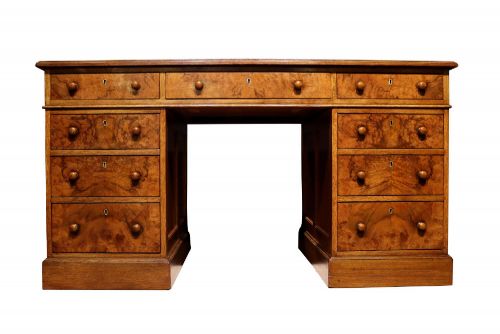
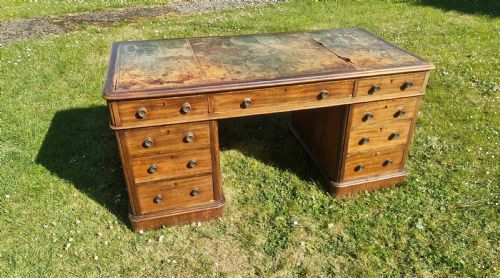


Nineteenth Century Kneehole Desk
A nineteenth century kneehole desk offers a commanding presence and clever storage, built for serious correspondence.
Nineteenth Century Kneehole Desk
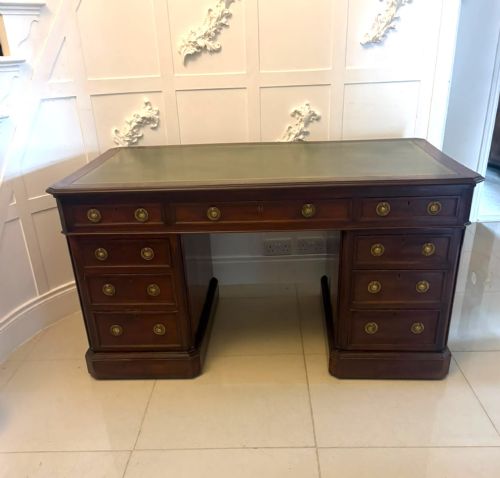
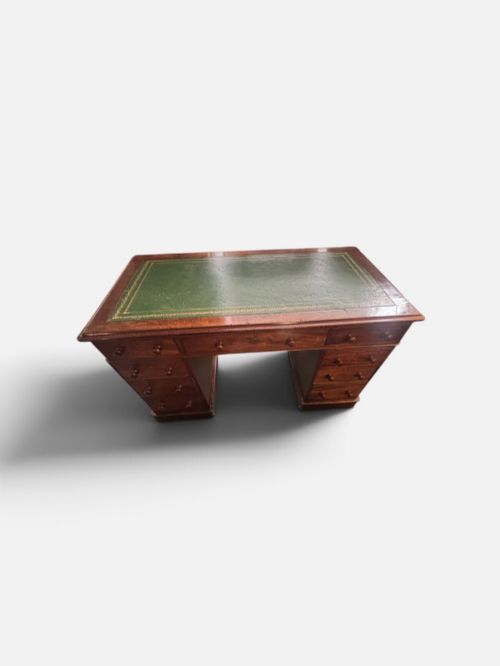
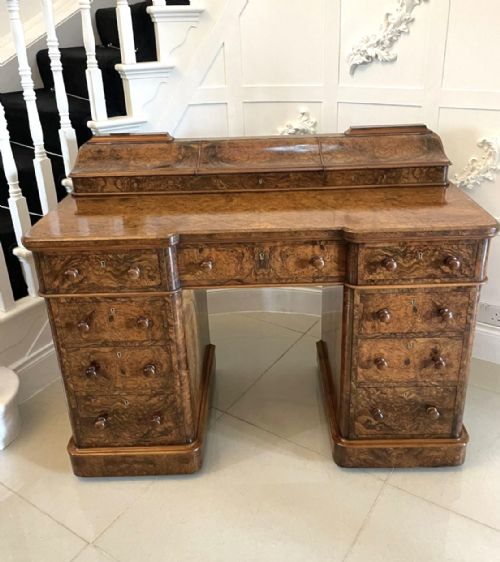
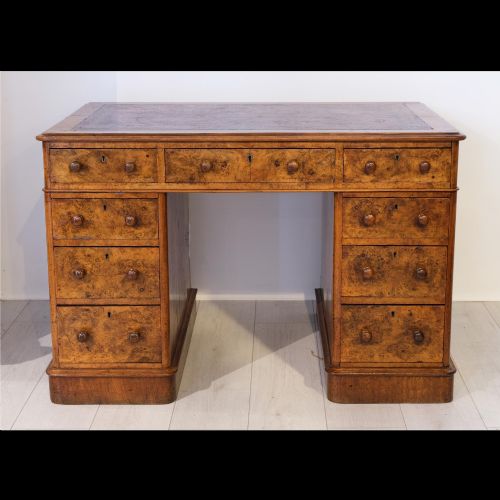
A nineteenth century kneehole desk is a substantial workspace featuring a recessed central recess flanked by pedestals of drawers, designed primarily for the study or library. The versions encountered most frequently on this page stem from the Victorian period, spanning decades from the eighteen-fifties through to eighteen-ninety, alongside occasional Regency and eighteenth-century survivals.
These pieces manifest in varied forms, including partner desks designed for simultaneous use, freestanding pedestal desks, and dressing tables that share the characteristic kneehole architecture. Woods such as mahogany, oak, burr walnut, and satin birch dominate the selection, often complemented by inset leather writing surfaces and brass hardware.
Makers recorded in the inventory range from renowned cabinet makers such as Maple & Co and Gillow & Co to specialised London workshops like John Gregory. The overarching style reflects the prevailing tastes of the nineteenth century, moving from classical Regency lines to heavier Victorian proportions and Aesthetic Movement ebonised finishes.
Materials and construction
Cabinet makers constructed these desks using dense primary timbers like mahogany and oak for structural integrity, often applying figured veneers such as burr walnut or satin birch to the exterior surfaces. Drawers feature traditional hand-cut dovetail joints, reflecting the labor-intensive construction methods of nineteenth-century workshops.
Writing surfaces typically incorporate tooled leather inserts, secured with pasted borders and sometimes accompanied by pull-out writing slides. Brass handles, drawer pulls, and occasionally locks provide functional and decorative accents, while secondary woods like pine appear in unseen structural areas.
Nineteenth Century Kneehole Desk Retail Price Guide 2026
Typical asking prices for nineteenth century kneehole desk among the pieces listed under this phrase on Sellingantiques today, from the lower quarter to the upper quarter. They describe what is for sale here now, not the wider market.
Mahogany and burr walnut are the dominant timbers recorded across these nineteenth-century desk listings.
Distinctions in quality
Maker attribution also elevates a piece significantly, with stamped signatures or paper labels from esteemed firms such as Gillow & Co or Maple & Co indicating superior workshop standards. Furthermore, the presence of original brass hardware, working locks with keys, and untouched patination on the timber demarcates an exceptional specimen from one that has undergone heavy restoration or alteration.
Maple & Co·Gillow & Co·John Gregory London
The Nineteenth Century Kneehole Desk Glossary
- Kneehole desk
- A writing table with a central recess for the legs, positioned beneath the writing surface and flanked by two pedestals of small drawers.
- Pedestal desk
- A heavy freestanding desk consisting of two independent pedestals containing drawers, connected by a top surface and a central section.
- Partners desk
- A large double-sided desk designed to accommodate two people sitting opposite one another, featuring drawers and cupboards on both faces.
- Burr walnut
- A highly prized wood veneer taken from the gnarled growth of a walnut tree, exhibiting intricate, swirling patterns.
- Writing slide
- A pull-out wooden board integrated beneath the main writing surface, providing additional temporary space for papers.
Nineteenth Century Kneehole Desk: Frequently Asked Questions
How do I care for the leather top?
Clean the leather gently with a slightly damp cloth, avoiding harsh chemical cleaners that can strip the original finish. Apply a specialist leather wax or balm periodically to keep the material supple and prevent cracking.
Protect the surface from direct sunlight and excessive moisture by using coasters and blotters during daily writing tasks.
Were these desks used in offices or homes?
Nineteenth century kneehole desks served primarily in private libraries, studies, and domestic drawing rooms rather than commercial offices. Wealthy households and professionals utilised them for managing correspondence, household accounts, and personal estate administration.
Their substantial construction and finished backs allowed them to sit proudly in the middle of a room rather than pushed against a wall.
How do I distinguish Victorian from Regency desks?
Regency desks, dating from the early nineteenth century, generally display lighter, more restrained classical proportions inspired by ancient Greek and Roman designs. Mahogany is the predominant timber, often accented with delicate brass inlay or reeded legs.
Victorian desks, emerging after eighteen-thirty-seven, tend to be heavier and more ornate, reflecting expanding industrial capabilities and diverse revival styles. They frequently incorporate richer veneers like burr walnut and feature more robust pedestal arrangements.