
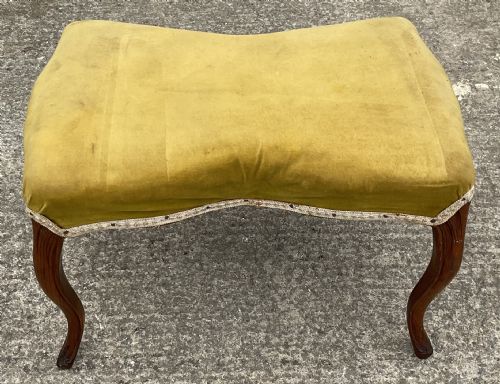


Nineteenth Century Dressing Stool
Nineteenth century dressing stool examples offer neat seating at the vanity, combining period timbers with traditional upholstery to anchor a bedroom scheme.
Nineteenth Century Dressing Stool
A nineteenth century dressing stool is a compact seating piece designed for the bedroom or dressing room, typically featuring an upholstered top supported by a timber frame. These pieces range from simple low footstools to elegant framed examples intended for use at a dressing table.
The versions most commonly met on this page include Victorian mahogany and walnut frames, alongside Regency and William IV variants. Pieces frequently exhibit structural forms such as X-frames and cabriole legs, linking them directly to the seating styles of the period.
Origins span English, French, and Swedish workshops, bringing diverse regional interpretations to a straightforward domestic form. Buyers encounter both single pieces and pairs, dressed in traditional textiles including velvet, leather, and chenille.
Materials and construction
Frames are constructed from dense hardwoods such as mahogany, walnut, and rosewood, chosen for their strength and rich grain. These timbers are shaped into curves or straight members, sometimes featuring carved detail on the knees and legs.
Upholstery relies on traditional textile coverings like velvet, leather, chenille, and hessian, fixed over padded foundations. Brass elements occasionally appear as decorative mounts, castors, or structural fixings on the frames.
Listings feature timbers including mahogany, walnut, rosewood, and oak, paired with textiles such as velvet, leather, and chenille.
Assessing quality
The distinction between standard and superior pieces rests on the crispness of the timber carving and the architectural balance of the frame. Refined examples display harmonious proportions, particularly in the sweep of a cabriole leg or the geometry of an X-frame.
Material selection dictates the upper tier of the range, where figured veneers, dense rosewood, or finely cast brass details elevate the piece. The integrity of the original timber structure and the quality of the upholstery textile further separate ordinary examples from the best.
The Nineteenth Century Dressing Stool Glossary
- Cabriole leg
- A furniture leg that curves outward and then tapers inward, mimicking an animal's leg. This form appears frequently on mid-nineteenth-century seating frames.
- X-frame
- A structural support shaped like the letter X, providing lateral stability to the stool. It lends a distinct architectural silhouette to dressing furniture.
- Chenille
- A fuzzy, piled yarn used in traditional upholstery textiles. It provides a tactile surface texture seen on period seat covers.
- Regency
- A British design period spanning the early nineteenth century, characterised by classical restraint and neoclassical influences. Pieces from this era often utilise mahogany.
- William IV
- A transitional design style bridging the late Regency and early Victorian eras, noted for robust proportions and dark hardwoods. Stools from this time demonstrate solid craftsmanship.
Nineteenth Century Dressing Stool: Frequently Asked Questions
Where do you put a dressing stool?
These compact seats sit comfortably beneath a dressing table or vanity in a bedroom. They also function as occasional seats or footstools in living spaces.
Because of their modest scale, they fit easily into alcoves or corners without dominating the room.
How do I identify a Victorian stool?
Victorian examples often feature walnut or mahogany frames with turned legs, cabriole supports, or carved decoration. The upholstery frequently includes textured fabrics like velvet or wool.
Construction details and timber ageing help confirm the mid-to-late nineteenth-century timeline.
Are these stools sturdy enough to sit on?
Period frames are built from hardwoods like mahogany and walnut, designed for daily domestic use. Their sturdy timber construction makes them fully functional for seating.
Checking the rigidity of the joints ensures the frame remains stable for regular use.
What is an X-frame stool?
An X-frame stool uses crossed timber members beneath the seat to form its primary structural support. This geometric design offers both stability and a decorative silhouette.
Originating in earlier classical furniture, the form saw a revival across the nineteenth century.