


Nineteenth Century Dog Figurine
These nineteenth century dog figurine examples bring character to a room, captured in bronze, earthenware and alabaster by period makers.
Nineteenth Century Dog Figurine
A nineteenth century dog figurine collection gathers Victorian Staffordshire pairs, French Animalier bronzes, and Meiji period Japanese works into one room. Buyers encounter earthenware spaniels and terriers alongside cold-painted bronze hounds and greyhounds.
The most common versions met here are Victorian Staffordshire pottery dogs and French bronze sculptures. These range from earthenware quill holders to carved Derbyshire alabaster and bronze desk accessories.
Originating across Britain, France, and Japan, these pieces reflect domestic companion animals and hunting hounds. Sculptors captured specific breeds including Maltese terriers, French bulldogs, basset anglais, and greyhounds.
Materials and Techniques
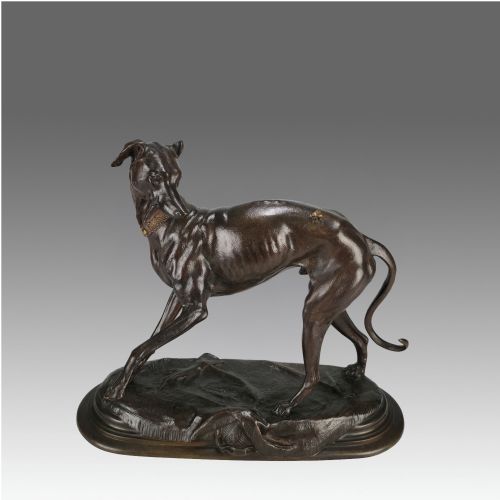
Foundries utilised lost-wax casting for bronze sculptures, capturing muscular detail in hunting hounds and greyhounds. Castings were finished with cold-painting or patination, sometimes bearing foundry marks from makers such as Barbedienne.
Carvers worked with Derbyshire alabaster to produce sculptural pairs of dogs. Artisans in Japan employed bronze techniques during the Meiji period to render domestic subjects with distinct regional character.
Greyhounds double as stationery holders here, serving as quill holders on nineteenth-century writing desks.
Evaluating Quality
The distinction between tiers rests upon the fidelity of the sculptural rendering and the crispness of the casting or glaze. Bronze works demonstrate precision in musculature and fur texture, while ceramics show careful brushwork in facial details.
Foundry attribution and artist signatures elevate certain bronzes, distinguishing signed works by sculptors like Barye, Cain, or Moigniez from unsigned foundry production. In pottery, the depth of lead or cobalt glaze and the preservation of enamel and gold leaf determine the standing of a pair.
Alfred Barye·Bright And Sons·Auguste Nicholas Cain·Jules Moigniez·Barbedienne
The Nineteenth Century Dog Figurine Glossary
- Animalier
- A nineteenth-century artistic movement dedicated to the realistic depiction of animals, particularly in bronze sculpture. Practitioners often observed subjects in zoological gardens.
- Staffordshire pottery
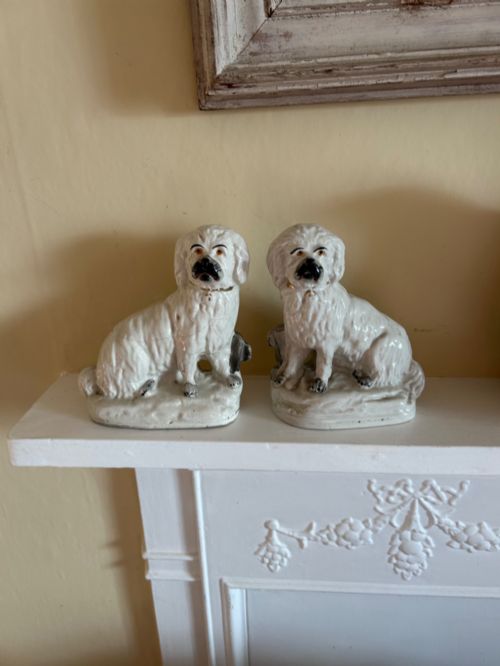
- Earthenware figures produced in the Staffordshire potteries of England. These decorative mantel ornaments frequently depict spaniels, greyhounds, and terriers in symmetrical pairs.
- Cold-painted bronze
- Metal sculpture painted with non-heat-set paints after casting. This technique was widely utilised by continental European foundries for decorative figures.
- Meiji period
- The era of Japanese history spanning from 1868 to 1912, noted for the production of bronze works exported to Western markets.
- Lead glaze
- A glossy ceramic coating containing lead oxide, applied to earthenware before firing. It creates a smooth, shiny surface finish on pottery figurines.
Nineteenth Century Dog Figurine: Frequently Asked Questions
How do I identify a Staffordshire dog pair?
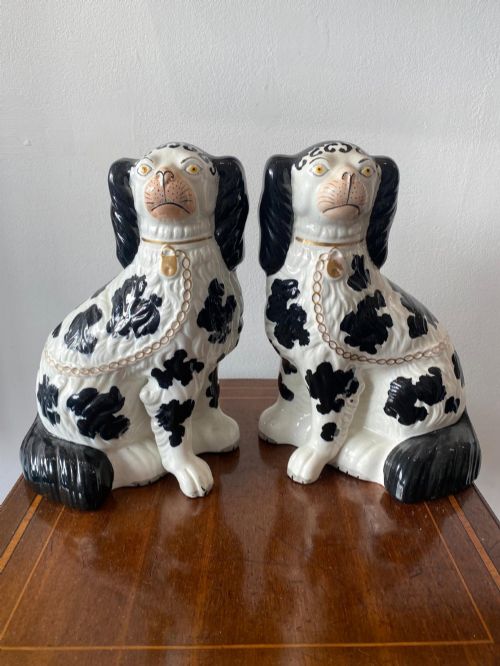
Staffordshire dogs appear as earthenware figures modelled as spaniels, greyhounds, or terriers, usually made in matching left and right orientations for mantel display. They feature hand-painted markings and often gold leaf collars.
Pottery techniques from the nineteenth century produce distinctive crazing in the glaze, separating these period examples from later reproductions.
What is Animalier bronze?
Animalier bronze describes realistic animal sculptures produced during the nineteenth century by European artists who studied anatomy closely. These pieces capture dogs in active poses, hunting scenes, or resting.
Foundries cast these works from detailed models, sometimes adding cold-painted pigments or rich chemical patinas to enhance the surface texture.
Where were these figures displayed originally?
Staffordshire pottery dogs traditionally sat upon mantelpieces in Victorian parlours, arranged facing inward toward each other. Bronze sculptures served as desk accessories, inkwells, or decorative objects in studies and libraries.
Their placement reflected both domestic affection for pets and the Victorian taste for natural history and animal subjects in interior decor.
How do I distinguish Japanese Meiji bronzes?
Meiji period Japanese bronzes combine traditional metalworking skills with subjects tailored for international export markets during the late nineteenth century. These sculptures demonstrate distinct casting methods compared to European works.
Artisans rendered domestic animals, such as the French bulldog, with specific attention to posture and surface patination characteristic of Japanese foundries of the era.