
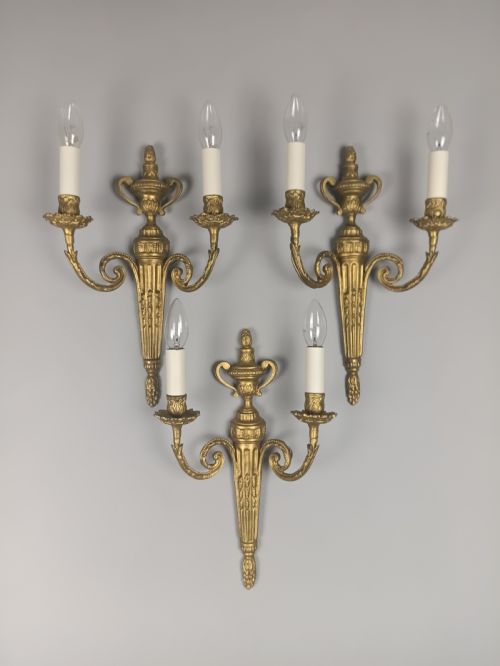
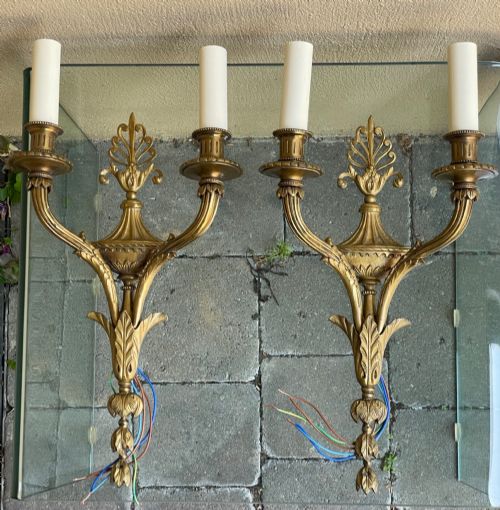


Neoclassical Twin Light Sconces
Neoclassical twin light sconces bring symmetrical illumination and formal architectural ornament to a wall through paired candle or bulb branches.
Neoclassical Twin Light Sconces
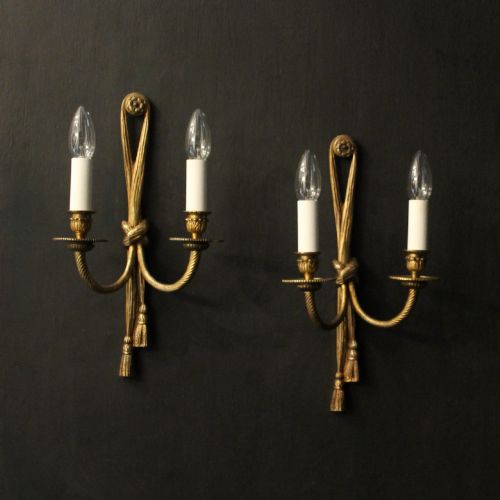
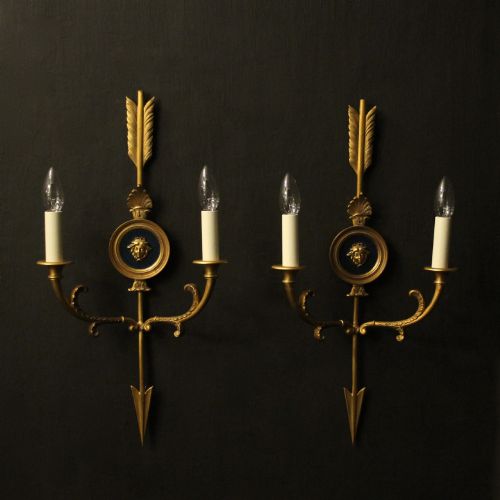
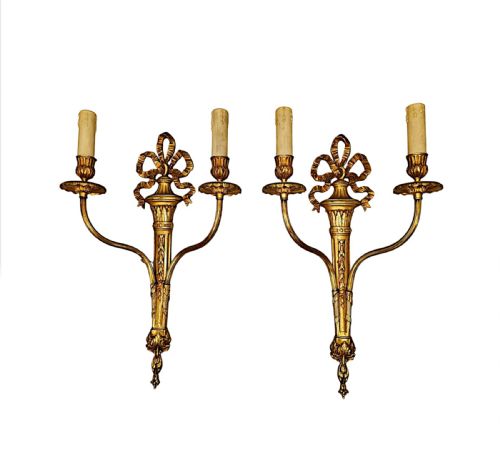
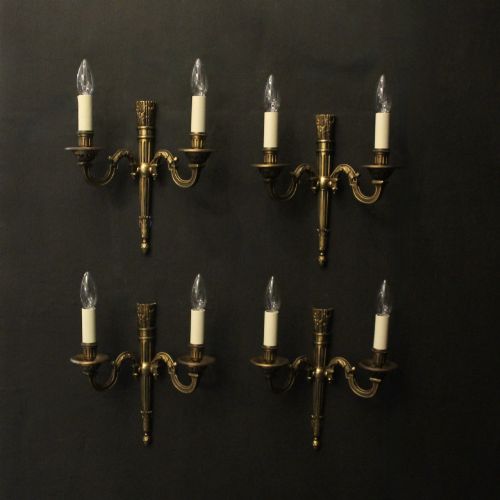
Neoclassical twin light sconces deliver balanced wall illumination through paired arms projecting from a central backplate, taking the form of wall lights, wall sconces, and wall lanterns. These fixtures draw upon historical vocabulary ranging from French Empire and Louis XVI style to Adam revival and Grand Regency.
The pieces appearing on this page span from the nineteenth century through the Edwardian era and into the early twentieth century, including the decades of 1880, 1900, 1910, 1920, and 1930. French origins predominate among the surviving examples, alongside English and Italian pieces.
Makers and workshops such as Maison Baguès contribute specialised metalwork to the selection, while various pieces incorporate decorative motifs like cherubs or carved wooden details. Buyers encounter everything from standard pairs to larger sets intended for coordinated interior schemes.
Materials and Technique
Makers constructed these fixtures primarily from copper-alloy metals including brass, cast brass, gilded brass, silvered brass, and bronze, alongside specialised surface finishes like ormolu and gilt bronze. Workshops also utilised timber to produce carved and gilded giltwood sconces.
Surface decoration frequently involved gilding, silver gilding, and polychrome paint applied over metal and wood foundations. Metal components were cast, chased, and joined to form the backplates and twin arms characteristic of these wall lights.
Materials represented across the inventory include brass, gilt bronze, ormolu, giltwood, silvered brass, and polychrome painted surfaces.
Judging Quality
Quality rests upon the crispness of the metal casting and the precision of the chased surface detail, where sharper definition distinguishes finer workshops from standard production. The depth and durability of the gilding or ormolu finish further separate superior examples from simpler ones.
Structural integrity of the arm joints and the weight of the backplate indicate the substantive nature of the materials employed. Original surface treatments and cohesive stylistic adherence to periods such as Louis XVI or Adam revival add considerable distinction.
Maison Baguès
The Neoclassical Twin Light Sconces Glossary
- Ormolu
- A technique of applying finely ground high-carat gold to a bronze object, creating a rich golden surface. This finish appears frequently on fine French wall lights.
- Gilt Bronze
- An alloy of copper and tin treated with gold leaf or mercury gilding to impart a lustrous metallic sheen. It provides durability and an opulent appearance.
- Adam Style
- An eighteenth-century neoclassical design movement revived in later periods, characterised by symmetrical urn, swag, and classical architectural motifs. Sconces in this style exhibit disciplined geometric balance.
- Backplate
- The vertical mounting plate that secures the fixture to the wall while supporting the projecting arms. It often bears the primary decorative relief of the sconce.
Neoclassical Twin Light Sconces: Frequently Asked Questions
How were twin light sconces originally used?
These fixtures served to illuminate rooms by holding candles along walls, often flanking mirrors, paintings, or architectural doorways to maximise reflected light.
In domestic interiors, pairs and larger sets provided ambient illumination before the widespread adoption of electrical wiring.
Are these sconces wired for electricity?
Many surviving examples have undergone conversion to electricity during the twentieth century, while others retain their original candle fittings or require rewiring.
Buyers should examine the internal wiring and lampholders to determine compatibility with current domestic electrical standards.
How do I distinguish French styles from English ones?
French pieces frequently employ gilt bronze and ornate Empire or Louis XVI motifs, including rich cast ornament and figural elements like cherubs.
English variants, such as those in the Adam revival or Regency style, often display more restrained neoclassical geometry and lighter brass or silvered finishes.
How should I clean gilded bronze metalwork?
Maintenance requires gentle dusting with a soft, dry brush to prevent the accumulation of grit within the chased details of the metal.
Avoid abrasive metal polishes and chemical cleaners, as these substances can strip the original ormolu or gold leaf surfaces.