


Neoclassical Marble Sideboard
A neoclassical marble sideboard brings architectural dignity and polished stone surfaces to a room, uniting classical proportion with fine cabinetmaking.
Neoclassical Marble Sideboard
A neoclassical marble sideboard encompasses commodes, side cabinets, and console tables fashioned with stone tops and grounded in classical design principles. Pieces span the eighteenth, nineteenth, and twentieth centuries, originating from English, French, Italian, and Dutch workshops.
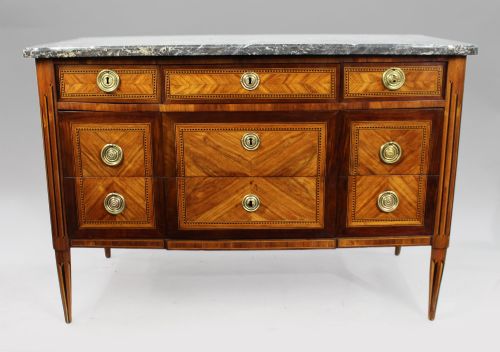
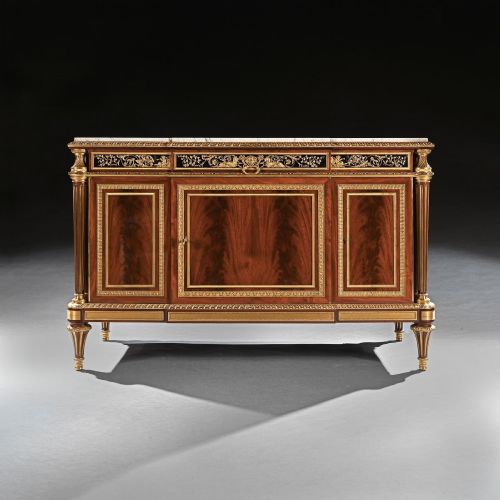
The form most frequently met on this page is the commode or side cabinet featuring a fitted marble slab above timber construction. These range from eighteenth-century parquetry examples to later revival pieces adopting Louis XVI and Empire styles.
How they were made
Construction relies on timber carcases of mahogany, walnut, satinwood, or burr elm, frequently enhanced by parquetry and marquetry inlay patterns. Cabinetmakers shaped these woods into straight, bow-front, breakfront, or demi-lune forms.
Mounts of brass, ormolu, and gilt bronze provide structural accent and decorative detail, complementing the heavy marble tops that crown each piece.
Listings span the eighteenth to the twentieth century, recording woods such as satinwood, burr elm, and mahogany alongside marble and ormolu.
What varies in quality
Quality rests in the precision of the timber work and the execution of the marquetry or parquetry patterns across the facade. Finer examples display meticulous grain selection and crisp handling of inlaid woods.
The refinement of the cast metal mounts and the thickness and selection of the marble top distinguish standard production from exceptional cabinetmaking.
Henry Dasson·Edmond Poteau·Weisweiler·Riesener
The Neoclassical Marble Sideboard Glossary
- Commode
- A low standing cabinet or chest of drawers designed for storage, frequently topped with marble in classical designs.
- Ormolu
- Gilded bronze mounts applied to furniture for decorative enrichment. The technique was widely employed in French cabinetmaking.
- Parquetry
- Geometric patterns formed by fitting small pieces of veneer together on a wooden surface. It appears on many eighteenth and nineteenth-century pieces.
- Demi-lune
- Half-moon shape used for console tables and side cabinets designed to sit flat against a wall.
- Marquetry
- Elaborate decorative inlay using various tinted woods to create pictorial or floral designs across furniture surfaces.
Neoclassical Marble Sideboard: Frequently Asked Questions
What is a neoclassical marble sideboard?
It is a low storage cabinet or console featuring a stone top, constructed during periods influenced by classical Greek and Roman design.
Such pieces include commodes and side cabinets made from woods like mahogany and walnut, finished with brass or ormolu mounts.
Where were these pieces made?
The pieces originate primarily from European workshops, with strong representation from French, Italian, Dutch, and English makers.
Continental cabinetmakers particularly favoured parquetry veneers paired with imported marble slabs.
How do I care for the marble top?
Marble requires gentle cleaning with warm water and mild soap, avoiding acidic substances that can etch the polished stone surface.
Routine dusting and prompt attention to spills will preserve the finish of the top over decades of use.
How do I identify a revival piece?
Revival pieces adopt styles such as Louis XVI or French Empire while dating to the nineteenth or early twentieth century rather than the original period.
Construction details, timber ageing, and secondary woods within the drawers help distinguish nineteenth-century interpretations from eighteenth-century originals.