

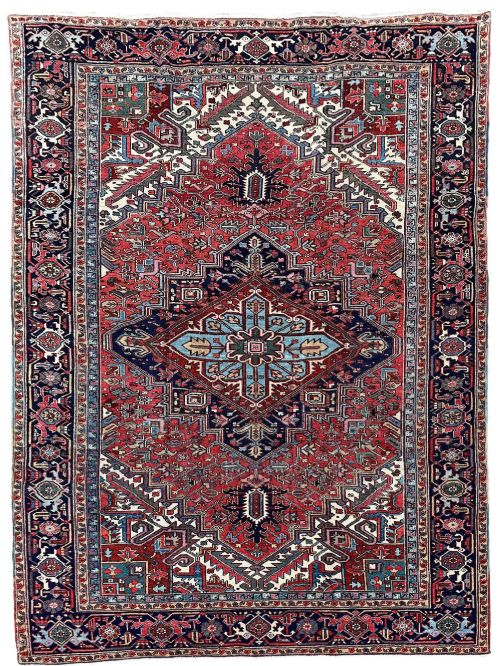

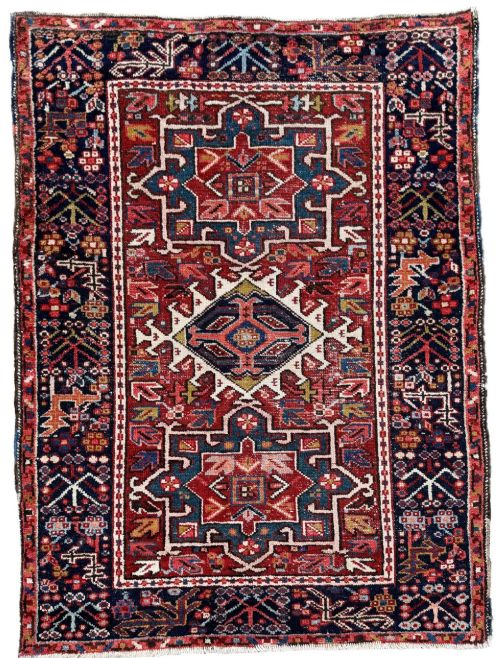

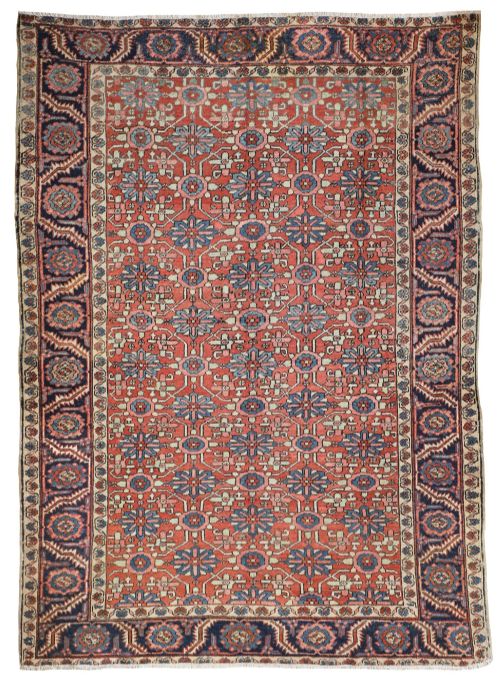
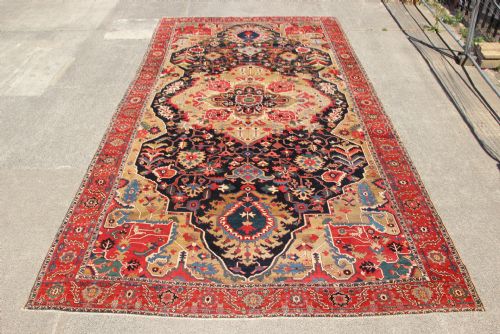


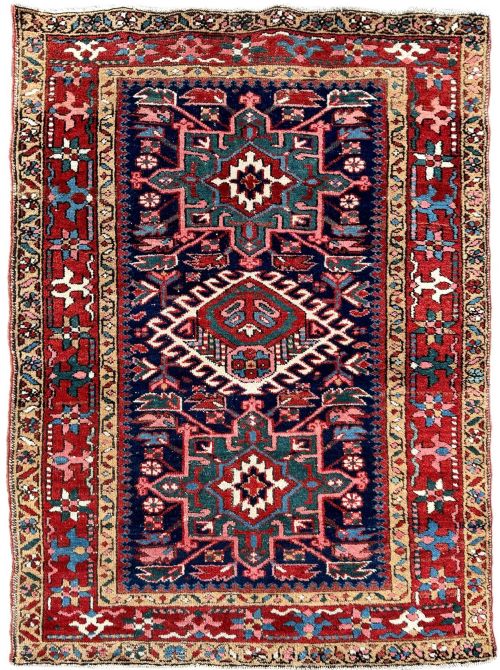
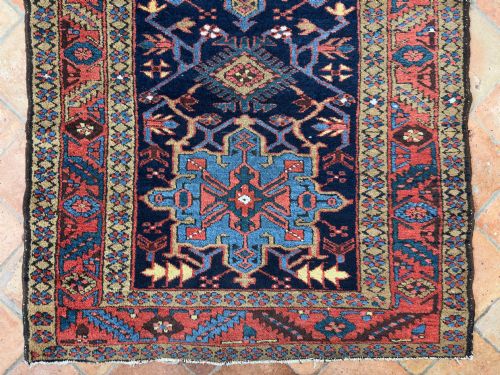


Navy Blue Heriz Rug
A navy blue heriz rug brings enduring Persian craft into a room, offering robust wool construction and geometric design.
Navy Blue Heriz Rug
A navy blue heriz rug represents a distinct category of Persian woven floor coverings dating from the late nineteenth century through the early twentieth century. These pieces encompass large carpets, smaller area rugs, and long hallway runners originating from the Heriz region and nearby northwestern districts.
The selection on this page centres primarily on traditional Persian Heriz carpets alongside related regional types such as Karaja, Serapi, Gorevan, and Hastrud weaves. Buyers will encounter both room-sized carpets and narrow runner formats suited to corridors and galleries.
How they were made
These floor coverings utilise a durable foundation of cotton for the warp and weft threads, providing structural stability to the heavy textile. Hand-knotted wool pile forms the surface, yielding a dense and resilient fabric designed for heavy daily use.
Weavers in the Heriz district employed sturdy knotting techniques characteristic of Persian tribal and village workshops. Vegetable and natural dyes produced the deep indigo and navy blue tones seen across the surviving carpets and runners from this area.
Navy Blue Heriz Rug Retail Price Guide 2026
Typical asking prices for navy blue heriz rug among the pieces listed under this phrase on Sellingantiques today, from the lower quarter to the upper quarter. They describe what is for sale here now, not the wider market.
Listings feature pieces dated from the eighteen-fifties through the nineteen-thirties, constructed from wool and cotton.
What varies in quality
The fineness of the weave and the complexity of the geometric medallion design dictate the grade of each Heriz carpet. Denser knot counts allow for sharper definition within the intricate floral and geometric motifs across the field.
The depth and saturation of the indigo and navy blue wool foundation separate standard village production from finer workshop examples like Serapi carpets. Uniformity in the hand-spun pile and balance within the border system indicate superior craftsmanship.
The Navy Blue Heriz Rug Glossary
- Heriz
- A region in northwest Persia renowned for durable carpets featuring bold geometric medallions and robust wool pile. These rugs date from the nineteenth and twentieth centuries.
- Serapi
- A sub-style of Heriz carpet often associated with earlier nineteenth-century production, characterised by more spacious designs and finer knotting. They command strong interest among collectors.
- Karaja
- A style of rug from a neighbouring village in the same weaving district, typically displaying smaller geometric motifs or multiple medallions. They appear as both individual pieces and matched pairs.
- Runner
- A long and narrow format of carpet designed specifically for hallways, corridors, and staircases. These pieces measure significantly longer than they are wide.
- Warp
- The stationary vertical threads stretched upon the loom that form the structural skeleton of the rug. Cotton serves as the standard material for this foundational grid.
Navy Blue Heriz Rug: Frequently Asked Questions
Where were navy blue heriz rugs made?
These textiles were knotted by village weavers in the Heriz district of northwest Persia, situated near Tabriz. The region developed a distinct aesthetic that blended tribal geometric patterns with larger-scale medallion layouts.
Production spanned several decades from the mid-nineteenth century into the twentieth century. Workshops and village homes utilised local wool and natural dyes to create these durable floor coverings.
How do you clean an antique wool rug?
Maintenance requires gentle vacuuming without a rotating power brush to protect the hand-knotted pile and cotton foundations. Professional textile cleaning is recommended for deep cleaning to preserve the natural wool fibres.
Avoiding excessive moisture and direct sunlight helps maintain the integrity of the indigo dyes and wool structure over time. Proper placement on suitable underlays prevents unnecessary friction against hard floors.
What is the difference between Heriz and Serapi carpets?
Serapi carpets represent an earlier, typically finer variation associated with the Heriz region, often featuring more open compositions and lower knot density variations. They date towards the mid-to-late nineteenth century and show distinct graphic clarity.
Standard Heriz carpets tend to feature denser geometric filling within the central medallions and corners. Both share the durable cotton and wool construction typical of northwestern Persian production.