



Naval Watercolour
Naval watercolour paintings capture the technical precision of maritime history on paper, offering collectors a direct window into seafaring heritage.
Naval Watercolour
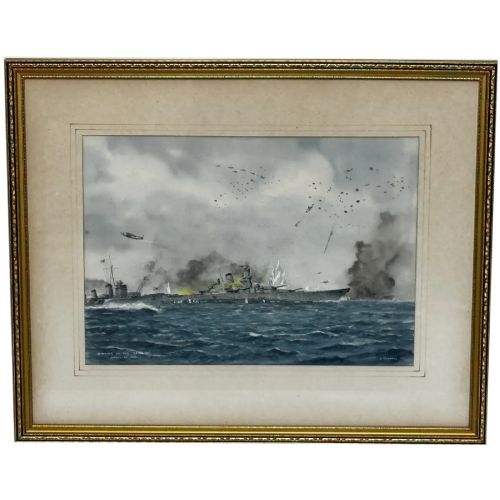
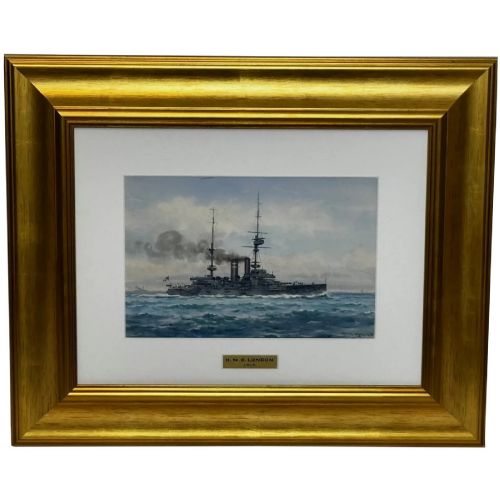
A naval watercolour captures ships, fleet actions, and portraits of officers across several centuries of maritime history. The selection ranges from detailed depictions of specific vessels like HMS London to atmospheric coastal scenes and portrait miniatures.
Buyers will encounter works spanning the eighteenth century through to the mid-twentieth century. These pieces encompass framed paintings, gouache works, and portrait miniatures on paper or agate panels.
The aesthetic shifts from Georgian precision and Victorian maritime sentiment to Edwardian and mid-century naval records. Many of these works document specific naval engagements, named warships, and individual officers with recorded service histories.
Materials and techniques
These works rely primarily on watercolour and gouache applied to paper supports, sometimes combined with pencil or ink for linear definition. Miniature portraits utilise specialised surfaces such as agate panels housed within gold frames.
Framing forms an integral part of the physical object, utilising wood, gilt, and glass to protect the delicate pigment layers. Artists employed washes and fine brushwork to render rigging, hull details, and coastal atmospheric conditions accurately.
Naval Watercolour Retail Price Guide 2026
Typical asking prices for naval watercolour among the pieces listed under this phrase on Sellingantiques today, from the lower quarter to the upper quarter. They describe what is for sale here now, not the wider market.
The inventory records portrait miniatures of naval officers alongside large framed paintings of ironclads and steam vessels.
Variations in quality
Quality rests upon the artist's command of maritime architecture, rigging accuracy, and atmospheric perspective. The finest examples demonstrate precise draughtsmanship in rendering complex vessel structures alongside a confident handling of water and light.
Provenance and documented historical context elevate certain pieces significantly. Works signed by known marine artists or depicting identifiable historical vessels carry greater documentary value than anonymous coastal sketches.
Eric Tufnell·Frank Watson Wood·Charles William Adderton·Vincenzo D’Esposito·J. Hardy·Samuel Owen·Frank Wasley·Sir William Charles Ross
The Naval Watercolour Glossary
- Gouache
- An opaque watercolour medium containing gum arabic and white pigment. It produces solid areas of colour and sharp highlights that contrast with transparent watercolour washes.
- Maritime
- Pertaining to the sea, navigation, and shipping. In these works, it describes the dominant subject matter of vessels, naval battles, and coastal operations.
- Portrait Miniature
- A small, highly detailed painting on paper, ivory, or stone. These works frequently depict naval officers and gentlemen within fitted frames.
- Man-Of-War
- A powerful armed sailing warship used by the navy from the seventeenth through the nineteenth century. These vessels form the focal point of many early maritime compositions.
- Ironclad
- A steam-propelled warship protected by iron or steel armour plates. This design represents the technological transition in naval construction during the nineteenth century.
Naval Watercolour: Frequently Asked Questions
How do I identify the date of a naval watercolour?
Examine the style of the vessel, the clothing of any figures, and the framing materials used. Uniform changes and ship design evolutions provide clear chronological markers.
Signatures, artist dates, and contemporary inscriptions on the reverse of the paper also establish the period of creation.
Were these watercolours painted by serving naval officers?
Many maritime works were produced by professional marine artists, yet naval officers frequently received training in topographical drawing. Officers recorded ships and anchorages during active service.
Attributions often note a military rank, indicating the maker's direct professional experience at sea.
How should I frame and display a watercolour?
Watercolour pigments remain sensitive to ultraviolet light and excessive moisture. Framing behind conservation glass with suitable mounts prevents fading and preserves the paper support.
Display pieces away from direct sunlight and damp environments to maintain the stability of the paper and gilt frames.
What is the difference between watercolour and gouache in these works?
Watercolour relies on translucent washes that allow the white of the paper to illuminate the pigment. Gouache incorporates chalk to create an opaque finish.
Artists frequently combined both mediums within a single composition to achieve depth in the sea alongside crisp highlights on ship hulls.