
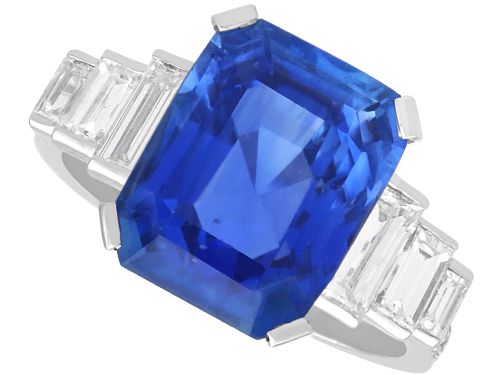
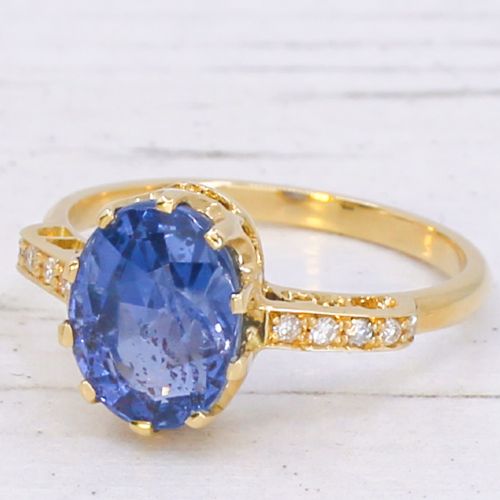


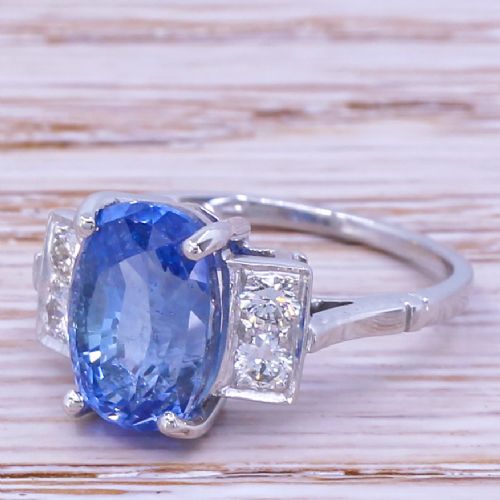
Natural Ceylon Sapphire
Natural ceylon sapphire jewels bring vibrant cornflower tones to platinum and gold settings across Victorian, Edwardian, Art Deco and Mid-Century eras.
Natural Ceylon Sapphire
When you search for natural ceylon sapphire, you are looking at fine gemstone jewellery spanning from the Victorian period through to the mid-twentieth century. The most common forms on this page are rings, ranging from delicate solitaires to substantial cocktail rings, alongside bracelets.
The pieces encompass distinct stylistic periods including Victorian, Edwardian, Art Deco and Mid-Century designs. Gemstones in these categories often appear unheated, preserving their authentic geological characteristics without thermal enhancement.
Makers utilised both platinum and various grades of gold, such as yellow gold and 18ct yellow gold, to mount these significant stones. Accompanying diamonds and natural pearls frequently complement the central blue or pink sapphires.
How they were made
Goldsmiths and platinum-smiths set natural ceylon sapphires into precious metals, securing stones with traditional claw, bezel and cluster arrangements. Platinum provided a strong, bright white framework particularly favoured during the Art Deco era.
Yellow gold and 18ct yellow gold formed warmer mountings, especially seen in Victorian and early twentieth-century rings where diamonds or natural pearls framed the central sapphire. Cabochon cutting was also employed to shape certain stones into smooth, rounded domes rather than faceted profiles.
Listings feature items spanning from the Victorian era through the 1900s, 1920s, 1940s, 1950s and 1960s.
What varies in quality
The visual appeal of a natural ceylon sapphire rests primarily on the depth and saturation of its hue, combined with natural clarity. Stones that display an even, vivid cornflower blue without distracting inclusions command greater attention from collectors.
The calibre of the surrounding metalwork and the integration of supporting diamonds or pearls dictate the overall sophistication of the piece. Master jewellers balanced substantial carat weights with refined platinum or gold settings that enhanced the presence of the central gem.
The Natural Ceylon Sapphire Glossary
- Unheated sapphire
- A gemstone that has not undergone artificial thermal enhancement to alter its colour or clarity. This preserves the natural geological properties forged within the earth.
- Cabochon
- A cutting style where a gemstone is shaped and polished with a smooth, convex dome rather than flat facets. This technique is often chosen to highlight the internal qualities of particular stones.
- Cluster ring
- A jewellery design featuring a prominent central gemstone encircled by a group of smaller stones, typically diamonds. This arrangement maximises overall visual impact on the hand.
- Trilogy ring
- A mounting style incorporating three principal gemstones set in a row, traditionally symbolising the past, present and future. These frequently combine sapphires with flanking diamonds.
Natural Ceylon Sapphire: Frequently Asked Questions
How do I care for my sapphire ring?
Clean your ring gently using warm soapy water and a soft brush to remove everyday oils and debris. Avoid harsh chemical cleaners or ultrasonic baths that might damage accompanying pearls or delicate settings.
Store each piece individually in a lined jewellery box to prevent precious platinum or gold from scratching against other items. Regular inspection by a professional jeweller ensures the security of claw and bezel settings.
Can I wear a vintage sapphire daily?
Sapphires possess a high degree of natural hardness on the Mohs scale, making them durable enough for regular wear. However, older settings from Victorian or Art Deco periods require mindful handling during active tasks.
Consider removing cocktail rings and gemstone bracelets before engaging in heavy manual work or sports. This protects both the structural integrity of antique platinum and gold work and the security of the main stones.
What defines an Art Deco sapphire ring?
Art Deco pieces typically display geometric symmetry, strong lines and architectural framing around the central gemstone. Jewellers during this period heavily favoured platinum for its strength and bright white finish.
These designs frequently incorporate calibre-cut accent stones or precise diamond halos that accentuate the substantial carat weight of the ceylon sapphire. The overall aesthetic prioritises crisp silhouettes and modern elegance.
What is the difference in gold types?
Yellow gold contains a traditional alloy mixture that produces a warm, classic hue frequently observed in Victorian and early twentieth-century pieces. Eighteenth-carat yellow gold specifies a higher proportion of pure gold within the metal alloy.
Platinum offers a distinct silvery-white appearance coupled with exceptional durability, allowing for finer wirework and secure prong settings. The choice of metal significantly influences the visual temperature of the mounted sapphire.