


Muted Tones Landscape Art
Muted tones landscape art gathers paintings from the Victorian era through the mid-twentieth century that rely on restrained palettes to capture atmosphere.
Muted Tones Landscape Art
Muted tones landscape art comprises paintings produced across the nineteenth and twentieth centuries that utilise restrained palettes and subdued pigments. Works meeting this search phrase range from early nineteenth-century watercolours to mid-century oil paintings and pastels.
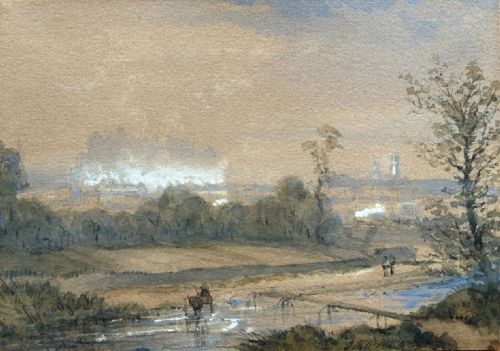
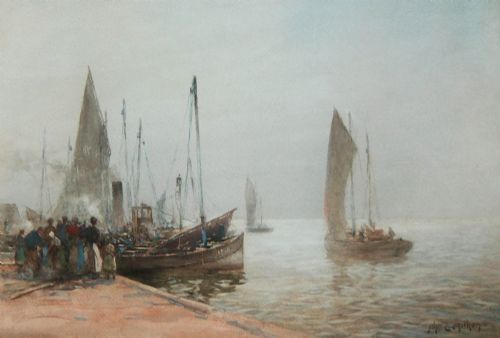
The pieces available on this page include coastal scenes, rural watermills, quiet village streets and industrial cityscapes from British, French and Canadian artists. Watercolours on paper and oils on canvas form the majority of the examples encountered here.
Many of these works belong to regional schools, capturing specific locales such as Yorkshire, Cornwall, Devon and northern France under overcast skies or autumnal light.
How They Were Made
Artists painted these landscapes using oil paint or watercolour applied to canvas, wood panels or paper supports. Watercolours rely on washes of pigment diluted with water to create soft transitions across skies and rivers.
Oil paintings employ layered brushwork upon stretched canvas or panel, building texture in fields, rooftops and harbour waters. Mixed media techniques involving coloured pencil and watercolour also appear in mid-twentieth-century works.
Several landscapes capture quiet British and French corners where horses, mules and stray harbour cats quietly share the view.
What Varies in Quality
Quality in these landscapes depends on the artist's command of tone and light within a restricted palette, distinguishing atmospheric depth from flat composition. Stronger pieces display confident brushwork and a balanced distribution of light across subdued shades.
The preservation of the paper or canvas also influences the standing of a piece, with clean, unblemished supports and original framing preserving the artist's intended tonality.
John R Prentice·James E Aitken·Gyrth Russell·Ernest Higgins Rigg·Fred Lawson·Florence Hess·Louie Stanley Maurice Prince·Sidney James Beer·Kate E Booth·Henry Charles Fox·Thomas James Lloyd·Stephen John Batchelder·Fred Stead·Lamotte·Thomas Swift Hutton·Irene Lagut·Maurice Asselin·Owen Bowen·Cuthbert Crossley·John D Walker·Augustus William Ennes·Alfred Leyman
The Muted Tones Landscape Art Glossary
- Watercolour
- A painting method where fine pigment is suspended in a water-soluble binder and applied to paper. This medium allows for transparent washes that suit subtle atmospheric effects.
- Oil Paint
- A slow-drying paint made by mixing pigments with drying oils such as linseed. It permits extensive blending and rich texture on canvas or panel.
- Post-Impressionism
- An artistic movement following Impressionism that extends its use of vivid or subdued colour while retaining a focus on distinct brushstrokes and real-life subject matter.
- British Impressionism
- A painting style developed in Britain that adopts French plein-air techniques to depict local landscapes with a focus on natural light and softened tones.
Muted Tones Landscape Art: Frequently Asked Questions
What subjects do these muted landscape paintings usually show?
The works depict rural valleys, coastal harbours, village streets and river banks observed across Britain, France and Canada. Painters focused on everyday settings rendered through quiet weather and overcast skies.
These scenes capture specific regional architecture and coastal life, ranging from Yorkshire fishing ports to Devon almshouses and northern French villages.
How should I care for an antique watercolour?
Watercolours require framing behind protective glass with conservation-grade mounts to prevent airborne dust and physical damage to the paper. Keeping the work away from direct sunlight preserves the delicate pigments.
Humidity control prevents foxing and mould growth on the paper support over time.
How do I date a nineteenth-century landscape painting?
Dating relies on the artist's recorded working years, the style of the clothing or architecture depicted, and maker inscriptions on the reverse of the canvas or mount. Archival records and exhibition labels often provide precise dates of execution.
The physical materials, including the type of canvas weave and stretcher construction, offer further chronological clues.
What is the difference between oil paint and watercolour on this page?
Oil paint is applied to canvas or wood panels, allowing for thick impasto brushwork and deep layers of pigment that capture rich surface texture. Watercolour uses thin washes on paper to achieve luminous transparency and delicate tonal gradations.
Both techniques were utilised by artists seeking to capture atmospheric light and subdued colour harmonies.