
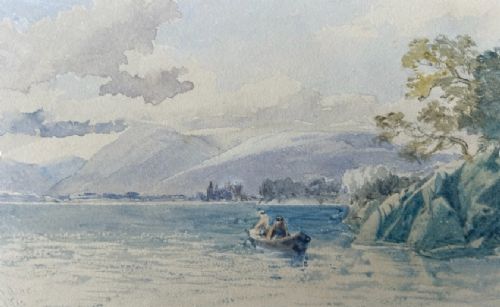
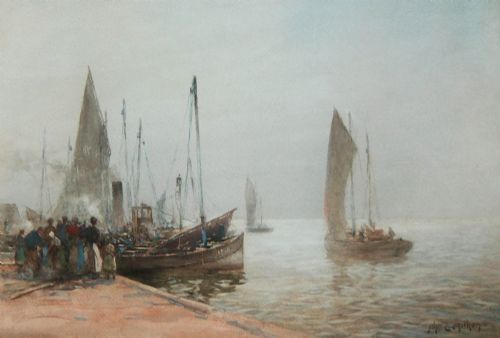


Muted Grey Watercolour Landscape
A muted grey watercolour landscape brings subdued atmospheric depth and quiet British topography directly into a room.
Muted Grey Watercolour Landscape
A muted grey watercolour landscape captures tranquil rural scenes, coastal harbours, and river views through a restrained monochromatic or cool palette. Buyers searching for a muted grey watercolour landscape typically encounter works originating from the nineteenth century up through the mid twentieth century.
The subjects range from Scottish lochs and Yorkshire dales to London river scenes and quiet rural lanes. These paintings document regional British topography through the distinct lens of Victorian, Edwardian, and Modern British artistic traditions.
Materials and Method
Artists executed these works by applying watercolour pigment suspended in water directly onto paper supports. The fluid nature of the medium allowed painters to achieve subtle washes of grey and muted tone that suggest mist, water, and overcast skies.
Framing typically incorporates a wood moulding enclosing glass to protect the delicate paper surface from moisture and atmospheric dust. This combination preserves the fugitive qualities of early pigments and keeps the paper stable over generations.
The listings span from the nineteenth century into the twentieth century, featuring paper, watercolour pigment, wood, and glass.
Distinctions in Quality
The strength of a piece rests upon the artist's handling of tone and wash to create atmospheric perspective within a restricted palette. Masterful control over wet-in-wet techniques allows subtle transitions of grey to define distance and light without muddying the paper.
Compositional balance and the sureness of the initial pencil or brush drawing dictate the architectural and topographical clarity of the scene. Superior works capture the specific light and weather of a location with economy and precision.
Thomas Miles Richardson Jnr·James E. Aitken·Fred Lawson·Arthur Reginald Smith·Cuthbert Crossley·Tom Clough·James Orrock·James Watson·Henri Joseph Harpignies·John Mitchell·A. G. Hayward·Ernest F. Hill·Edmund Morris Wimperis·Thomas James Lloyd·Hirst Walker·Fred Mayor·George Graham·Angus Rands·Robert Lesley Howey·Henry Charles Fox·William Collins·Henry John Sylvester Stannard·Carleton Grant·Harry Wanless·Rowland Henry Hill
The Muted Grey Watercolour Landscape Glossary
- Watercolour pigment
- Finely ground colour particles mixed with a water-soluble binder for painting on paper. This medium produces transparent washes that rely on the white of the paper to reflect light through the colour.
- Monogram
- A motif made by overlapping or combining two or more letters to form a single symbol. Artists frequently used these initials to sign works discreetly in place of a full signature.
- Impressionism
- An artistic style characterised by relatively small, thin yet visible brush strokes and an emphasis on accurate depiction of light. British practitioners adapted these principles to capture local weather and atmospheric conditions.
- Seascape
- A painting representing the sea, coastal views, or marine vessels. These works focus heavily on maritime lighting, tides, and harbour architecture.
Muted Grey Watercolour Landscape: Frequently Asked Questions
What periods do these watercolours cover?
The available works span from the nineteenth century through the Victorian and Edwardian eras into the mid twentieth century. Artists working across these decades captured changing British landscapes in muted tones.
Each period brings its own characteristic approach to paper and pigment, reflecting the artistic movements of the time from early realism to British impressionism.
How should I frame and display them?
Watercolour paintings require protection behind glass to prevent airborne dust and moisture from damaging the paper surface. Acid-free mounts keep the paper from touching the glass directly.
Keep these works away from direct sunlight to prevent the watercolour pigments from fading over time.
Where do these landscape scenes usually take place?
The settings focus primarily on British topography, including Yorkshire dales, Scottish coasts, London river views, and rural lanes. Artists often painted specific regional landmarks from life.
Locations range from northern harbours and lakes down to southern rivers and urban bridges.
How do I identify a Victorian piece?
Victorian watercolours often exhibit detailed brushwork combined with atmospheric washes that record specific nineteenth-century topography. Signatures or monograms frequently appear alongside period framing or inscriptions.
The paper stock and handling of pigment reflect the specific training and materials common to nineteenth-century British artists.