


Muted Grey Watercolour Artwork
Muted grey watercolour artwork brings subtle tonal atmosphere to walls through historic British landscape and marine paintings.
Muted Grey Watercolour Artwork
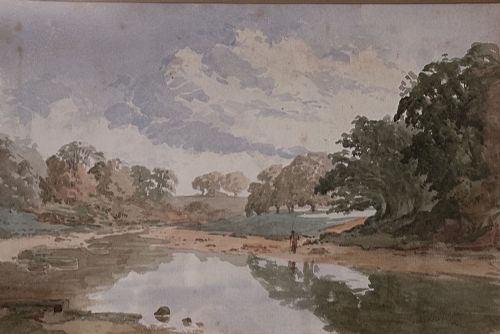
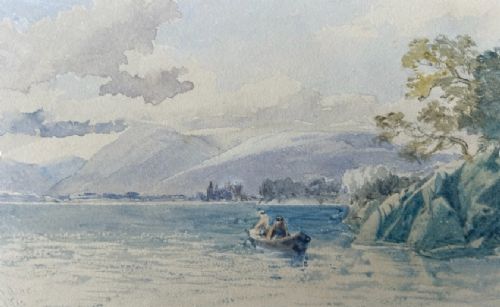
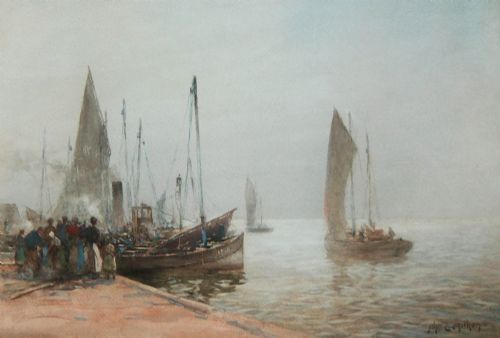
Muted grey watercolour artwork spans from the Victorian period through the Edwardian era and into mid-twentieth century Modern British movements. These paintings capture British landscapes, coastal scenes, and street views using restrained, atmospheric palettes.
Buyers encounter depictions of Yorkshire dales, Scottish shores, and London landmarks executed on paper. The works vary from nineteenth-century village views to early twentieth-century harbour scenes and winter landscapes.
Regional British artists dominate the selection, recording local topography with delicate pigment washes. Works range from small genre watercolours to larger framed coastal marine studies.
Materials and technique
Artists applied watercolour pigment and ink onto paper supports, sometimes combining wet-in-wet washes with controlled linework. This technique allowed painters to build soft, atmospheric grey tones for skies and water.
Wood frames protect the paper sheets behind glass, preserving the fugitive qualities of nineteenth and twentieth-century pigments. The interaction between absorbent paper and diluted paint creates the characteristic translucent layers visible in these paintings.
Listings feature works created across the nineteenth and twentieth centuries, spanning Victorian, Edwardian, and Modern British artistic traditions.
Assessing quality
Quality rests upon the artist's economy of line and the skilful handling of tonal washes to evoke weather and light. Superior examples demonstrate confident brushwork that defines space without heavy reliance on ink outlines.
Condition plays a vital role, particularly the preservation of the paper support and the stability of the muted pigments against fading. Stronger compositions maintain depth and luminosity within restricted grey and neutral colour schemes.
Thomas Miles Richardson Jnr·James E Aitken·Albert Ludovici Jnr·Fred Lawson·Arthur Reginald Smith·Cuthbert Crossley·Tom Clough·James Orrock·James Watson·Henri Joseph Harpignies·John Mitchell·AG Hayward·Ernest F Hill·Edmund Morris Wimperis·Thomas James Lloyd·Rowland Henry Hill·Hirst Walker·Fred Mayor·William Lee Hankey·George Graham·Angus Rands·Robert Lesley Howey·William Collins·Henry John Sylvester Stannard·Carleton Grant
The Muted Grey Watercolour Artwork Glossary
- Watercolour pigment
- Finely ground colour particles suspended in a water-soluble binder. This medium allows artists to achieve delicate transparency on paper.
- Wash
- A thin, fluid layer of diluted watercolour paint spread across the paper. It creates smooth backgrounds for skies and water.
- Genre painting
- Artwork depicting scenes from everyday life, such as figures by the water or streets in Paris. These pieces record social history alongside landscape details.
- Marine watercolour
- A painting focused on the sea, coastal views, harbours, and shipping. Artists used muted grey tones to capture overcast maritime weather.
Muted Grey Watercolour Artwork: Frequently Asked Questions
How should I frame historic watercolour artwork?
Historic watercolours require conservation framing with acid-free mounts to prevent the paper from yellowing over time. Keeping the glass clear of the painted surface protects the delicate pigment layers from moisture and physical damage.
Positioning the framed artwork away from direct sunlight preserves the muted grey tones and stops the paper from fading. Proper backing boards provide essential structural support for nineteenth and twentieth-century sheets.
What subjects appear in these vintage watercolours?
The subjects focus primarily on British landscapes, Yorkshire dales, Scottish coastal waters, and London street scenes. Artists also recorded rural figures, harbours, and winter weather.
These historic views offer a record of nineteenth and twentieth-century topography and daily life. The restrained palettes suit buyers seeking quiet, atmospheric wall art.
How do I date a nineteenth-century watercolour?
Dating relies on visible artist signatures, dated monograms, and stylistic markers associated with Victorian, Edwardian, or Modern British movements. Contemporary framing styles sometimes retain original maker inscriptions on the reverse.
Examining the type of paper support and pigment characteristics helps confirm the period. Reference records for regional British artists provide further chronological context.
Are these watercolours original paintings?
Every piece listed is an original, hand-painted artwork on paper rather than a mechanical print or reproduction. Artists applied watercolour pigment and ink directly using brushes.
Brushstrokes and pigment pooling remain visible under close inspection. This individuality distinguishes each historic painting.