


Muted Grey Watercolour Art
Muted grey watercolour art offers atmospheric landscapes and coastal scenes created by British artists across the nineteenth and twentieth centuries.
Muted Grey Watercolour Art
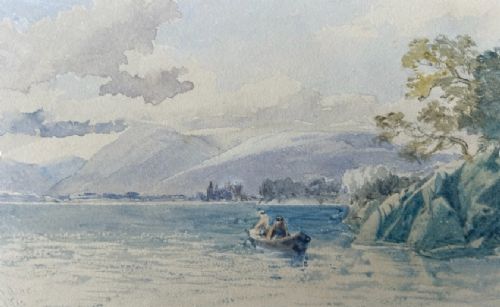
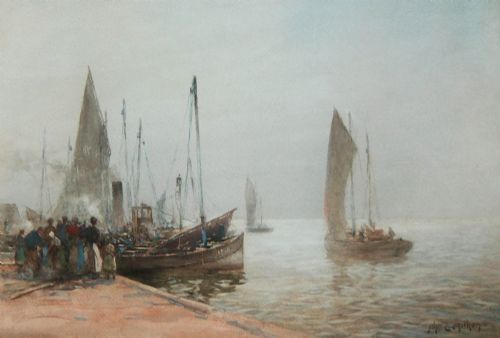
When searching for muted grey watercolour art, collectors encounter original paintings that capture overcast skies, misty coastlines, and winter days through subtle palettes of grey, slate, and muted earth tones. These works encompass British Impressionism, Early 20th Century British, and Victorian styles, recording scenes from Scottish lochs to Yorkshire harbours and London rivers.
The most common pieces on this page are paper-based paintings from the late nineteenth and early twentieth centuries, created by regional British painters who favoured atmospheric effects over bright hues. Subjects range from snowy countryside views and quiet estuaries to historic townscapes rendered in restrained tones.
How they were made
These works rely primarily on watercolour pigment applied to paper, often supported by underlying pencil or ink lines that define the composition before washes are laid down. Artists manipulated water content to create soft edges, gentle gradients, and hazy skies that give these watercolours their signature muted character.
The paper provides the underlying brightness for lighter grey and white areas, while denser passages of pigment build the shadows in coastal and woodland scenes. Wood frames frequently house these paintings to protect the delicate paper surface.
The listings span from the Victorian era through the 1960s, utilising paper, watercolour paint, ink, and wood.
What varies in quality
Quality in these watercolours depends on the artist's control over tone and atmosphere, where superior brushwork captures the damp air and fading light of a British winter without muddying the palette. The strongest examples maintain luminosity within restrained grey tones, whereas lesser works lose depth and appear flat.
Compositional balance and the confident handling of water and pigment separate accomplished professional works from simpler sketches. The dexterity with which an artist suggests movement in water or weight in storm clouds dictates the enduring appeal of the painting.
Thomas Miles Richardson Jnr·James E. Aitken·Albert Ludovici Jnr·Fred Lawson·Arthur Reginald Smith·Cuthbert Crossley·Tom Clough·James Orrock·James Watson·Henri Joseph Harpignies·John Mitchell·A. G. Hayward·Ernest F. Hill·Edmund Morris Wimperis·Thomas James Lloyd·Rowland Henry Hill·Hirst Walker·Fred Mayor·William Lee Hankey·George Graham·Angus Rands·Robert Lesley Howey·Henry Charles Fox·William Collins·Henry John Sylvester Stannard
The Muted Grey Watercolour Art Glossary
- Watercolour pigment
- Finely ground colour particles suspended in a water-soluble binder, used to create transparent washes on paper.
- Wash
- A thin, fluid layer of diluted watercolour paint spread evenly across the paper to create background skies or water.
- Monogram
- A set of initials combined into a single mark by the artist, often used in place of a full signature on nineteenth-century watercolours.
- Impressionism
- An art movement focusing on transient effects of light and atmosphere, visible in the looser brushwork of later British works on this page.
Muted Grey Watercolour Art: Frequently Asked Questions
What subjects appear in these watercolours?
These paintings depict British landscapes, coastal harbours, snowy rural scenes, and river views across England and Scotland. Artists frequently captured overcast weather, quiet waters, and town streets under grey skies.
Common settings include Yorkshire dales, Scottish lochs, London bridges, and coastal fishing ports like St. Ives and Whitby.
How do I date an antique watercolour?
Dating relies on signatures, artist active periods, framing styles, and the type of paper used. Many works carry legible signatures or monograms alongside dates written by the artist.
Victorian and Edwardian examples often display period framing and paper characteristics typical of nineteenth and early twentieth-century production.
How should I frame and display these?
Watercolours require framing behind glass with acid-free mounts to prevent the paper from touching the glazing and suffering moisture damage. Conservation-grade materials protect the pigments from fading over time.
Display these paintings away from direct sunlight and damp environments to preserve the integrity of the paper support.
What is British Impressionism in watercolour?
British Impressionism refers to late nineteenth and early twentieth-century painting that embraced looser brushwork and atmospheric effects. Artists sought to capture fleeting moments of light, weather, and mist rather than rigid botanical detail.
This approach aligns closely with muted grey palettes, where tone and mood take precedence over bright local colour.