


Moulded Panel Chest
A moulded panel chest offers a sturdy storage solution with deep historical roots, bringing robust seventeenth-century craftsmanship directly into your home.
Moulded Panel Chest
A moulded panel chest is a robust storage piece typically constructed during the seventeenth and eighteenth centuries, frequently appearing as a chest of drawers or a coffer. Buyers seeking this phrase will encounter sturdy timber forms originating from English, French, and Italian workshops across periods such as the Jacobean, Charles II, and Georgian eras.
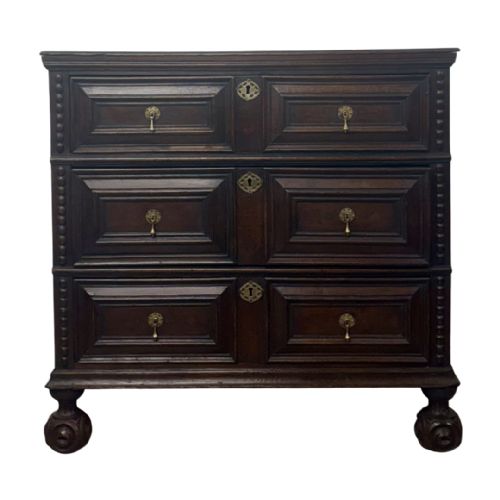
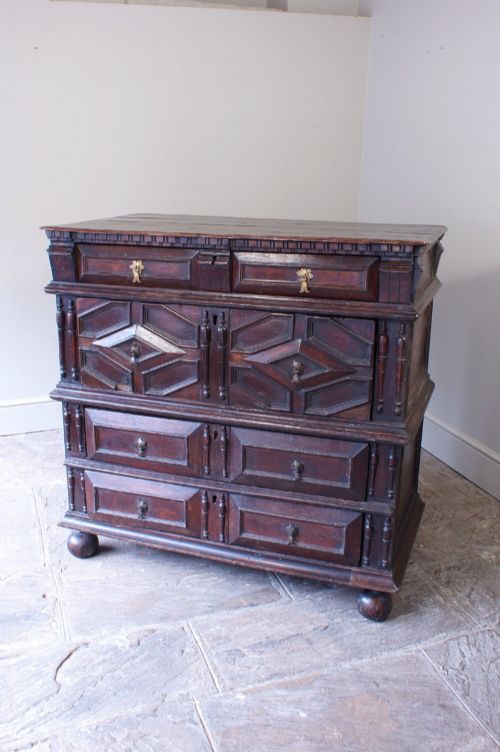
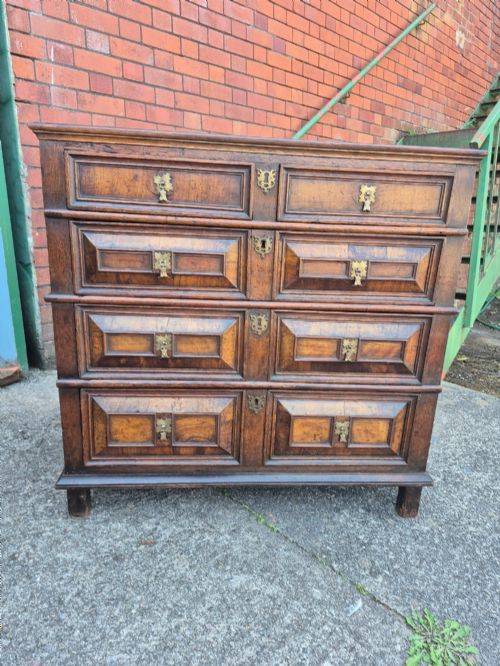
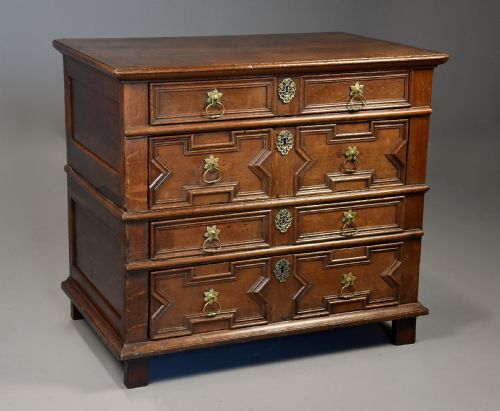
The version most commonly met on this page is the oak chest of drawers featuring geometric or moulded panels upon the front elevation. These items range from two-part modular constructions to single carcase designs embellished with contrasting woods.
How they were made
Carpenters constructed these pieces primarily from solid oak, frequently incorporating secondary timbers such as walnut, fruitwood, cedar, and snakewood for decorative embellishment. Panels were set within frame structures to accommodate the natural seasonal movement of the timber without splitting.
Surface decoration relies heavily on geometric mouldings applied to drawer fronts, often paired with contrasting grain patterns and brass hardware such as drop handles and escutcheons. Iron fixings and occasional marble tops appear on continental examples from the eighteenth century.
Listings span the seventeenth and eighteenth centuries, incorporating periods such as Charles II, William and Mary, and Georgian.
What varies in quality
The distinction between tiers of quality rests upon the sophistication of the timber selection and the crispness of the geometric mouldings. Pieces incorporating exotic veneers like snakewood alongside primary oak or walnut demonstrate higher ambition in the workshop.
Another factor is the structural integrity of the timber drawers and panelled sides, where surface patination and the survival of original decorative elements elevate the standing of the piece.
The Moulded Panel Chest Glossary
- Geometric moulding
- Raised wooden strips applied in symmetrical patterns to drawer fronts. This technique created visual depth during the seventeenth century.
- Two-part chest
- A modular cabinet built in upper and lower sections for ease of transport. Such pieces are typical of the Charles II period.
- Coffer
- A heavy wooden box with a hinged lid used for storage. These items represent an earlier form of household furniture.
- Patina
- The surface sheen and colour acquired by wood over centuries of handling and exposure. It indicates age and weathering.
- Escutcheon
- A protective plate surrounding a keyhole. They are commonly fashioned from brass on period cabinetry.
Moulded Panel Chest: Frequently Asked Questions
Where were moulded panel chests placed?
These pieces served practical storage functions in bedchambers and main living spaces of seventeenth- and eighteenth-century homes. They held textiles, linens, and personal valuables securely.
Today, they function well as storage cabinets in modern hallways or living rooms, offering a flat top surface for display.
How do I care for an oak chest?
Maintain the timber by keeping it away from direct heat sources and sudden humidity changes. Apply natural waxes sparingly to nourish the dry surface.
Avoid commercial polishes that build up silicones and dull the historic patination of the wood.
What is a two-part chest?
A two-part chest consists of a top cabinet resting directly upon a lower base section. This construction made heavy seventeenth-century furniture easier to transport between rooms or houses.
Many Charles II examples utilise this stacked format to accommodate deep timber carcases.
How do I identify a seventeenth-century piece?
Look for construction markers such as hand-cut dovetails, pegged joints, and solid oak or walnut timbers. Geometric mouldings applied to panelled fronts are characteristic of this era.
Continental variations may feature fruitwood veneers or marble tops while retaining similar heavy proportions.