
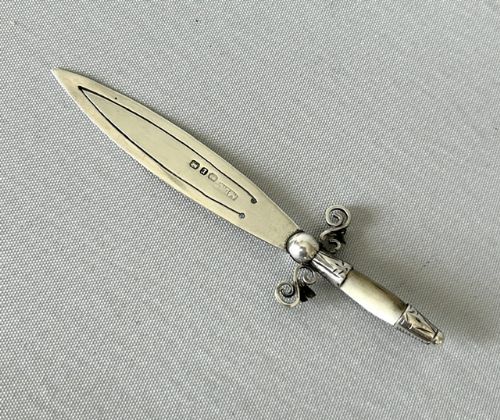


Mother of Pearl Handles
Mother of pearl handles bring an iridescent gleam to antique cutlery, sewing tools and opera glasses.
Mother of Pearl Handles
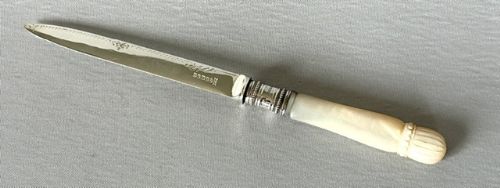
When you search for mother of pearl handles, you encounter decorative items and implements spanning the Victorian, Edwardian and George V periods. The material appears most frequently on fruit cutlery sets, serving knives, letter openers and opera glasses.
Objects range from single items like bookmarks and stilton scoops to large cased sets for dessert and fish. Many pieces combine the lustrous nacre with sterling silver or silver plate.
The form spans practical desk accessories, sewing implements and dining equipment produced by English, French and Dutch makers. These pieces survive from the nineteenth and early twentieth centuries in fitted presentation boxes.
How they were made
Craftsmen shaped thin plates of iridescent nacre, harvested from pearl oyster shells, and pinned or riveted them to metal tangs using brass or silver components. The natural material required careful cutting to preserve the shimmering depth and grain of the shell.
Metal elements such as sterling silver, silver plate and gold plating were joined to the shell grips, sometimes featuring engraved decoration or cast blades. Fitted boxes lined with velvet often housed these delicate implements.
One exceptional piece listed is a novelty golf club cake knife from the Edwardian era.
What varies in quality
Quality rests in the uniformity and thickness of the nacre scales, alongside the crispness of any metal engraving or silver assay marks. Pieces with deep iridescence and intact, well-fitted grips show superior manufacture.
The presence of original fitted boxes and matched sets elevates an item above individual utility pieces. Maker marks from established silversmiths also distinguish finer examples from unmarked workshop output.
Mabie Todd & Co·William Devenport·Levesley Brothers·Robert Fead Mosley·Watson & Gillot·Fattorini & Sons
The Mother of Pearl Handles Glossary
- Nacre
- The iridescent inner layer of pearl oyster shells used to form the handle scales. This natural substance provides the characteristic shimmering depth seen on antique cutlery.
- Stilton scoop
- A specialised utensil with a curved blade designed for serving hard cheese. Examples often feature ornate silver mounts and shaped shell grips.
- Assay mark
- A stamp indicating the purity of precious metal components like sterling silver. These marks help date the manufacture of the attached handle mounts.
- Fruit knife
- A small pocket or table knife intended for slicing fruit without staining the steel blade from acid. They frequently incorporate decorative shell scales.
- Opera glasses
- Compact magnifying binoculars used in theatres, often decorated with tinted or natural nacre barrel panels.
Mother of Pearl Handles: Frequently Asked Questions
Can I use antique cutlery daily?
Fruit knives and serving sets with nacre grips can be used gently for special dining occasions. Hand washing is essential to preserve the vintage materials.
Dishwashers and hot water will crack the shell and loosen the metal pins holding the handles together.
How do I date these pieces?
Examine any silver hallmarks for town marks, date letters and maker stamps to establish the exact year of production. Stylistic clues like Victorian engraving or Edwardian box designs also help narrow the era.
Compare the metal mounts and case construction with known examples from the nineteenth and early twentieth centuries.
Why do the colours vary so much?
The inner layer of the oyster shell forms naturally with shifting crystalline structures that reflect light differently. Some pieces show silvery white tones while others display golden or smoky hues.
Different species of pearl oyster and varying harvest locations create this natural variety in every handle.