

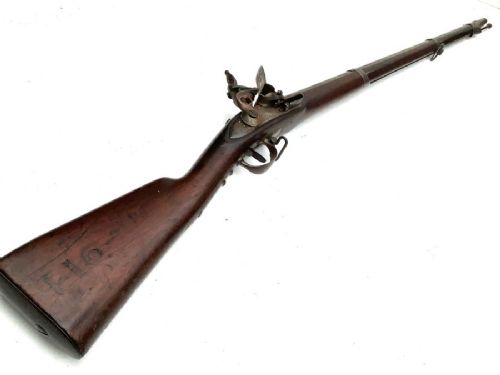


Military Musket
These military musket examples bring tactile history into your hands, offering tangible connections to centuries of tactical evolution.
Military Musket
When you search for a military musket, you encounter historical firearms and related accoutrements spanning the eighteenth and nineteenth centuries. These pieces encompass British and French military hardware from notable conflicts and imperial expansions.
You are most likely to meet flintlock and percussion ignition systems originating from periods such as the Georgian era, the Napoleonic Wars, and Victorian campaigns. Forms range from full-length infantry arms to shorter carbines, musketoons, and specialised powder measures.
The inventory covers diverse service arms including Brown Bess muskets, Charleville patterns, Enfield rifles, and East India Company issues. These objects represent standard infantry equipment produced by national armouries and private contractors alike.
How they were made
Construction relies heavily on durable hardwoods such as walnut and general timber for stocks, paired with heavy iron and steel for barrels and lock mechanisms. Brass and bone components frequently appear as structural reinforcements, mounts, or decorative inlays.
Makers integrated leather for slings and accessory housing, utilising traditional blacksmithing and early industrial assembly techniques. Metal parts display forged or cast finishes characteristic of period armouries operating in Birmingham, Tower Hill, and continental workshops.
Military Musket Retail Price Guide 2026
Typical asking prices for military musket among the pieces listed under this phrase on Sellingantiques today, from the lower quarter to the upper quarter. They describe what is for sale here now, not the wider market.
Soldiers occasionally scratched their regimental numbers into brass buttplates, turning standard-issue hardware into deeply personal campaign journals.
What varies in quality
The distinction between ordinary issue pieces and superior examples rests in the crispness of maker markings, government inspection stamps, and the integrity of the original stock timber. Crisp proof marks and legible lockplate engravings elevate an arm above standard service wear.
Proportional balance, original matching components, and the preservation of steel patination versus aggressive cleaning dictate the desirability of surviving military arms. Variations in auxiliary equipment like socket bayonets or specialised powder measures further distinguish specific service issues.
Sargant and Son
The Military Musket Glossary
- Flintlock
- An ignition mechanism utilising a piece of flint held in a cock to strike a steel frizzen and create sparks for gunpowder ignition. This system dominated military firearms technology throughout the eighteenth and early nineteenth centuries.
- Percussion cap
- A later ignition system employing a small detonating primer placed on a nipple, struck by the hammer to fire the charge. This method replaced the flintlock due to superior reliability in wet weather.
- Blunderbuss
- A short-range firearm with a flared muzzle designed to scatter lead shot or multiple projectiles. These arms saw use by coach guards and military units for close-quarters defence.
- Musketoon
- A shorter, lighter version of the standard infantry musket intended for cavalry or naval service. The reduced barrel length facilitated handling in confined spaces.
- Miquelet
- A distinct form of snaplock ignition utilising an external mainspring and combined steel and frizzen, common in Mediterranean and Spanish regions. It represents an alternative technological lineage to standard northern European flintlocks.
Military Musket: Frequently Asked Questions
What is a military musket?
A military musket is a smoothbore or rifled shoulder firearm issued to national armed forces during the eighteenth and nineteenth centuries. These arms formed the primary infantry weapon for European and colonial armies.
Examples include famous patterns like the British Brown Bess and the French Charleville, utilised extensively during major conflicts including the Napoleonic Wars.
How do flintlock and percussion muskets differ?
Flintlock muskets rely on a piece of flint striking steel to create sparks that ignite priming powder in a pan. This system requires dry conditions and careful maintenance in the field.
Percussion muskets use a copper cap filled with sensitive explosive compound placed over a hollow nipple. The hammer strikes the cap directly, offering vastly improved reliability in wet weather.
How should I display a musket?
Muskets require stable indoor environments away from direct sunlight, high humidity, and extreme temperature fluctuations. Wall mounting brackets or horizontal display cases must support the full weight evenly along the wooden stock.
Applying light museum-grade wax or oil to metal components helps prevent active corrosion while preserving the historical surface finish.