
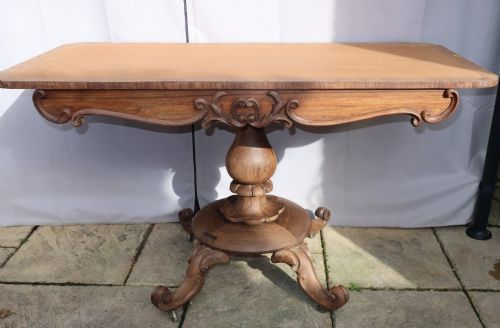
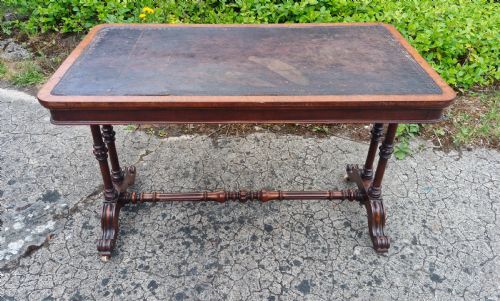


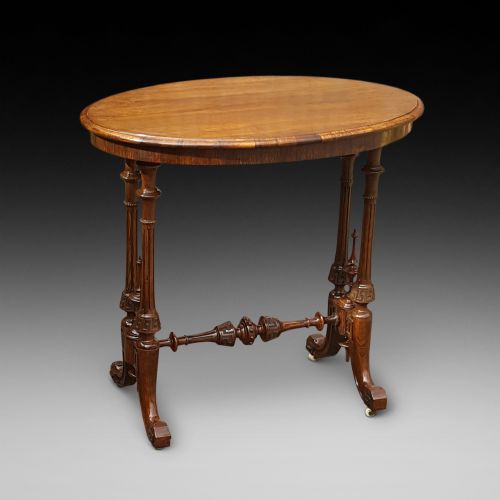

Mid Victorian Sofa Table
A mid victorian sofa table brings steady nineteenth-century craftsmanship and warm timber tones straight to a central room.
Mid Victorian Sofa Table
A mid victorian sofa table represents the broader family of nineteenth-century centre tables, writing tables, and occasional pieces found across these listings. Buyers hunting for this specific form encounter sturdy freestanding tables shaped for domestic parlour and library use.
The selection here draws primarily from nineteenth-century Victorian production, spanning decades from eighteen-fifty to eighteen-eighty. Most examples lean towards formal centre tables and writing desks rather than narrow sofa tables, though the timber quality and proportions remain closely aligned.
Makers and workshops of the period utilised rich native and exotic timbers to construct these items. Walnut, burr walnut, mahogany, and rosewood dominate the physical evidence, often enhanced by marquetry inlay or leather top inserts.
Materials and construction methods
Cabinet makers of the era relied heavily on dense hardwoods like mahogany, rosewood, and walnut for structural stability and surface beauty. Burr walnut veneers and intricate marquetry inlay frequently decorated the primary display surfaces.
Secondary materials such as brass fittings, ceramic castors, and inset leather panels added both utility and textural contrast to writing and centre tables. Timber frames were joined with traditional joinery techniques suited to heavy domestic service.
Nineteenth-century listings on this site frequently employ burr walnut, rosewood, and mahogany across various occasional and centre table forms.
Judging the standard of execution
Quality in these tables rests upon the selection of timber veneers, particularly the grain movement visible in burr walnut and rosewood panels. Finer examples display meticulous matching of timber figures across the top surface.
The sophistication of decorative elements, including marquetry inlay, giltwood highlights, and turned basket bases, separates standard production from superior pieces. Structural integrity in the legs and stretcher supports further defines the grade of execution.
James Winter and Sons
The Mid Victorian Sofa Table Glossary
- Burr walnut
- A highly figured timber harvested from walnut tree growths, prized for its swirling grain patterns. Cabinet makers used it extensively for decorative table tops during the nineteenth century.
- Marquetry inlay
- Pieces of contrasting timber or other materials fitted into a veneer to form geometric or floral designs. This technique ornamented the surfaces of fine Victorian tables.
- Centre table
- A freestanding table designed to be viewed from all sides, placed in the middle of a room rather than against a wall. Many nineteenth-century tables served this dual purpose.
- Stretcher table
- A table featuring horizontal rails connecting the legs near the base to provide additional rigidity. These rails often included decorative turnings.
Mid Victorian Sofa Table: Frequently Asked Questions
Where should I place a centre table?
These pieces function best as freestanding items in the middle of a principal room or library. Their finished backs and detailed surfaces allow them to be viewed from every angle.
Ensure there is adequate clearance around the perimeter for daily movement and seating. They also serve well as substantial lamp or occasional tables against larger wall spaces.
How do I care for nineteenth-century timber?
Protect polished walnut, mahogany, and rosewood surfaces from direct sunlight and excessive heat sources. Consistent indoor humidity prevents the timber and veneer from splitting.
Apply a traditional beeswax polish sparingly to maintain the natural lustre of the wood. Avoid placing wet or hot items directly onto the antique finish.
Can these tables be used for writing?
Many nineteenth-century examples were constructed specifically as writing or library tables. Versions featuring inset leather tops provide an ideal firm surface for correspondence.
Check the working height and knee clearance of individual pieces if you plan to use them regularly as a desk. Most nineteenth-century domestic tables sit slightly lower than modern office furniture.
How do I identify a Victorian table?
Look for characteristic nineteenth-century timber choices such as burr walnut, rosewood, and solid mahogany. Construction methods often include hand-cut joints and heavier timber scantlings than earlier Georgian pieces.
Stylistic markers range from restrained mid-century lines to heavier Victorian rococo revival carvings and decorative marquetry. Associated hardware like ceramic castors further confirms the period of manufacture.