






Mid Century Tea Trolley
These mid century tea trolley examples combine practical mobility with striking period design, offering a versatile surface for serving drinks and displaying glassware.
Mid Century Tea Trolley
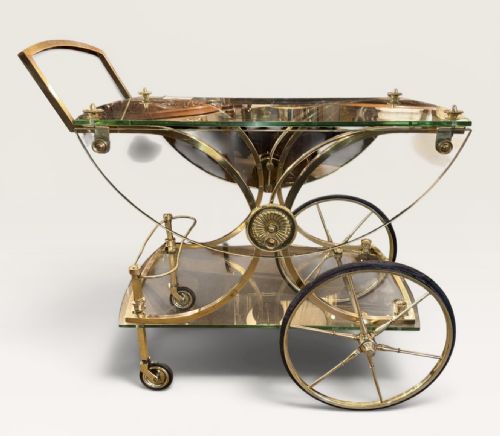
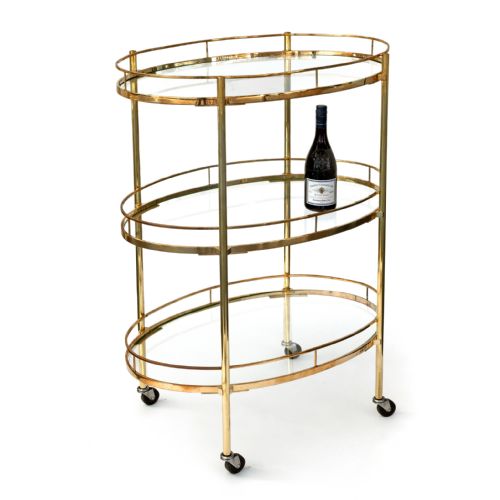
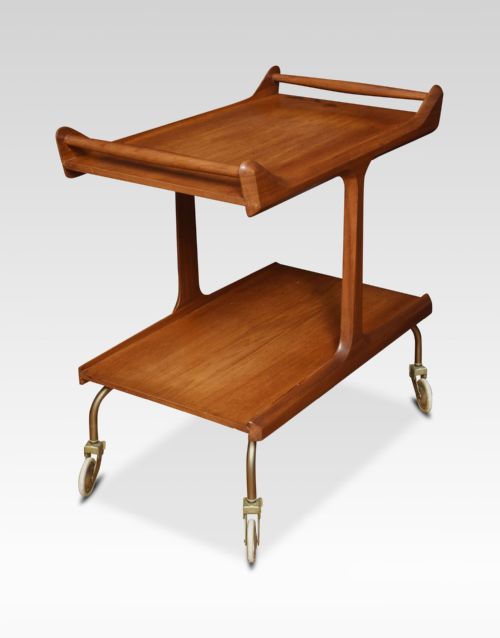
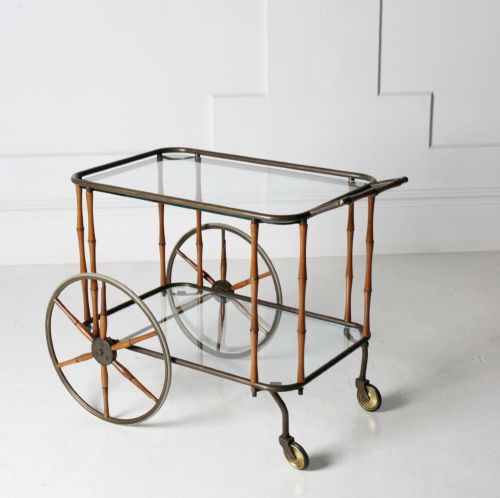
A mid century tea trolley serves as a mobile surface for entertaining, taking the form of tiered display stands, bar carts, and nested tables. These pieces accommodate bottles, glassware, and serving vessels while moving easily across rooms on castors or wheels.
The versions encountered on this page span from early twentieth-century designs through to pieces created later than 1960. Forms range from circular walnut bar carts to multi-tiered brass etageres and cane-bound beech frames.
Origins and styling vary significantly across the selection, encompassing French neoclassical aesthetics, Hollywood Regency glamour, Art Deco geometry, and mid-century British craftsmanship. Certain examples function equally well as dessert carts or display stands.
Materials and construction methods
Makers utilised a combination of hardwoods and metals, pairing walnut and teak with brass, chrome, and iron frames. Glass shelves and inserts provide durable surfaces for serving, whilst specialised finishes such as goatskin and faux bamboo introduce distinct textural contrast.
Cane binding and bent beech demonstrate specialised carpentry techniques employed to shape organic materials into sturdy, curved structures. Metal components are frequently cast, galleried, or polished to create secure surrounds and decorative trims.
Mid Century Tea Trolley Retail Price Guide 2026
Typical asking prices for mid century tea trolley among the pieces listed under this phrase on Sellingantiques today, from the lower quarter to the upper quarter. They describe what is for sale here now, not the wider market.
Materials utilised across the current selection include warm hardwoods like teak and walnut alongside reflective glass, brass, and chrome.
Distinctions in quality and execution
The calibre of a piece rests on the refinement of its materials and the precision of its assembly, such as the snugness of nested tables or the structural integrity of tiered brass frames. Original maker labels and documented attributions elevate the standing of specific carts.
Finishing details dictate the overall character, from the hand-application of delicate goatskin to the polish of brass galleries and the tightness of cane binding. Simpler utilitarian trolleys contrast with ornate luxury items featuring specialised decorative metalwork.
Maison Bagues·Lusty of Leicester·Aldo Tura·Maison Jansen
The Mid Century Tea Trolley Glossary
- Etagere
- An open multi-tiered piece of furniture used for displaying objects or serving items. These structures typically feature two or three levels supported by slender uprights.
- Galleried
- A raised border or rim fitted around the edge of a shelf or tray. This feature prevents bottles and glassware from sliding off during transit.
- Bar cart
- A mobile unit specifically configured for holding bottles, decanters, and drinking accessories. They often incorporate specialised racks or circular trays for secure storage.
- Nesting tables
- A set of several smaller tables designed to fit neatly beneath one another when not in use. They provide flexible surface space that can be deployed individually as needed.
Mid Century Tea Trolley: Frequently Asked Questions
What is a mid century tea trolley?
A mid century tea trolley is a mobile serving cart designed to transport and display drinks, glassware, and afternoon tea items. These pieces typically feature wheels or castors and multiple tiers.
They emerged in various stylistic movements, incorporating materials like brass, glass, walnut, teak, and cane. Their primary purpose combines utility with decorative interior presence.
How were these trolleys used historically?
Historically, these items served upper and middle-class households during social gatherings, allowing hosts to move refreshments between rooms with ease. They acted as portable cocktail bars or tea service stations.
Beyond entertaining, many functioned as permanent display stands for decorative objects, porcelain, and books within living spaces.
How do I live with a bar cart?
Integrating a bar cart into a modern room involves positioning it against a wall or beside seating where it remains accessible yet out of the main traffic flow. Styling them with glassware, decanters, and small lamps enhances their visual impact.
Because they are mobile, you can easily relocate them to different corners of a room when hosting guests.
How do I tell periods apart?
Distinguishing between periods relies on observing material choices and stylistic ornamentations, such as the geometric lines typical of Art Deco or the streamlined forms of later mid-century design. Brass and glass combinations often lean towards Hollywood Regency or French neoclassical aesthetics.
Early twentieth-century examples frequently employ turned woods and cane work, whereas items from the 1960s embrace minimalist metal frames and exotic surface coverings like goatskin.