

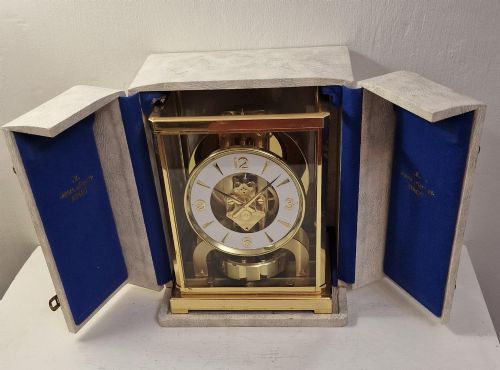


Mid Century Glass Clock
These mid century glass clock examples unite precise horology and transparent enclosures, bringing exceptional visual depth to any mantel.
Mid Century Glass Clock
When you search for a mid century glass clock, you encounter notable timepieces housed within protective transparent enclosures, ranging from bell-jar Atmos mechanisms to skeleton dials. The pieces appearing on this page span several decades, with a strong representation of mid century Swiss production alongside English carriage clocks and French nineteenth century examples.
Most frequently, you will find mantel clocks and table clocks featuring glass domes, square dials, or round dials paired with brass, rhodium-plated metal, and gilt frames. These items balance mechanical innovation with visible internal movements, appealing directly to collectors of functional mid century design.
What varies in quality
Quality differences rest primarily in the execution of the mechanical movement and the purity of the glass housing. Superior examples feature high jewel counts and advanced perpetual motion calibres that maintain precise timekeeping through temperature variations.
The finish of the metalwork, whether gilt brass or rhodium plating, and the clarity of the blown or cast glass dome distinguish standard production from exceptional horological pieces. Original boxes, papers, and specialised dial shapes further elevate the standing of an individual clock.
Mid Century Glass Clock Retail Price Guide 2026
Typical asking prices for mid century glass clock among the pieces listed under this phrase on Sellingantiques today, from the lower quarter to the upper quarter. They describe what is for sale here now, not the wider market.
Some nineteenth century clocks relied on changes in weather to keep ticking, proving that British rain has at least one practical use.
John Morley·Jaeger LeCoultre
The Mid Century Glass Clock Glossary
- Atmos clock
- A mechanical mantel clock manufactured by Jaeger-LeCoultre that runs using changes in atmospheric temperature and pressure. It requires no manual winding.
- Bell-jar model
- A timepiece enclosed beneath a blown glass dome that rests upon a fitted base. This housing protects the delicate movement from dust while allowing full visibility.
- Skeleton timepiece
- A clock designed with open plates and bridges that expose the entire gear train. This construction lets light pass directly through the centre of the movement.
- Rhodium-plated
- Coated with a hard, reflective platinum-group metal that prevents tarnishing. The process gives brass or steel components a bright, durable silver-coloured finish.
- Carriage clock
- A small spring-driven timepiece developed for travel during the nineteenth century. These portable clocks typically feature glass panels on all four sides and a carrying handle.
Mid Century Glass Clock: Frequently Asked Questions
How do Atmos clocks work?
Atmos clocks operate via a hermetically sealed capsule containing a gas and liquid mixture that expands and contracts with temperature fluctuations. This mechanical breathing motion winds the mainspring continuously without human intervention.
Because the temperature changes required are extremely small, a variation of a single degree is sufficient to power the clock for hours. This clever mechanism allows the timepiece to run perpetually.
How should I clean a glass dome?
Clean the glass dome using a soft microfibre cloth and a mild glass cleaner applied to the cloth rather than sprayed directly onto the glass. This prevents moisture from reaching the delicate base or movement.
Handle the glass dome with both hands and lift it straight up off the base to avoid striking the internal clock mechanism during removal.
Where should I place a table clock?
Position your clock on a stable, level surface away from direct sunlight, strong draughts, and heavy vibrations. A sturdy mantelpiece or heavy sideboard provides an ideal platform for keeping the movement accurate.
Avoid locations near exterior doors or heating vents where rapid temperature shifts might interfere with the balance wheel or the thermal expansion of the movement.
How do I identify a skeleton clock?
Examine the dial and plates to see if the internal gear train is fully visible from both the front and the sides. Skeleton clocks omit traditional solid dial faces to display the intricate working of the escapement and gear wheels.
Many of these models use skeletal brass bridges and chapter rings suspended within a glass enclosure to emphasise the depth of the mechanism.