
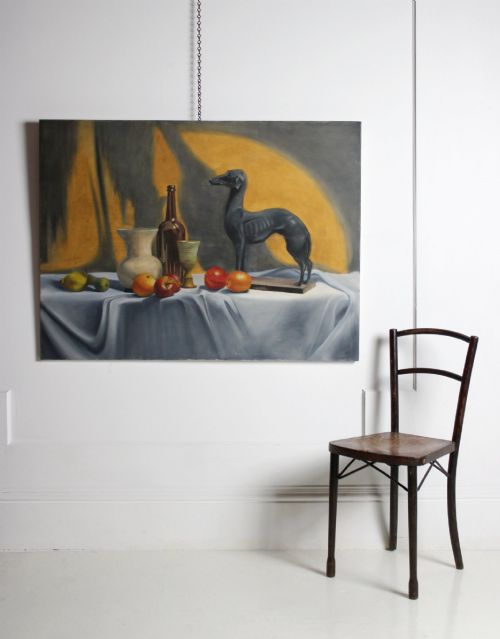


Mid Century Fruit Artwork
Mid century fruit artwork brings vibrant colour and domestic intimacy into a room through bold brushwork and striking compositions.
Mid Century Fruit Artwork
Mid century fruit artwork encompasses still life paintings and watercolours produced across the 1930s, 1940s, 1950s and 1960s. These pieces focus on tabletop arrangements featuring apples, bowls, and plates alongside everyday domestic objects.
The most common formats on this page are oil on canvas and watercolour on paper, often presented in framed wall art. Works span various European traditions including French colourist pieces, Spanish school studies, and Modern British compositions.
Subjects range from traditional realism and impressionism to abstracted modernist interpretations. Buyers encounter intimate watercolours alongside large banquet canvases suitable for anchoring a dining space or kitchen interior.
Materials and Techniques
Artists painted primarily with oil paint on canvas or board, applying pigment in thick impasto strokes or smooth, luminous layers. Watercolours on paper provide a lighter, more translucent alternative, often fixed within glazed wooden frames.
Many works incorporate gilt or painted wooden framing that complements the period aesthetic. Canvases are frequently stretched over timber frames, while board supports offer a rigid foundation for heavier applications of oil.
Listings feature oil paintings and watercolours created across the 1930s, 1940s, 1950s and 1960s, employing canvas, wood, paper and glass.
Judging Quality and Execution
Quality rests upon the confidence of the brushwork and the harmony of the palette. Superior pieces demonstrate deliberate compositional balance, where fruit and vessels anchor the space without feeling static or crowded.
The distinction between standard decorative work and finer art lies in the handling of light and shadow. Stronger paintings use varied tones and rich colour relationships to create depth rather than relying on flat outlines.
James Tower·Henri Joseph Pauwels·Bela Balogh·John Gilbey Bowles·Maud Frances Eyston Sumner
The Mid Century Fruit Artwork Glossary
- Impasto
- Paint applied thickly to a canvas, standing visibly above the surface and retaining the marks of the brush or palette knife. This technique adds tactile dimension to mid century fruit artwork.
- Still life
- An artwork depicting inanimate subject matter, typically commonplace objects such as fruit, flowers, and tableware. These arrangements allow artists to focus entirely on colour, form, and light.
- Watercolour
- A painting method in which paint is made of pigments suspended in a water-based solution. Works on paper require protection behind glass to prevent atmospheric damage.
- Colourist
- An artist whose work is characterised by the energetic and expressive use of primary and secondary hues. French and British painters of this period often utilised vibrant palettes to evoke mood.
- Canvas
- Heavy woven fabric stretched across a wooden stretcher frame to serve as a support for oil painting. It provides a flexible yet durable surface for textured brushwork.
Mid Century Fruit Artwork: Frequently Asked Questions
How should I hang mid century fruit artwork?
These paintings suit dining rooms, kitchens, or living spaces where tabletop arrangements echo the domestic subject matter. Hang them at eye level to appreciate the brushwork and colour composition.
Ensure the pieces are protected from direct sunlight to preserve oil pigments and paper supports over time.
What periods do these pieces cover?
The selection spans from the 1930s through to the 1960s, capturing shifts from traditional realism to wartime watercolours and bold modernist abstraction.
Mid-century modern and post-impressionist influences dominate the later decades, while earlier works reflect quieter tonalist palettes.
Are these works painted on canvas or board?
Most works utilise oil on canvas or oil on board, though some earlier examples are watercolours on paper. Each medium offers a different textural quality depending on the artist's technique.
Canvases are typically stretched on wooden frames, while board supports provide a rigid backing.
How do I identify a modernist still life?
Modernist pieces often simplify shapes, flatten perspective, and use non-naturalistic colour palettes to emphasise form over strict realism. Artists working in this style prioritize emotional resonance and abstract balance.
Look for expressive brushstrokes and unconventional arrangements of fruit and everyday ceramics.