

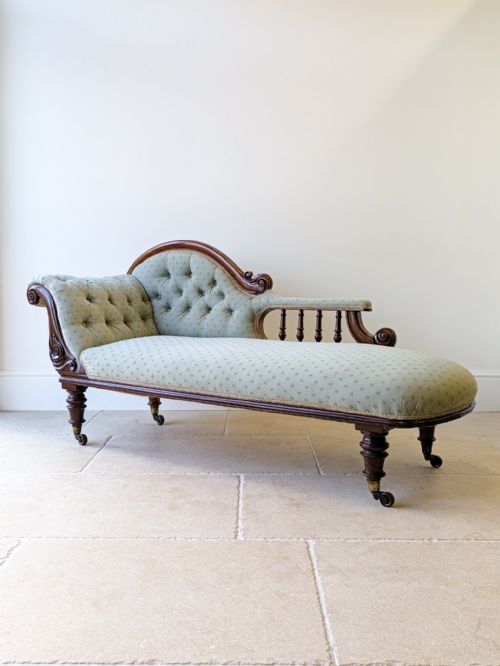
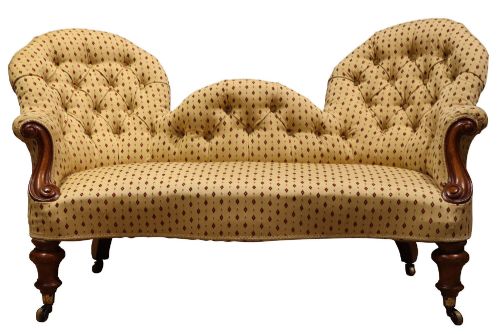
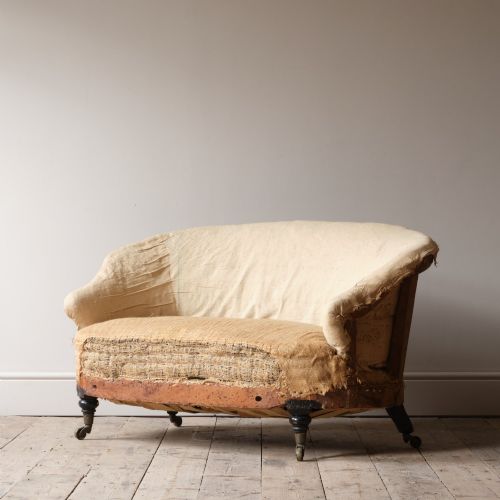


Mid 19th Century Couch
A mid 19th century couch brings deep buttoned comfort and grand proportions to a room, offering a functional piece of seating history.
Mid 19th Century Couch
When you search for a mid 19th century couch, you encounter Victorian and Continental seating designed for domestic reception rooms. These substantial furnishings take the form of settees, double-ended settees, chaises longues, and canapes.
The versions most commonly met on this page originate from the mid-nineteenth century, including specific dates around eighteen-fifty and eighteen-sixty, alongside Regency and Victorian stylistic influences.
Makers such as Howard and Sons and Holland and Sons appear amongst the pieces, alongside country house and French chateau interpretations. The forms range from upholstered frames ready for finishing to fully covered sofas.
How they were made
The construction of a mid 19th century couch relies on solid timber frameworks, predominantly utilising mahogany, walnut, beech, and general wood. These sturdy skeletons provide the necessary support for elaborate upholstered forms.
Traditional internal building methods involve materials like calico, hessian, and fabric layers. Brass details frequently appear on castors or structural accents, combining durability with mobility.
Mid 19th Century Couch Retail Price Guide 2026
Typical asking prices for mid 19th century couch among the pieces listed under this phrase on Sellingantiques today, from the lower quarter to the upper quarter. They describe what is for sale here now, not the wider market.
Listings feature pieces spanning the nineteenth century, including specific dates from eighteen-fifty to eighteen-sixty.
What varies in quality
The distinction between standard examples and superior pieces rests in the integrity of the timber frame and the attribution to notable workshops. Pieces associated with makers like Howard and Sons or Holland and Sons demonstrate finer architectural proportions and joinery.
Material selection dictates the overall execution, where dense hardwoods such as mahogany and walnut elevate the stature above simpler beech frames. The sophistication of the design, spanning French chateau to Victorian styles, governs the visual impact.
Howard and Sons·Holland and Sons
The Mid 19th Century Couch Glossary
- Double-ended settee
- A sofa featuring scroll arms or raised backs at both ends of the seating area. This layout allows a user to recline from either direction.
- Canape
- A traditional French-style sofa featuring an exposed wooden frame and upholstered seat and back. These pieces often display continental neo-classical influences.
- Hessian
- A coarse woven fabric utilised as foundational stuffing support in traditional upholstery. It conceals internal webbing and holds the stuffing in place.
- Calico
- A plain-woven cotton fabric used as an inner lining or under-upholstery layer on historical seating. It provides a clean surface before decorative top fabrics are applied.
Mid 19th Century Couch: Frequently Asked Questions
Where did they place a mid 19th century couch?
These furnishings historically occupied formal drawing rooms, parlours, and large reception spaces where guests gathered.
They also served private withdrawing rooms and grand country house chambers for daytime resting.
How do I care for the wood?
Maintain the mahogany and walnut surfaces by dusting regularly with a dry cloth and applying natural beeswax sparingly.
Keep the timber away from direct heat sources and strong sunlight to prevent drying and cracking.
Can I use daily as seating?
These sofas function well for everyday use provided the internal webbing and upholstery remain structurally sound and supportive.
Heavier daily wear may require periodic reinforcement of the frame and replacement of internal fillings by a specialist.
How do I identify a Victorian sofa?
Look for dense hardwoods like mahogany and walnut paired with characteristic Victorian and continental neo-classical design motifs.
Maker stamps or specific attribution to firms like Howard and Sons often confirm the exact period and origin.