




Micro Mosaic Wood Inlay
Micro mosaic wood inlay pieces are intricate boxes, tables, and plaques created from thousands of tiny timber tiles.
Micro Mosaic Wood Inlay
When you search for micro mosaic wood inlay, you are looking at small domestic items and furniture decorated with minute, carefully arranged wooden tesserae. The pieces gathered here span the nineteenth century and into the twentieth, taking the form of tea caddies, games tables, trinket boxes, and wall plaques.
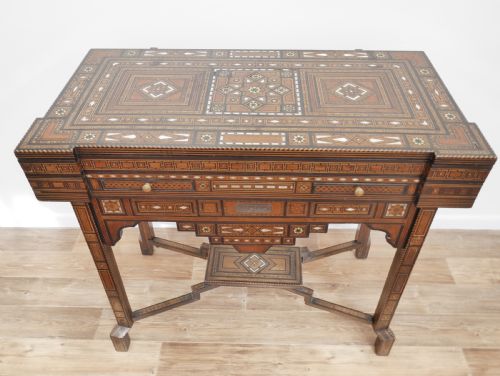
The version you are most likely to meet on this page is Victorian Tunbridge Ware, originating from Kent and featuring geometric or pictorial mosaic panels set into rosewood or walnut carcases. Alongside these English works, the selection includes Anglo-Indian bone and wood boxes, Ottoman Syrian chess tables, and Persian Khatamkari items.
These objects served as desktop accessories, parlour game surfaces, and decorative containers for affluent nineteenth-century households. Their survival relies on the stability of their timber foundations and the strength of the historic animal glues holding each mosaic element in place.
Materials and techniques
Craftsmen used naturally coloured timbers such as boxwood, sycamore, holly, walnut, and rosewood to build up detailed pictorial and geometric motifs. These woods were sawn into microscopic strips, glued together in bundles, and sliced across to produce hundreds of identical mosaic tiles.
In Anglo-Indian and Middle Eastern traditions, workers combined wood inlay with carved bone and contrasting laminates to decorate stationery boxes and games tables. The resulting mosaic veneers were then applied to solid timber carcases and finished by hand-polishing.
Victorian makers once hid tiny secret compartments inside their tea caddies, waiting for unsuspecting owners to discover them.
Variations in quality
The fineness of the mosaic tesserae determines the visual ambition of the piece, with smaller individual tiles demanding greater precision from the maker. Simpler geometric bands contrast with elaborate pictorial representations of castles or local landmarks.
The choice of base timber also elevates the object, with dense rosewood and figured walnut providing a superior ground compared to plain secondary woods. Preserved original linings, working locks, and complete mosaic borders further distinguish the finer examples.
Henry Hollamby
The Micro Mosaic Wood Inlay Glossary
- Tunbridge Ware
- A specialised form of woodwork originating from Kent, featuring minute mosaic designs made from natural coloured timbers. It reached its peak popularity during the Victorian period.
- Tesserae
- The individual tiny blocks of wood or bone that form the mosaic pattern. Their microscopic scale defines the intricacy of the design.
- Khatamkari
- An ancient Persian technique of marquetry and mosaic work, utilising delicate triangles of wood, bone, and metal wire. These elements create geometric stars and intricate surface patterns.
- Sadeli work
- A specific type of Indian micro mosaic inlay produced in Bombay, using intricate geometric patterns constructed from horn, bone, and stained woods. It frequently adorns nineteenth-century work boxes.
- Carcasse
- The underlying structural wooden body of a box or table upon which the mosaic veneer is applied. The stability of this foundation dictates the longevity of the decorative surface.
Micro Mosaic Wood Inlay: Frequently Asked Questions
What is micro mosaic wood inlay?
Micro mosaic wood inlay involves assembling thousands of microscopic wooden tiles to form pictorial or geometric surface decorations. Makers used naturally coloured timbers to build up complex images without employing paint.
These mosaics appear primarily on nineteenth-century domestic items like tea caddies, games tables, and small trinket boxes.
Where does Tunbridge Ware come from?
Tunbridge Ware originates from the spa town of Royal Tunbridge Wells in Kent, alongside nearby Eridge. The industry flourished during the Victorian era, producing distinctive boxes and plaques.
Local workshops specialised in replicating local castles and landscape views using thousands of coloured wood blocks.
How do I care for these boxes?
Keep wooden mosaic pieces away from direct sunlight and sudden temperature changes to prevent the tiny timber tiles from shrinking. Stable indoor humidity protects the historic animal glue holding the mosaic veneer.
Dust gently with a dry cloth and avoid using liquid polishes or moisture on the mosaic surface.
What is Anglo-Indian inlay?
Anglo-Indian inlay combines traditional British box forms with indigenous Indian decorative techniques such as Sadeli work. These pieces frequently incorporate carved bone alongside contrasting dark woods.
Craftsmen produced them for export during the nineteenth century, blending European utility with intricate Asian craftsmanship.
How are Persian and Syrian tables made?
Persian Khatamkari and Syrian Damascus tables utilise geometric inlay schemes constructed from fine wooden rods, bone, and metal wire. Artisans slice these composite bundles into thin sheets to cover furniture surfaces.
This technique creates complex star and polygon patterns across chess boards and side tables.