



Metal Door Pulls
These metal door pulls are solid period ironmongery that brings tactile authenticity and daily utility to any entrance.
Metal Door Pulls
When you search for metal door pulls, you encounter sturdy hardware designed for heavy residential use across multiple centuries. The selection spans Victorian, Georgian, Edwardian, and Regency periods, alongside early twentieth-century examples.
Manufacturing and materials
Items in this category rely primarily on cast brass, cast bronze, and cast iron. These metals were poured and finished to create durable hardware meant to withstand continuous handling.
Surface treatments range from polished metal finishes to natural patination earned through decades of domestic service.
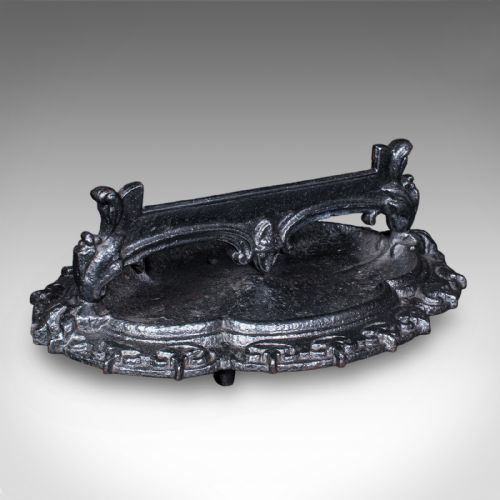
Some visitors may mistake a sturdy Victorian boot scraper for a miniature garden gate left behind by an absent-minded blacksmith.
Assessing the work
Quality rests in the crispness of the casting and the weight of the metal. Finer examples show sharp relief in patterns like bee hive or octagonal turning, whereas simpler pieces rely on plain surfaces.
The integrity of the mechanism in bell pulls and the preservation of original mounting points also separate standard utilitarian items from more sculptural hardware.
The Metal Door Pulls Glossary
- Centre door knob
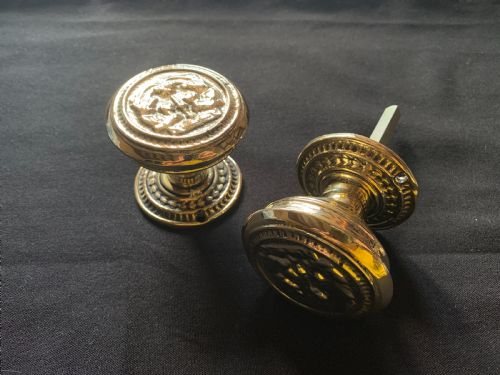
- A large door knob mounted in the middle of an entrance door rather than at the edge, primarily used for pulling the door closed or fitted with a striking plate for visitors. These form a significant portion of early hardware.
- Door bell pull
- A pivoting handle or lever connected via a wire or crank to a mechanical bell inside the house. Georgian and Victorian examples display slender stems and backplates.
- Boot scraper
- A heavy iron or bronze floor fixture placed outside an entrance to clean mud from footwear before entry. They often incorporate decorative architectural styling.
- Cast bronze
- An alloy of copper and tin shaped by pouring into a mould, prized for its strength and resistance to corrosion. It yields a rich, dark tone over time.
Metal Door Pulls: Frequently Asked Questions
How do I install an antique bell pull?
Most bell pulls require a clearance hole through the door or doorframe to connect the exterior handle to the internal crank mechanism. Traditional wire linkages then run to the bell housing.
Because original linkages rarely survive intact, modern flexible cable or reproduction wire is often substituted during installation to restore functionality.
Are centre door knobs turned or cast?
Centre door knobs are typically produced through casting methods, utilising brass or bronze poured into moulds to achieve solid forms. Subsequent lathe turning refines specific geometric profiles like octagonal or bee hive shapes.
This combination of casting and turning ensures both structural heft and precise decorative detailing on the grip.
What is the difference between brass and bronze hardware?
Brass is primarily a copper and zinc alloy that takes a bright polish and mellows to a golden brown patina. Bronze contains copper and tin, offering greater tensile strength and a darker, red-brown or chocolate hue.
Both metals were utilised across the Georgian and Victorian eras depending on the desired finish and intended wear resistance.
How should I clean antique metal hardware?
Gentle washing with warm water and mild soap removes surface dirt without disturbing the historical patina. A soft cloth helps maintain the existing finish.
Harsh chemical abrasives and metal polishes should be avoided unless stripping modern lacquers, as they strip away centuries of natural ageing.