

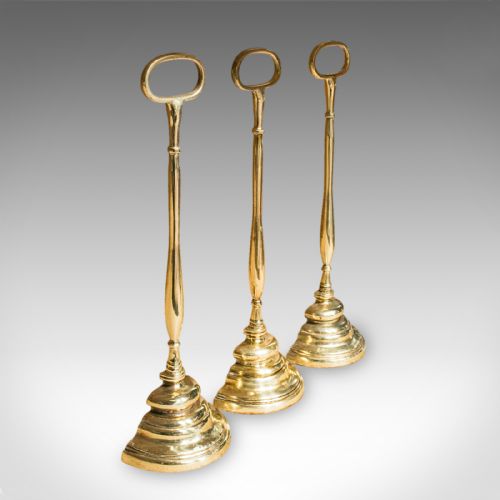


Cast Polished Handles
These cast polished handles bring tactile weight and honest metalwork to a room, offering the durability that everyday hardware lacks.
Cast Polished Handles
When you search for cast polished handles, you are looking at utilitarian hardware and household objects shaped from metals like brass, bronze, copper, steel, and cast iron. These pieces span several eras, including the Georgian, Regency, Victorian, and Edwardian periods, alongside the Art Nouveau style.
The objects listed under this description typically include door pulls, door knobs, and letter box plates designed for architectural use. They combine structural heft with a reflective finish that highlights the underlying casting process.
You are most likely to encounter Victorian and Edwardian examples on this page, alongside earlier Georgian and Regency designs. These domestic items demonstrate how functional ironmongery also served decorative purposes in period interiors.
Methods of manufacture
The pieces on this page are produced through traditional casting techniques in metals such as brass, bronze, and copper. Molten metal is poured into moulds to create solid forms with substantial weight and defined profiles.
Following the casting process, the surfaces are polished to a bright sheen that accentuates the contours of the design. Steel and cast iron elements are similarly worked to achieve durable finishes suited to daily architectural or domestic handling.
Cast Polished Handles Retail Price Guide 2026
Typical asking prices for cast polished handles among the pieces listed under this phrase on Sellingantiques today, from the lower quarter to the upper quarter. They describe what is for sale here now, not the wider market.
Current listings feature items from the Georgian, Regency, Victorian, and Edwardian periods, as well as the year nineteen hundred.
Judging quality in metalwork
Quality in these metal objects depends on the crispness of the casting and the depth of the subsequent polish. Finer pieces retain sharp architectural details and clean lines without the softening that comes from worn moulds or over-polishing.
The substance of the metal itself dictates the character of the piece, with heavier gauges and solid alloys providing a superior handfeel. The integrity of the original fixings and the balance of the proportions further distinguish superior examples from simpler production.
The Cast Polished Handles Glossary
- Cast metal
- Metal shaped by pouring liquid material into a mould. This technique allows for repeatable forms with robust structural properties.
- Polished metal
- A surface finish achieved by abrading and buffing the metal until it reflects light. This treatment emphasises the texture and colour of the underlying alloy.
- Architectural hardware
- Functional metal fixtures attached to buildings and doors. These items include handles, knockers, and letter plates designed for daily interaction.
- Art Nouveau
- A stylistic movement from around 1900 characterised by organic, flowing lines. Objects from this period often feature naturalistic curves inspired by plant forms.
Cast Polished Handles: Frequently Asked Questions
What periods do these handles represent?
The pieces span several eras, stretching from the Georgian and Regency periods through the Victorian and Edwardian eras up to nineteen hundred.
This variety includes distinct stylistic shifts, ranging from classical Georgian symmetry to the organic curves of Art Nouveau hardware.
How were these metal items used?
They served practical functions in domestic and architectural settings, operating as door furniture, pulls, and letter box plates.
Their sturdy construction ensured they could withstand constant daily handling while contributing to the overall aesthetic of the interior.
Which metals are most common?
Brass is frequently seen across the selection, often accompanied by copper, bronze, steel, and cast iron.
Each metal brings a different weight and tonal quality to the finished object, influencing both its appearance and its tactile feel.
How do I care for polished metal?
Maintenance involves gentle cleaning with appropriate metal polishes to preserve the reflective surface without removing the underlying material.
Regular dusting and minimal moisture exposure help maintain the original lustre developed over decades of use.