

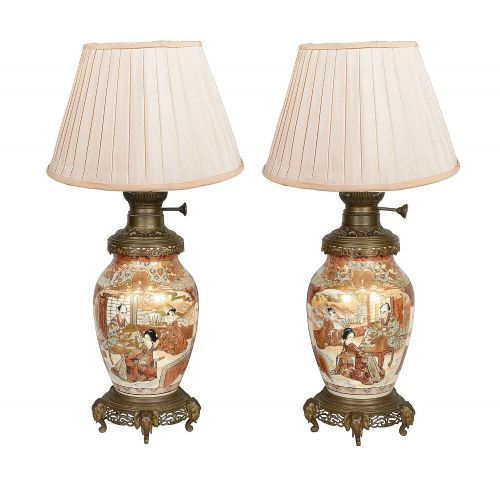


Meiji Porcelain Lamp
A meiji porcelain lamp brings distinct Japanese Satsuma, Kutani and Imari character into a room through converted nineteenth-century ceramic vases.
Meiji Porcelain Lamp
When searching for a meiji porcelain lamp, a buyer encounters table lamps created from Japanese Satsuma, Kutani, Imari and blue and white vases. These pieces date from the nineteenth century through to nineteen twenty, reflecting both the Meiji period and subsequent Japonisme tastes.
Many of these lamps appear in pairs, utilising vases and spill vases that were subsequently fitted for electrical use. The selection spans standard table heights up to large nineteenth-century Yokohama porcelain examples reaching ninety centimetres high.
The objects combine traditional Japanese ceramic artistry with nineteenth-century and early twentieth-century lighting fixtures. Buyers find both intricate Satsuma earthenware and robust blue and white porcelain forms adapted for domestic illumination.
What varies in quality
Quality in a meiji porcelain lamp rests upon the fineness of the original ceramic painting and the preservation of the glaze. Pieces featuring meticulous hand-painted enamel details or crisp blue and white decoration stand apart from simpler iterations.
The integration of the conversion work also defines the standard, specifically how well the brass and wood mounts complement the porcelain body without obscuring the historic ceramic form. Scale and symmetry within pairs further separate standard examples from exceptional ones.
Some nineteenth-century spill vases originally meant for holding fireplace matches now spend their retirement illuminating reading corners as stately table lamps.
The Meiji Porcelain Lamp Glossary
- Satsuma
- A type of Japanese earthenware featuring a crackle glaze and ornate enamel painting over a creamy body. It frequently appears in nineteenth-century table lamps.
- Kutani
- A style of Japanese porcelain known for bold colour palettes, particularly iron red and green. These wares often feature detailed pictorial scenes.
- Imari
- A traditional Japanese export porcelain decorated in underglaze blue, iron red and gold. These pieces display distinct geometric and floral motifs.
- Japonisme
- A late nineteenth-century Western artistic movement influenced by Japanese art and design. This aesthetic inspired the integration of Japanese vases into European home furnishings.
- Spill vase
- A tall, narrow ceramic vessel originally designed to hold wooden matches for lighting fires. Many were later converted into slender table lamps.
Meiji Porcelain Lamp: Frequently Asked Questions
Are these lamps converted from old vases?
Yes, the majority of these pieces originate as nineteenth-century Japanese vases or spill vases that were later wired to function as table lamps.
This conversion process preserves the historic ceramic artistry while adapting the vessels for contemporary domestic electrical use.
How do I identify Satsuma ware?
Satsuma porcelain and earthenware is typically recognised by its ivory-coloured crackle glaze and dense enamel decoration enriched with gilt highlights.
These pieces often depict traditional figures, landscapes or floral patterns characteristic of the Meiji period.
Do these lamps come in pairs?
Many listings feature matching pairs of lamps, though single examples also appear in various forms and heights.
Pairs usually share identical decorative motifs, porcelain bodies and overall dimensions, making them suitable for balanced mantel or sideboard placement.
What is Kutani porcelain?
Kutani porcelain is a distinct Japanese ceramic tradition celebrated for its vibrant polychrome glazes and intricate pictorial compositions.
These lamps display rich iron red and green tones that create a striking visual presence in a room.