

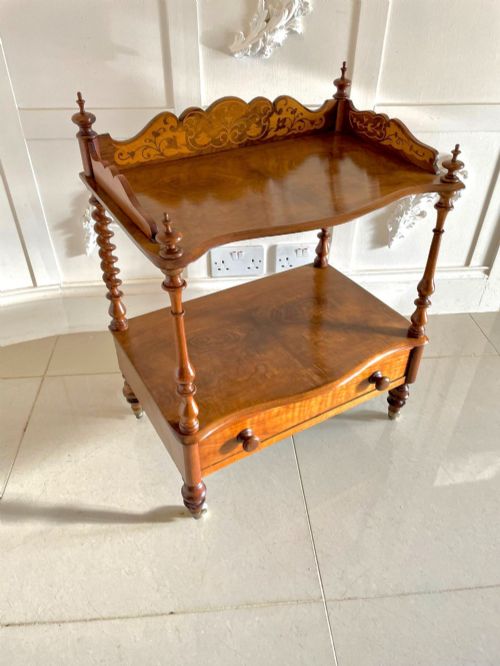
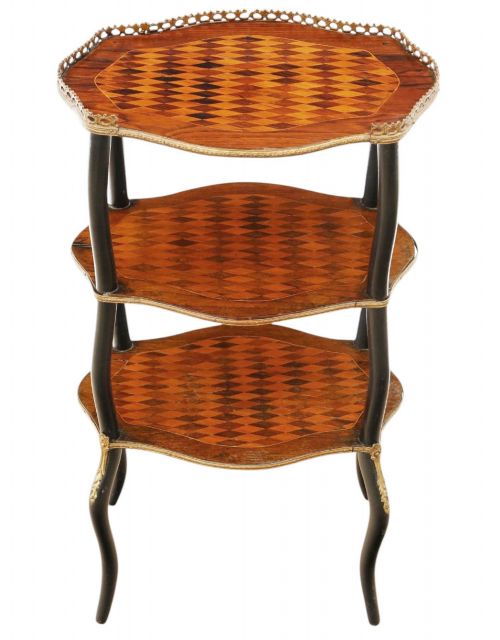


Marquetry Whatnot Table
These marquetry whatnot table pieces combine tiered shelving with detailed wood inlay to display small objects while anchoring a room.
Marquetry Whatnot Table
When you search for a marquetry whatnot table, you are looking at multi-tiered display furniture that brings vertical storage and decorative wood surfaces into a room. These pieces appear as tiered stands, etageres, and display shelves designed to hold small decorative objects or writing materials.
You are most likely to meet Victorian and Edwardian examples on this page, spanning the nineteenth century up to nineteen ten. These items often adopt French Revival, Louis XV Style, or Belle Epoque design influences alongside traditional British forms.
Forms range from simple three tier oval inlaid stands to more complex pieces combining jewellery cabinets, desks, and lamp tables. Walnut, burr walnut, mahogany, and ebonised wood provide the primary structures for these tiered display items.
How they were made
Cabinet makers constructed these pieces using mixed timber parquetry and intricate wood veneer patterns applied to walnut, mahogany, and satinwood carcases. Skilled artisans cut contrasting woods to form geometric or floral marquetry designs across the top surfaces and tiers.
Metal mounts in ormolu and brass trim edges, supports, and galleries, adding structural definition and decorative contrast to the dark wood. Ebonised wood elements provide a stark backdrop for inlaid panels and gilt bronze mounts.
Marquetry Whatnot Table Retail Price Guide 2026
Typical asking prices for marquetry whatnot table among the pieces listed under this phrase on Sellingantiques today, from the lower quarter to the upper quarter. They describe what is for sale here now, not the wider market.
Listings span the nineteenth and early twentieth centuries, featuring walnut, burr walnut, satinwood, and ebonised timber.
What varies in quality
The precision of the wood veneer work and the complexity of the parquetry patterns distinguish the finer examples from simpler production. Crisp cutting of the marquetry motifs and the harmonious selection of burr walnut or satinwood indicate higher workshop standards.
The Marquetry Whatnot Table Glossary
- Marquetry
- Decorative veneer work forming pictures or patterns by arranging small pieces of wood, shell, or ivory. This technique covers the display surfaces of many tiered stands.
- Whatnot
- An open set of shelves used for displaying small ornaments or books. These tiered items appeared frequently in nineteenth century interiors.
- Etagere
- A piece of furniture consisting of a set of open shelves for displaying ornaments. French versions often incorporate curved legs and ormolu mounts.
- Parquetry
- Geometric mosaic woodwork used for floors or furniture surfaces. It appears alongside floral marquetry on table tops.
- Ormolu
- Gilded bronze used for decorative mounts and trimmings on furniture. It accents the corners and supports of French revival pieces.
Marquetry Whatnot Table: Frequently Asked Questions
What is a whatnot table used for?
These pieces provide open shelving arranged in tiers to display decorative items, books, or small collections within a principal room.
Their vertical design allows them to occupy minimal floor space while offering multiple surfaces for display and occasional use.
How do I identify a Victorian whatnot?
Victorian examples typically date from eighteen sixty to the late nineteenth century, utilising dark timbers like walnut, burr walnut, and mahogany.
They frequently feature turned supports, inlaid wood marquetry, and open tiers designed for display rather than enclosed storage.
What is the difference between an etagere and a whatnot?
An etagere generally refers to French influenced pieces with decorative mounts and lighter frames, often associated with Belle Epoque or Louis XV styles.
Whatnot is a traditional British term for multi-tiered shelving stands, though both descriptions overlap heavily in nineteenth century furniture.
Where should I place a tiered display stand?
These tables suit corners, hallways, or sitting rooms where vertical display space adds architectural interest without crowding the room.
Their open shelves make them ideal for holding lamps, small clocks, or ceramic pieces where they can be viewed from multiple angles.