
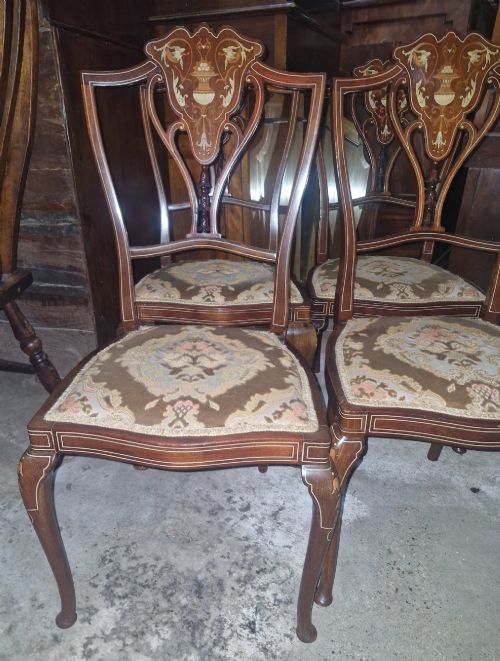
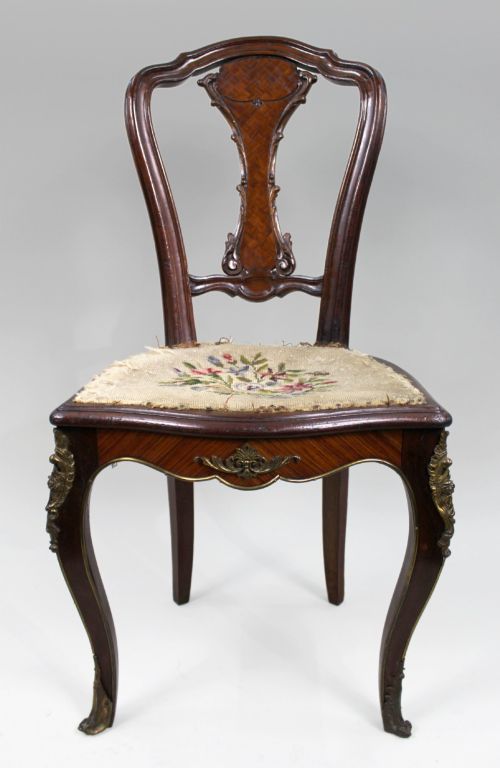
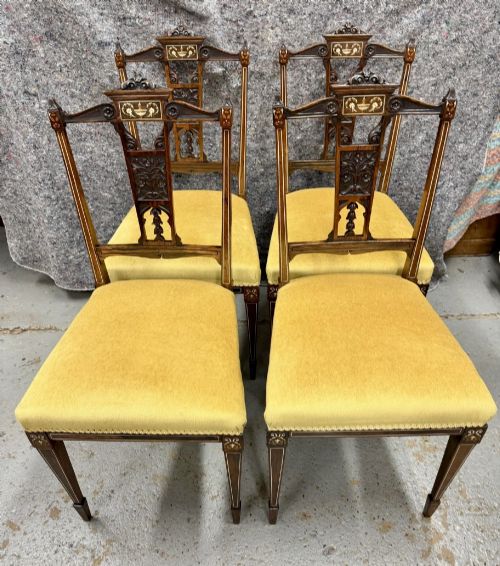
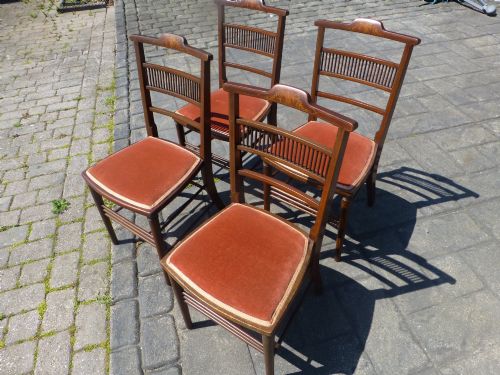


Marquetry Salon Dining Chair
A marquetry salon dining chair offers intricate floral and geometric wood inlay work, combining ornamental elegance with practical seating for period interiors.
Marquetry Salon Dining Chair
A marquetry salon dining chair represents a fusion of decorative inlay and functional seating, commonly found across Victorian and Edwardian periods. These pieces serve as both decorative salon furnishings and usable dining seats, reflecting the refined tastes of their eras.
The versions most frequently encountered on this page belong to the Edwardian and Victorian eras, taking the form of dining chairs, side chairs, salon chairs, and armchairs. They are constructed primarily from timbers such as mahogany, rosewood, and walnut.
Makers of these chairs utilised contrasting light woods like boxwood and satinwood to create detailed inlaid patterns across the backs and frames. The resulting forms range from restrained Sheraton Revival designs to more fluid Edwardian Art Nouveau interpretations.
How they were made
Cabinetmakers constructed the main framework using dense cabinet timbers including mahogany, rosewood, and walnut, ensuring structural stability for daily use. Individual components were shaped and joined to form sturdy chair frames suited to both dining and salon settings.
Decorative surfaces rely on meticulous wood inlay and marquetry techniques, setting fine veneers of boxwood and satinwood into contrasting dark timber backrests and rails. Metal elements such as ormolu mounts occasionally appear on French-influenced pieces to accentuate the woodwork.
The documented periods span the Victorian and Edwardian eras, incorporating French Rococo Revival and Art Nouveau styles.
What varies in quality
The standard of a marquetry salon dining chair depends significantly on the precision of the wood inlay and the crispness of the surrounding carving. Finer examples display tightly fitted veneers and intricate botanical or geometric motifs that remain flush with the primary timber.
Material selection also dictates the hierarchy of these chairs, with dense rosewood and figured mahogany framing superior examples upholstered in velvet or woven fabric. Coarser versions rely on simpler timber choices and broader, less detailed inlay work.
The Marquetry Salon Dining Chair Glossary
- Marquetry
- Decorative patterns formed by inserting small pieces of wood veneer into a solid wood background. This technique creates detailed pictorial or geometric designs across chair backs.
- Parquetry
- Geometric wood inlay arranged in regular repeating patterns such as cubes or chevrons. It provides a structured contrast to the more fluid floral marquetry motifs.
- Satinwood
- A lustrous, yellow-toned timber utilised for fine stringing and contrasting inlay details. Its bright hue highlights the darker mahogany and rosewood foundations.
- Ormolu
- Gilded bronze ornamentation applied to furniture mounts. This material adds metallic contrast to wood surfaces on French-influenced pieces.
- Boxwood
- A dense, pale wood frequently chosen for delicate inlay lines and floral highlights. Its fine grain allows for sharp cutting in intricate marquetry.
Marquetry Salon Dining Chair: Frequently Asked Questions
What is a marquetry salon dining chair?
A marquetry salon dining chair is a decorative seat featuring detailed wood inlay work across the backrest or frame, produced primarily during the Victorian and Edwardian eras. These chairs bridge the gap between formal drawing-room display and practical dining use.
They incorporate contrasting timbers such as boxwood and satinwood set into mahogany, rosewood, or walnut. Their styles span from revival designs to subtle Art Nouveau interpretations.
Were these chairs used for dining?
Yes, many examples served a dual purpose in period homes, functioning both as occasional salon seating and as dining chairs for formal gatherings. Their lighter frames made them adaptable for moving between rooms as needed.
Upholstery in velvet or woven fabric provided comfort during extended sitting. The decorative inlay ensured they remained visually striking even when tucked around a dining table.
How do I tell Victorian from Edwardian chairs?
Victorian chairs often feature heavier proportions, darker walnut or mahogany frames, and dense, traditional carving alongside marquetry. They tend to reflect earlier revival aesthetics inspired by French or classical sources.
Edwardian pieces generally present lighter rosewood or mahogany structures with more restrained inlay work. Art Nouveau influences and Sheraton Revival styling become prominent during this later period.
How do I care for inlaid wood furniture?
Inlaid wood furniture requires stable indoor humidity and protection from direct sunlight to prevent the delicate veneers and boxwood stringing from drying out. Regular dusting with a soft, dry cloth preserves the polished surface.
Avoid placing these chairs near direct heat sources or applying modern chemical polishes. Gentle waxing maintains the natural lustre of the timber without harming the historic inlay.