



Marquetry Office Desk
A marquetry office desk brings patterned wood veneers and refined writing surfaces into a room, offering both workspace and decorative presence.
Marquetry Office Desk
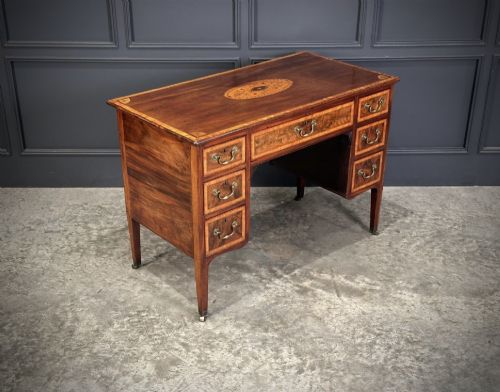
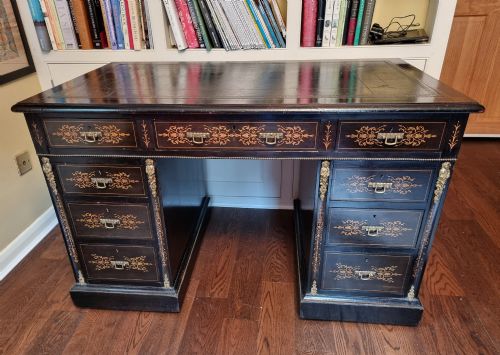
A marquetry office desk encompasses writing tables, pedestal desks, and bureau bookcases built across the eighteenth, nineteenth, and early twentieth centuries. These pieces combine functional workspace with detailed wood inlay work across surfaces and drawers.
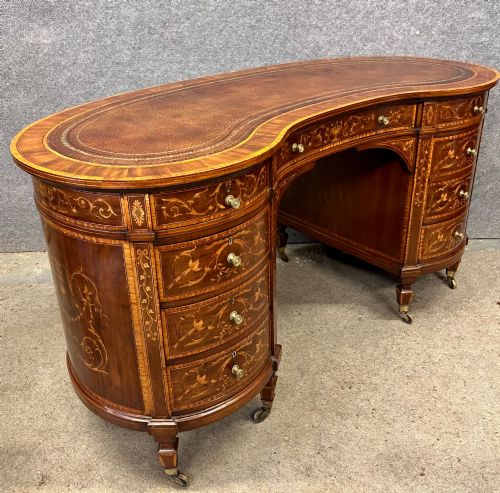
The Victorian and Edwardian periods supply many of the examples seen here, often following Sheraton Revival, Georgian, or French Louis designs. Forms range from compact kidney-shaped writing tables to large kneehole desks and bureau plats.
Makers such as Edwards and Roberts, Gill and Reigate, and James Shoolbred produced pieces featuring precise floral and geometric inlay. Alongside these desks, related seating including library armchairs and swivel chairs appears within the selection.
How they were made
Craftsmen built these desks using foundational woods like mahogany, walnut, and rosewood, applying contrasting veneers of satinwood and burr walnut for decorative panels. Inlay work involved cutting precise floral, scroll, or architectural motifs into the timber surface.
Metal mounts in ormolu and handles cast in brass frequently accent French bureau plats and English Sheraton revival pieces. Writing surfaces often incorporate inset leather panels framed by banded wood borders.
Marquetry Office Desk Retail Price Guide 2026
Typical asking prices for marquetry office desk among the pieces listed under this phrase on Sellingantiques today, from the lower quarter to the upper quarter. They describe what is for sale here now, not the wider market.
Desk forms vary from compact kidney-shaped writing tables to pedestal desks, Davenport desks, and bureau bookcases.
What varies in quality
The precision and complexity of the wood inlay determine a desk's standard, with tighter joins and varied timber tones separating master workshops from standard production. Cabinet makers such as Edwards and Roberts achieved sharper definition in their floral and scroll motifs.
Secondary framing timbers and the quality of mount castings, particularly in ormolu-mounted French models, reflect the tier of manufacture. Well-executed carcass construction ensures drawers retain alignment and structural integrity over time.
Edwards and Roberts·Gill and Reigate·James Shoolbred
The Marquetry Office Desk Glossary
- Marquetry
- The decorative art of applying pieces of veneer to a structure to form ornamental patterns and pictures. Craftsmen selected contrasting woods to create floral or geometric designs.
- Bureau Plat
- A flat-topped writing table, usually freestanding with drawers beneath the surface. Originating in France, these tables often feature ormolu mounts and leather writing inserts.
- Ormolu
- Gilt bronze ornamentation applied to furniture mounts and feet. This technique was widely used on nineteenth-century French and English revival desks.
- Satinwood
- A durable hardwood with a lustrous, golden-yellow sheen used extensively for inlay and banding. It provides strong visual contrast against darker timbers like mahogany.
- Pedestal Desk
- A heavy wooden desk built upon two independent pedestals containing drawers. These pieces often feature an inset leather writing surface.
Marquetry Office Desk: Frequently Asked Questions
What is a marquetry office desk?
A marquetry office desk is a wooden writing table or pedestal desk decorated with fitted wood veneers forming patterns. These pieces date primarily from the Victorian and Edwardian eras, combining workspace utility with decorative inlay.
Craftsmen utilised timbers such as mahogany, walnut, and satinwood to create detailed surfaces on various desk forms, including kidney-shaped tables and bureau plats.
How do I identify a Victorian desk?
Victorian desks often display robust proportions and incorporate revival styles such as Sheraton Revival or French Louis designs. Burr walnut and mahogany are common primary woods used during this period.
Maker signatures or stamps inside drawer linings frequently help confirm the nineteenth-century origin and attribution to firms like Edwards and Roberts.
Where were these desks placed?
These desks served as functional writing furniture in studies, libraries, and principal reception rooms of large houses. Freestanding models like bureau plats were designed to sit away from walls to display inlay work on all sides.
Matching desk chairs and swivel seats upholstered in leather were arranged alongside the tables to complete the working suite.
How do Edwardian desks differ?
Edwardian desks tend to be lighter in scale, often drawing inspiration from eighteenth-century Sheraton designs. Satinwood inlay and mahogany frames appear frequently in pieces from this period.
Workshop labels from makers such as James Shoolbred or Gill and Reigate help date these lighter writing tables to around nineteen hundred.