



Marquetry Corner Armchair
A marquetry corner armchair brings tactile timber and clever geometry into awkward spaces, offering a clever seat that fits neatly where standard chairs fail.
Marquetry Corner Armchair
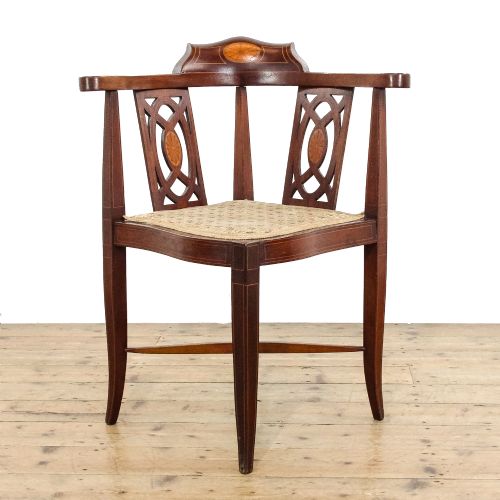
A marquetry corner armchair sits precisely in the junction of two walls, using a diagonal seat plan designed to make the most of small rooms. The listings show these pieces appearing predominantly in Edwardian incarnations, alongside examples from the nineteenth century and the nineteen-twenties.
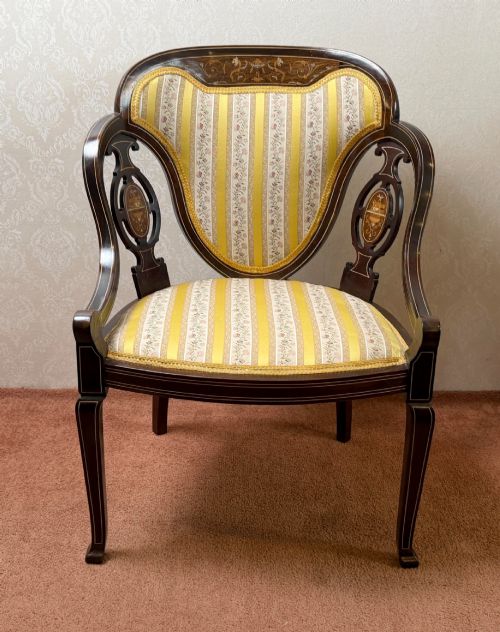
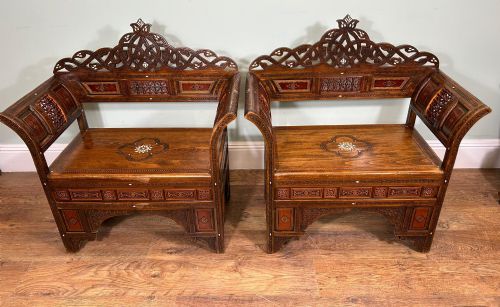
The dominant forms span corner chairs, occasional chairs, salon armchairs, and tub chairs, often upholstered in fabric. Many carry revival influences, shifting between Sheraton revival lines, Art Nouveau curves, and Moorish revival patterns.
The materials recorded in the evidence lean heavily towards mahogany, walnut, and rosewood, enriched with wood inlay, satinwood inlay, and marquetry inlay. Buyers searching for a marquetry corner armchair encounter a distinct concentration of Edwardian mahogany craftsmanship.
Construction and surface decoration
Cabinetmakers built these seats using dense hardwoods such as mahogany and rosewood, shaping the curved rails and corner posts to support the diagonal stress of the frame. Wood inlay and marquetry inlay provide the decorative surface, cutting contrasting timbers into the primary wood to form floral or geometric patterns.
Satinwood inlay appears alongside broader marquetry work, offering bright contrast against darker mahogany grounds. Upholstered sections use fabric over internal padding, set within the wooden framework of salon and tub armchairs.
Marquetry Corner Armchair Retail Price Guide 2026
Typical asking prices for marquetry corner armchair among the pieces listed under this phrase on Sellingantiques today, from the lower quarter to the upper quarter. They describe what is for sale here now, not the wider market.
Syrian Moorish armchairs bring Damascus geometry into Edwardian parlours, proving that nineteenth-century interior designers loved a global mix.
Distinctions in craftsmanship
The standard of timber preparation and the precision of the inlay work separate finer examples from simpler production. Crisp execution in the marquetry inlay shows tighter joints and more varied wood selections.
Structural integrity in the complex angled joints of a corner frame determines the durability of the piece. Subtle details in the turning of the legs and the flow of the upper rail distinguish standard salon seating from superior examples.
The Marquetry Corner Armchair Glossary
- Marquetry
- The art of applying pieces of veneer to a structure to form decorative patterns. Craftsmen cut contrasting timbers to create pictorial designs across the backrest or seat rail.
- Corner chair
- A seating form designed to fit into the intersection of two walls. The diagonal orientation places one leg at the front and a curved back rail wrapping around the sides.
- Satinwood
- A pale, yellow-brown timber utilised for contrasting inlay work. Its reflective grain provides bright highlights against darker woods like mahogany.
- Tub armchair
- A seat featuring a continuous curved back and arms forming a rounded enclosure. This form appears frequently among Edwardian upholstered variants.
- Sheraton revival
- A late nineteenth and early twentieth century style drawing on the neoclassical furniture designs of George Sheraton. Pieces in this manner favour light proportions and delicate inlay.
Marquetry Corner Armchair: Frequently Asked Questions
Where does a corner armchair go in a room?
These pieces are designed specifically to slot into ninety-degree wall angles, making use of space that standard rectangular seating ignores. They also function well as standalone accent items when placed away from walls.
Positioning one in a hallway or a corner of a reception room provides a compact seat without blocking thoroughfares. The diagonal front leg aligns naturally with foot traffic in smaller interiors.
How do I identify an Edwardian marquetry chair?
Edwardian examples usually combine light mahogany frames with delicate satinwood or marquetry inlay depicting floral motifs or classical swags. The proportions tend to be lighter than earlier Victorian items.
Many pieces from this period reflect revival tastes, incorporating Sheraton or Art Nouveau influences in the shaping of the top rail and spindle arrangements.
What is the difference between inlay and marquetry?
Inlay involves inserting pieces of wood into cavities carved directly into a solid timber surface. This technique creates crisp borders or linear patterns along structural members.
Marquetry assembles an entire picture from assembled veneers on a backing sheet before applying it to the furniture carcass. This method allows for complex pictorial designs using multiple contrasting woods.
Are these chairs comfortable for daily use?
Most of these pieces were intended for light reception or salon use rather than long periods of relaxation. Upholstered tub and salon variants offer more support through padded seats and curved backrests.
Their primary purpose historically was decorative conversation seating rather than lounging. Modern users often place them where they receive occasional rather than heavy daily sitting.