






Marine Folk Art
Marine folk art brings the raw maritime trade and coastal life of the nineteenth and early twentieth centuries directly into domestic spaces.
Marine Folk Art
Marine folk art comprises handcrafted items originating from coastal communities, sailors, and vernacular makers during the nineteenth and early twentieth centuries. These pieces reflect a direct engagement with the sea, capturing ships, coastal workers, and marine life through various tactile mediums.
Origins span English, Cornish, and Scottish coastal regions, alongside specific carvings from Inuit tribal makers and Pitcairn islanders. The forms range from functional carved whalebone and shark vertebrae canes to wall art and sculptural depictions of marine fauna.
Materials and construction
Makers utilised available organic and maritime materials such as whalebone, shark vertebrae, horn, shellwork, and wood to construct these objects. Sculptural pieces and walking sticks rely heavily on scrimshaw techniques and manual carving, shaping dense bone and antler into functional or decorative forms.
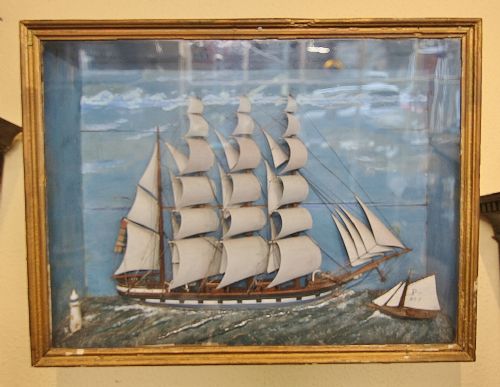
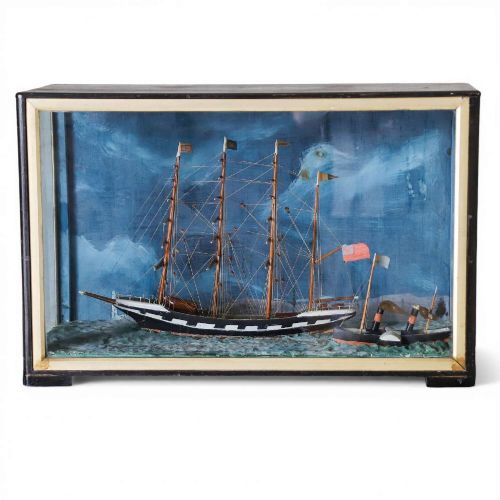
Dioramas and shadow boxes combine painted canvas, glass, plaster, and carved wooden ship models to create layered three-dimensional seascapes. Paintings and wall art employ oil paint on canvas or panel, capturing coastal genre scenes with textured brushwork.
Marine Folk Art Retail Price Guide 2026
Typical asking prices for marine folk art among the pieces listed under this phrase on Sellingantiques today, from the lower quarter to the upper quarter. They describe what is for sale here now, not the wider market.
Sailors carved fierce sharks and flying fish out of vertebrae, proving that even a predator's spine makes a fine walking stick.
Judging quality in marine folk art
Quality rests on the precision of the carving and the complexity of the construction, particularly within dioramas where layered rigging and painted backgrounds determine depth. Finer examples display meticulous attention to nautical detail in ship models and convincing anatomical proportions in animal carvings.
The integrity of the original materials and the preservation of surface patination dictate the desirability of bone and wood pieces. Stronger works retain their original painted surfaces and unpolished whalebone textures, while lesser items suffer from unsympathetic modern interventions.
James Kyd·Liverpool Ship Building Co·William Shayer·James G Faulds
The Marine Folk Art Glossary
- Diorama
- A three-dimensional scene enclosed in a glass-fronted shadow box, commonly depicting sailing ships upon painted seas. These pieces were often constructed by sailors during long voyages.
- Half hull model
- A three-dimensional representation of a ship's hull built against a backboard, used by shipyards for design and documentation. Liverpool Ship Building Co. produced significant examples of these practical objects.
- Scrimshaw
- Carving or engraving upon whalebone, whale ivory, or walrus tusk, traditionally practised by whalers. The incisions are often highlighted with dark pigment to reveal the design.
- Genre painting
- Artwork depicting scenes from everyday life, particularly involving fisher folk and coastal communities. Artists such as William Shayer and James Kyd worked extensively within this tradition.
- Whalebone
- Baleen or skeletal material derived from whales, utilised by sailors and indigenous carvers for walking sticks and statues. It provides a dense, durable medium for intricate hand carving.
Marine Folk Art: Frequently Asked Questions
What is marine folk art?
Marine folk art encompasses handmade objects created by sailors, coastal communities, and vernacular craftsmen during the nineteenth and early twentieth centuries. These items range from detailed ship dioramas to carved whalebone walking sticks and oil paintings of fisher folk.
The category highlights the material culture of maritime life, combining utilitarian items with decorative expressions of the sea. Each piece reflects the specific environment and technical skills of its maker.
How were maritime dioramas made?
Maritime dioramas were constructed using carved wooden ship models placed inside shallow wooden boxes fronted with glass. Makers layered painted canvas, plaster, and fabric to simulate rolling waves and Turneresque skies.
Sailors and coastal craftsmen built these scenes to record specific vessels, such as the clipper or the Glynllifon, often incorporating real shellwork and metal rigging components for added realism.
What materials did sailors use?
Sailors utilised readily available materials found on ships and coastal outposts, including wood, canvas, glass, and metal paints. Organic substances such as whalebone, shark vertebrae, and horn were particularly common for carved functional items.
Items like walking sticks and Pitcairn flying fish sculptures demonstrate resourcefulness, transforming whale parts and driftwood into decorative artefacts during extended periods at sea.
How do I display a diorama?
Dioramas require stable wall mounting or secure shelf placement away from direct sunlight and fluctuating moisture levels. The original wooden shadow boxes and glass fronts protect the delicate paper, paint, and textile elements inside.
Placing these pieces in rooms with controlled indoor climates helps preserve the organic materials, canvas panels, and oil paint surfaces from degradation over time.