







Marble Desk Inkwell
These heavy marble desk inkwells anchor a writing table with solid presence, bringing tactile weight and period character to daily correspondence.
Marble Desk Inkwell
A marble desk inkwell provides a substantial, decorative platform for writing instruments and ink reservoirs. When exploring this selection, buyers encounter pieces designed to sit squarely on library and office desks.
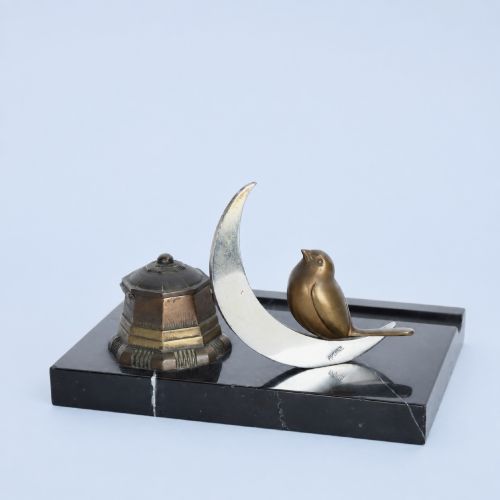
The objects span varied styles including French Empire, Neoclassical, Art Deco, and Art Nouveau. Pieces range from simple desk tidies to elaborate architectural stands featuring mounted metal figures or inset stone panels.
Origins stretch across European workshops, with French designs appearing frequently alongside Italian Grand Tour souvenirs, British examples, and Austrian bronzes. The form evolved from strict classical symmetry towards the curved lines of the early twentieth century.
Materials and construction
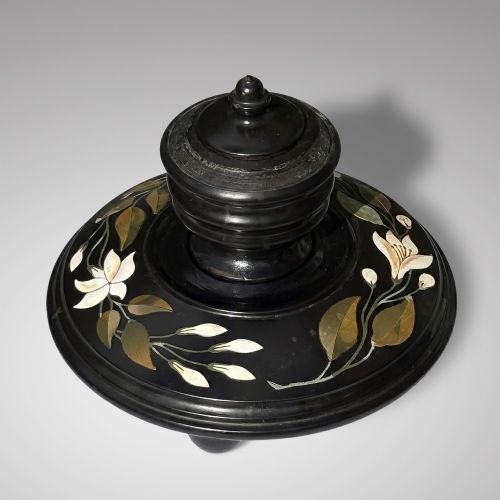
Makers shaped bases from natural stones including Sienna marble, green onyx, Ashford marble, and black marble, sometimes pairing them with prato verde or vert varieties. These stone blocks were cut, polished, and occasionally inlaid with contrasting minerals like lapis lazuli or carved lava cameos.
Metal elements such as gilt bronze, ormolu, brass, and patinated bronze were cast and applied to the stone bases. Artisans secured inkwells, pen trays, and decorative figures using threaded fixings and pins, combining mineral solidity with detailed metalwork.
Marble Desk Inkwell Retail Price Guide 2026
Typical asking prices for marble desk inkwell among the pieces listed under this phrase on Sellingantiques today, from the lower quarter to the upper quarter. They describe what is for sale here now, not the wider market.
Listings feature marble, ormolu, bronze, and onyx alongside specialised stones like lapis lazuli and Ashford marble.
Evaluating craftsmanship and execution
Quality rests in the precision of the stone cutting and the sharpness of the cast metal mounts. Finer pieces display crisp chasing on ormolu and bronze figures, whilst simpler items rely on plain stone blocks with minimal hardware.
The integration of materials dictates distinction, as seen in the careful fitting of inlaid lapis lazuli or the delicacy of cold-painted bronze figures. Harmonious proportions between the marble base and the mounted ink containers distinguish superior commissions from standard production.
Franz Bergmann·Lefebvre of Belgium·Albert Marionnet·Jules Dalou·Zimmermann
The Marble Desk Inkwell Glossary
- Ormolu
- Gilded bronze mounted on decorative objects. This technique creates a rich gold-coloured surface that resists tarnishing over time.
- Grand Tour
- A traditional trip through Europe undertaken by upper-class travellers in the nineteenth century. Souvenirs included architectural models and carved stone inkstands.
- Ashford marble
- A Derbyshire limestone inlaid with mineral fossils and coloured stones. Craftsmen used this material to create intricate floral or geometric patterns on black backgrounds.
- Encrier
- A French term for an inkstand or inkwell. These pieces often incorporate pen rests and multiple ink containers.
- Cold-painted bronze
- A method where bronze sculptures are painted with cold enamel rather than fired in a kiln. This finish requires careful preservation to prevent chipping.
Marble Desk Inkwell: Frequently Asked Questions
How do I clean a marble inkwell?
Dust the stone gently with a dry microfiber cloth and avoid harsh chemical cleaners that can etch the polished surface.
Metal mounts require separate care using a soft brush, keeping moisture away from any exposed stone joints.
Were these used for everyday writing?
These desk sets served in studies, libraries, and offices for daily correspondence using dip pens and bottled ink.
Heavier models remained stationary on large desks while smaller versions were carried between rooms.
How do I identify an Art Deco piece?
Art Deco inkwells typically feature geometric forms, streamlined silhouettes, and materials like green onyx or black marble.
They often incorporate stylized animal figures or crescent moons rather than classical architectural motifs.
What is a Grand Tour souvenir?
Nineteenth-century travellers returning from Italy and France collected local stonework and bronzes to commemorate their journeys.
These inkstands frequently replicated ancient ruins or used regional marbles such as prato verde.