


Marble Candelabra Clock Set
These marble candelabra clock sets bring together a central mantel clock and matching side pieces in white marble, bronze, and ormolu.
Marble Candelabra Clock Set
A marble candelabra clock set forms a matched three-piece garniture designed for the mantelpiece, consisting of a central clock flanked by twin candelabras or urns. When searching for a marble candelabra clock set, buyers encounter substantial domestic assemblies intended to anchor the ornamentation of a nineteenth-century interior. These arrangements draw heavily upon French Louis XVI and Empire design vocabulary, integrating classical symmetry with functional timekeeping.
The compositions on this page stem predominantly from the nineteenth century, including Victorian and Napoleon III periods, alongside occasional twentieth-century iterations. White marble, black slate, and green onyx supply the stony foundation, shaped into pedestals and architectural cases. The matching candelabras replicate the metalwork and motifs of the central clock, creating a unified display for a principal room.
How they were made
Makers constructed these sets by combining heavy natural stone with cast and gilded metals. White marble, siena marble, and slate were cut and polished to form the architectural bodies of the clocks and the bases of the candelabras. Bronze and brass components were cast, chased to refine surface detail, and finished with fire-gilding or ormolu to provide bright golden contrasts against the dark or pale stone.
Movements within the clocks rely on eight-day mechanical gear trains, often incorporating striking mechanisms and visible pendulums behind glass bezels. Enamel dials, frequently signed by the Parisian firms who retailed or produced them, display Roman or Arabic numerals. Candelabra arms were engineered to detach or branch securely from central pedestals, matching the sculptural motifs - such as cherubs or neoclassical foliate scrolls - found on the clock cases.
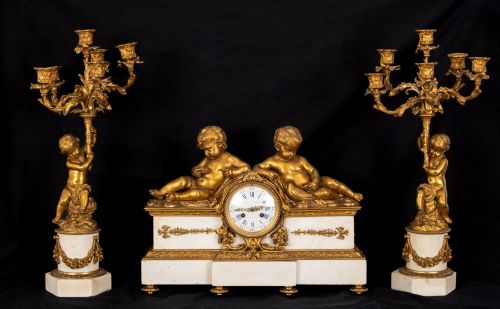
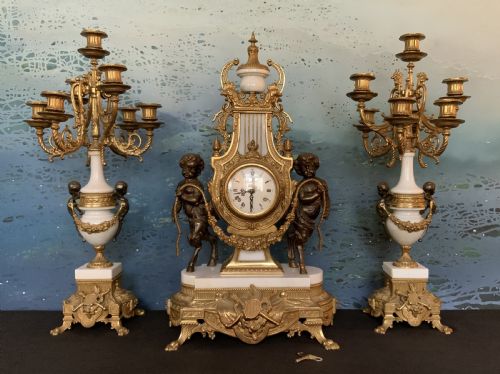
Plump gilded cherubs peer out from behind brass clock faces, permanently assigned to hold aloft heavy candelabra branches.
What varies in quality
The selection of the marble itself dictates the hierarchy of the piece. Uniform white marble without heavy grey veining, or rich siena and green onyx specimens, command greater presence. Furthermore, the inclusion of maker signatures on the clock movements or dials elevates a set above anonymous workshop productions.
H Luppens Paris·AD Mougin Paris·Vincenti
The Marble Candelabra Clock Set Glossary
- Garniture
- A set of matched ornamental objects for a mantelpiece, typically comprising a central clock and two flanking candelabras or vases. This arrangement established balanced symmetry in period reception rooms.
- Ormolu
- Finely chopped gold applied to a bronze base through a mercury amalgamation technique, creating a durable golden surface. It provides the bright metallic highlights characteristic of French decorative arts.
- Clock movement
- The internal mechanical brass mechanism that drives the gears, escapement, and striking train. Eight-day versions require winding roughly once a week.
- Siena marble
- A yellow-brown decorative stone quarried in Italy, featuring dark grey and purple veining. It was favoured during the nineteenth century for high-status Empire and Napoleon III decorative objects.
- Visible pendulum
- A clock design featuring a glazed aperture in the dial or case front, allowing the swinging pendulum to be seen in motion. This added a dynamic visual element to static mantel garnitures.
Marble Candelabra Clock Set: Frequently Asked Questions
How do I clean the marble and ormolu?
Dust the stone and metal surfaces gently with a soft, dry cloth to prevent grime accumulation. Avoid abrasive cleaners or commercial metal polishes, which strip ormolu gilding from the underlying bronze.
For stubborn marks on the marble, use a damp cloth with mild soapy water, drying the stone immediately afterwards. Keep moisture away from the clock movement and dial enamel at all times.
How do I wind an antique clock set?
Insert the appropriate winding key into the small holes on the enamel dial, turning gently until resistance increases. Do not overwind the mainspring, as this can snap the internal steel.
Ensure the clock is standing on a level surface before setting the pendulum in motion. Uneven placement causes the beat to become erratic, leading the mechanism to stop.
Where should I place a garniture set?
These sets suit heavy mantelpieces, large sideboards, or console tables where three pieces can sit safely together. Ensure the surface supports the combined weight of the stone and metal components.
Keep the set away from direct sunlight, radiators, and damp walls to protect the timber backing, marble integrity, and delicate ormolu surfaces.
How do I identify a Louis XVI style set?
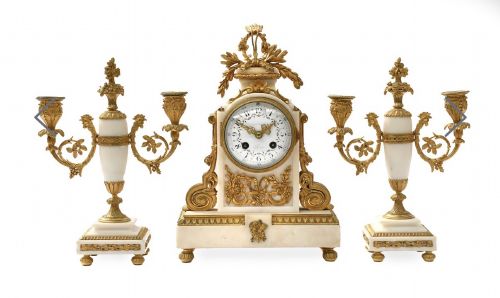
Look for strict classical symmetry, straight tapering columns, urn motifs, and ribbons executed in ormolu. The forms emphasise rectangular and architectural lines rather than the asymmetrical curves of earlier rococo styles.
Many nineteenth-century revival pieces adopt these neoclassical vocabularies, pairing white marble bodies with crisply chased gilt bronze mounts.