
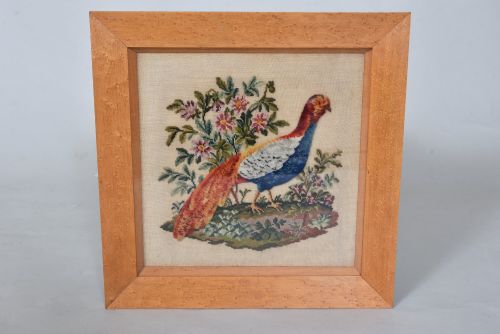
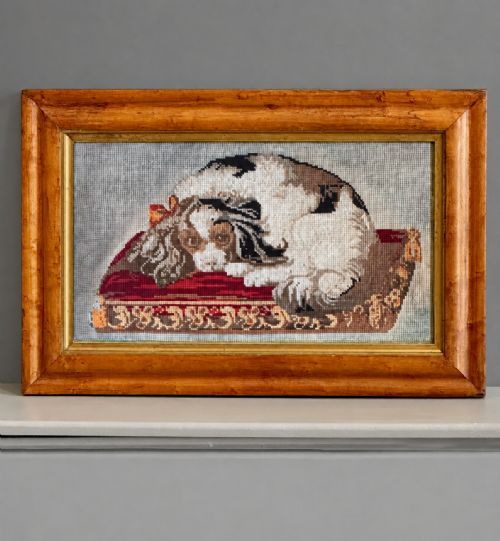


Maple Framed Needlepoint
These maple framed needlepoint pieces bring domestic handiwork and portraiture from the Georgian and Victorian eras straight onto the wall.
Maple Framed Needlepoint
When you search for maple framed needlepoint, you are looking at textile art produced across the Georgian and Victorian periods, housed in wooden surrounds. The surviving examples on this page span wall art, framed textile pieces, and pictorial samplers worked by hand.
The most common form you will meet here is the Victorian or nineteenth-century needlework panel, often depicting animals, birds, or commemorative scenes. These range from Berlin wool work spaniels to sailors' woolies and dated samplers.
Earlier pieces from the Georgian era tend to utilise silk floss or embroidery on linen or canvas, capturing figural subjects like oyster sellers alongside traditional lettering and motifs. Biedermeier birds eye maple frames also appear, framing landscape or portrait orientations with distinctive timber grain.
How they were made
Makers stitched wool, silk floss, and thread onto linen, canvas, or supportive scrim grounds using various embroidery techniques. Plushwork and Berlin work created raised, textured surfaces for subjects such as pheasants and spaniels.
The surrounding timber work relies on maple and burr maple, sometimes exhibiting the distinctive figured pattern known as birds eye. Glazed protection kept the delicate textile fibres safe from dust and atmospheric moisture within the domestic interior.
The current listings combine maple wood frames with silk, wool, and canvas textiles across Victorian, Georgian, and Biedermeier styles.
What varies in quality
Quality rests upon the fineness of the needlework and the fidelity of the imagery. Tightly worked stitches with well-shaded silk or wool demonstrate greater skill than simpler, hurried executions.
The enclosure matters as much as the textile itself, since burr maple and birds eye timber frames with original glass and backing elevate the overall integrity of the piece. Crisp legibility in dated samplers and commemorative works also separates standard output from superior examples.
The Maple Framed Needlepoint Glossary
- Berlin work
- A popular nineteenth-century style of needlepoint worked in coloured wools from charted patterns printed on grid paper. This technique allowed for shaded, pictorial designs like animals and domestic scenes.
- Birds eye maple
- A figure in maple wood where the grain swirls around small spots that resemble bird eyes. It was favoured by cabinetmakers for decorative frames and furniture during the nineteenth century.
- Sampler
- A piece of embroidery produced as a demonstration or test of skill, often featuring alphabets, numerals, and maker details. Nineteenth-century examples frequently record the name of the child and the year of creation.
- Sailors woolie
- A type of embroidered textile art created by nineteenth-century sailors using coarse wool yarns. They typically depict maritime vessels at sea against stitched backgrounds.
- Plushwork
- An embroidery technique that creates a piled, velvet-like surface resembling fur or feathers. It adds dimensional texture to animal depictions.
Maple Framed Needlepoint: Frequently Asked Questions
How old are these needlework pieces?
The pieces span the Georgian and Victorian eras, with dates stretching from the early nineteenth century through to the later Victorian decades.
Specific creation dates sometimes appear directly stitched into samplers or recorded in historical records, whilst stylistic markers help date unmarked pictorial panels.
Are the frames original to the needlework?
Many examples retain their original maple or birds eye maple frames, complete with early glass and backboards. Timber framing protects the delicate textile fibres from environmental wear.
Examining the fixings and the fit within the rebate helps determine if the frame and needlepoint have a long association.
What subjects do the embroideries show?
The imagery covers a broad spectrum of nineteenth-century life and taste, including domestic animals, commemorative military themes, and figural street vendors. Samplers display alphabets, dates, and maker names.
Plushwork pheasants and King Charles spaniels sit alongside maritime woolies and silk embroidered figures.
How should I hang and care for them?
Display these framed textiles away from direct sunlight to prevent the silk and wool threads from fading. Maintaining stable indoor humidity protects both the historic fabrics and the timber frames.
Glass fronts should be cleaned carefully without letting moisture seep beneath the rebate into the textile.