
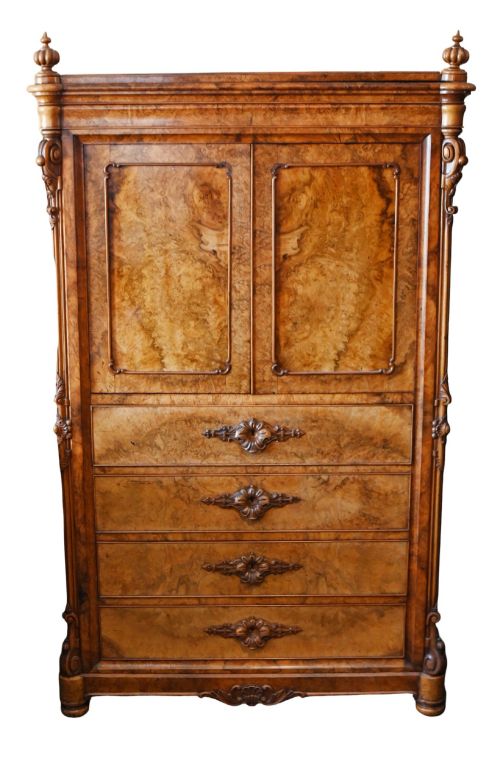
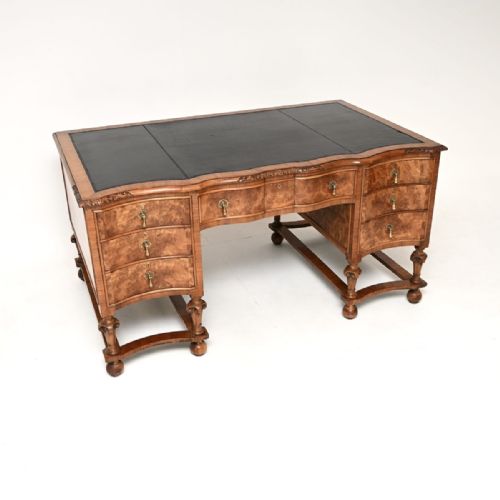
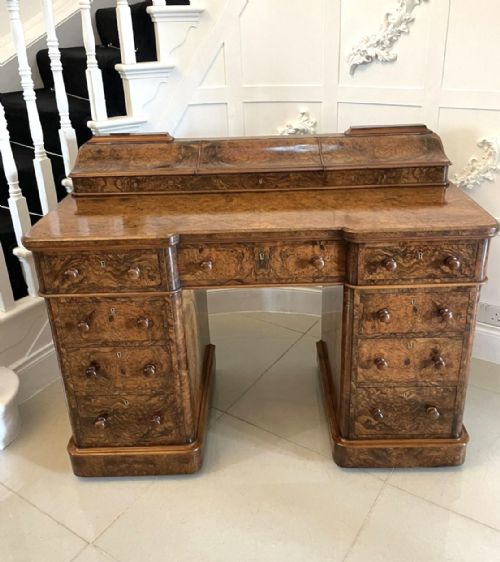


Maple and Walnut Desk
A maple and walnut desk brings rich timber contrast to a study, pairing pale figured woods with deep dark walnut.
Maple and Walnut Desk
A maple and walnut desk combines contrasting timbers to create a striking workspace, appearing in forms such as partners desks, kneehole desks, writing tables, and pedestal desks. You encounter pieces spanning the Victorian era through the Edwardian period, alongside Art Deco examples and twentieth-century items.
The selections frequently showcase the work of prominent London makers using burr walnut, birds eye maple, and solid walnut. These tables often incorporate inset leather or baize writing surfaces, alongside specialised configurations like fifteen-drawer Dickens desks.
How they were made
Cabinet makers constructed these desks using solid walnut and structural framing, overlaid with highly figured burr walnut or birds eye maple veneers to catch the light. Secondary timbers provided internal framing for multiple drawers.
Writing surfaces were inset with tooled leather or baize, while brass handles, keyplates, and sometimes glass tops completed the construction.
Several desks come equipped with their original keys, allowing drawers to lock away secrets after centuries of letter writing.
What varies in quality
The selection of timber grain drives much of the distinction, where richly figured burr walnut and birds eye maple veneers elevate the visual impact above plain stock. Cabinetmaking precision shows in drawer linings, dovetail joints, and the crispness of any carved detailing.
Original fittings such as marked brass hardware, functioning locks with keys, and well-preserved leather writing surfaces separate standard utility items from exceptional workshop productions.
Maple and Co·Maples of London
The Maple and Walnut Desk Glossary
- Burr walnut
- A prized veneer taken from the excrescent growths on walnut trees, showing swirling, intricate knot patterns. It creates a highly decorative surface on drawer fronts and desk tops.
- Partners desk
- A large double-sided desk designed for two people to work opposite one another, featuring drawers and cupboards on both faces. These often incorporate extensive pedestals.
- Kneehole desk
- A compact pedestal desk featuring a central recess for the user's legs, flanked by columns of drawers. This form became popular in the Victorian period.
- Birds eye maple
- A figured timber showing small, swirling dots resembling tiny eyes breaking through the pale surface. It provides a distinct contrast to dark walnut surrounds.
- Dickens desk
- A high-backed writing desk featuring a sloped writing surface with multiple small drawers arranged in tiers above. They offer substantial compartmentalised storage.
Maple and Walnut Desk: Frequently Asked Questions
What is a partners desk?
A partners desk is a large double-sided writing table built with drawers and cupboards on both faces, allowing two people to work opposite one another.
These pieces typically feature leather-inset tops and substantial pedestal bases with considerable storage capacity.
How do I care for a leather top?
Leather writing surfaces require gentle cleaning with a slightly damp cloth and occasional treatment with appropriate leather balms to prevent cracking.
Avoid placing hot cups or excessive moisture directly onto the leather to preserve the gold-tooled borders.
What is burr walnut?
Burr walnut is a decorative wood veneer harvested from the knotty growths of walnut trees, yielding rich and swirling grain patterns.
Cabinet makers utilised these figured veneers on prominent surfaces like drawer fronts and desk tops to create dramatic visual contrast.
Are these desks suitable for daily work?
These desks provide robust writing and working surfaces, though modern computer equipment may require careful placement to protect historic timber.
Many examples offer ample drawer space and sturdy construction well-suited to contemporary study environments.