



Map Globe on Stand
These map globe on stand pieces bring geography into the room, offering a tactile piece of cartography that catches the eye.
Map Globe on Stand
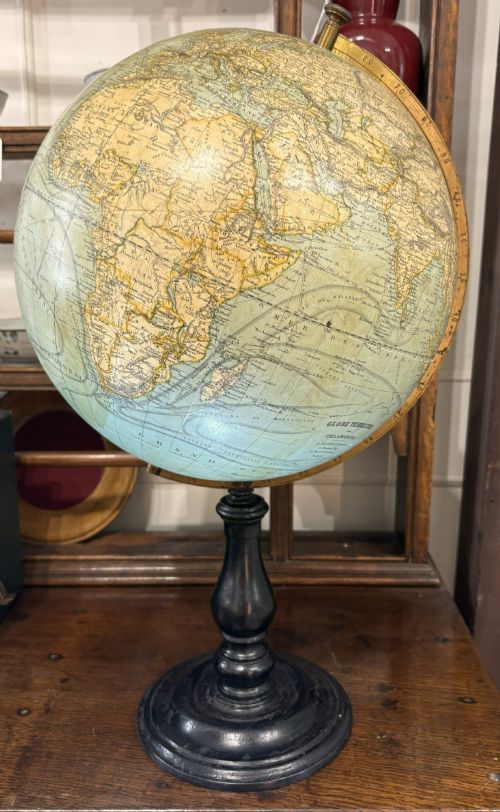
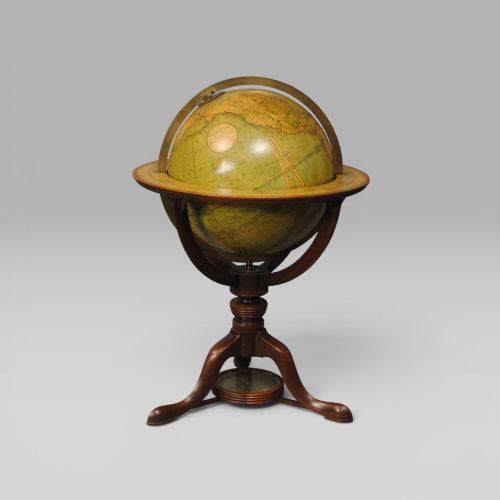
A map globe on stand brings historical cartography directly into the room, serving as both a scientific instrument and a decorative object. Buyers searching this phrase encounter terrestrial globes mounted on various bases, ranging from small desk versions to floor-standing models.
The pieces listed on this page span the nineteenth century, the Edwardian era, and the mid-twentieth century. Forms vary from tiny miniature globes to substantial twelve-inch and thirteen-inch terrestrial globes originating from British, French, and German makers.
How they were made
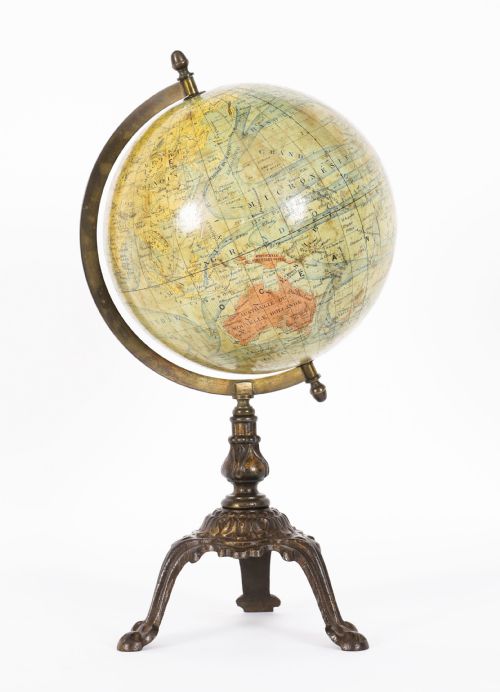
Makers constructed these globes using paper gores applied over plaster spheres, which were then mounted onto stands fashioned from wood, mahogany, or ebonised wood. Metal components, brass meridian rings, and cast iron bases provided the necessary structural support for the rotating spheres.
Cartographic details were printed on paper and hand-applied or lithographed in sections, reflecting the geographical knowledge of periods such as the Victorian era and the interwar years.
Map Globe on Stand Retail Price Guide 2026
Typical asking prices for map globe on stand among the pieces listed under this phrase on Sellingantiques today, from the lower quarter to the upper quarter. They describe what is for sale here now, not the wider market.
Miniature German globes measure just four inches across, proving that mapmakers once packed the entire planet into the palm of your hand.
What varies in quality
Quality in a map globe on stand lies in the clarity of the cartographic printing and the integrity of the paper gores across the plaster sphere. Sharpness of geographical boundaries and legible place names distinguish superior examples from ordinary ones.
The materials and craftsmanship of the stand itself also dictate value, with sturdy mahogany or brass mountings showing superior construction compared to simpler metal or basic wooden bases.
Cary London·Lebegue and Cie·Geographia·M Vivien·Raths Physikalischer
The Map Globe on Stand Glossary
- Terrestrial globe
- A spherical representation of the Earth showing landmasses and oceans rather than celestial constellations. These were produced in various sizes for educational and decorative use.
- Gores
- The lunate paper strips printed with map details that are carefully pasted onto the spherical core. Alignment of these sections determines the precision of the cartography.
- Paper mache
- A composite material formed from paper pulp and adhesive, sometimes utilised for lightweight globe spheres. It provides a stable surface for the applied map gores.
Map Globe on Stand: Frequently Asked Questions
How do I date a globe?
Dating relies on examining the political boundaries, country names, and colonies printed on the paper gores. Comparing the depicted railway lines and capital cities to historical records provides a reliable production window.
Makers often included publication dates near the cartouche, though stands and mountings can sometimes originate from slightly different periods than the sphere itself.
Are desk globes and floor globes different?
Desk globes are scaled smaller to sit comfortably on tables or desks, while floor-standing globes utilise taller wooden or metal stands designed to stand directly on the floor. Both serve the same cartographic purpose but suit different interior spaces.
Floor-standing versions often feature more elaborate stands with compasses or horizon rings built into the base framework.
What materials are stands made from?
Stands utilise traditional woods such as mahogany and ebonised wood alongside cast iron, brass, and standard metal. The choice of material often reflects the period of manufacture and the intended size of the globe.
Heavier cast iron and turned wood provided the stability needed for larger floor-standing models.
How should I clean my globe?
Dusting gently with a dry, soft cloth is the safest method to remove surface particles without damaging the delicate paper gores. Avoid using liquids, damp cloths, or chemical cleaners, as moisture causes the paper to warp and the adhesive to fail.
Keeping the globe away from direct sunlight prevents the printed colours from fading over time.