
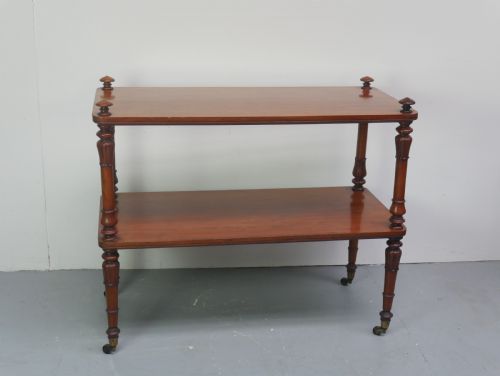


Mahogany Tray Buffet
These mahogany tray buffet pieces are tiered serving stands and dumb waiters built to hold dining room requisites, offering multi-level surface space.
Mahogany Tray Buffet
A mahogany tray buffet, also catalogued as a dumb waiter, tiered stand, or serving table, provides stacked surfaces for glassware and dishes during formal meals. The pieces listed across this page span multiple eras, including Georgian, Regency, Victorian, and Edwardian periods.
The most common forms on this page are two-tier and three-tier revolving or stationary stands. Many examples incorporate raised gallery edges on their circular trays to prevent items from sliding.
Makers and workshops of the 18th and 19th centuries constructed these objects primarily for dining rooms and drawing rooms. The evidence shows prominent attribution to makers such as Maple & Co and Gillows.
How they were made
Cabinet makers utilised solid mahogany and figured Cuban mahogany to turn central columns and shape graduating circular trays. Brass components such as castors appear frequently to support mobile tripod and pillar bases.
Turned and block supports, along with turned knob finials, provide structural rigidity to multi-tiered variants. Structural joinery relies on pegged tenons and threaded wooden spindles to secure the revolving or fixed tiers.
Early dining etiquette required dumb waiters so guests could gossip freely without servants overhearing table conversations.
What varies in quality
The density and figuring of the mahogany timber define the visual weight and richness of an individual piece, with Cuban mahogany marking the upper echelon of grain depth. The precision of the turning on central pillars and finials distinguishes standard workshop production from master cabinet work.
Makers' stamps and paper labels provide definitive attribution, elevating historical interest beyond anonymous regional joinery. Mechanical complexity, such as smooth revolving tiers supported on stable tripod bases with original brass castors, dictates functional refinement.
Maple & Co·Gillows
The Mahogany Tray Buffet Glossary
- Dumb waiter
- A freestanding tiered stand used to hold plates, glasses, and food without requiring a servant at the table. These objects feature two or three graduating circular trays mounted on a central pillar.
- Cuban mahogany
- A dense, dark timber harvested in the Caribbean and prized for its rich grain patterns and durability in 18th-century furniture. Cabinet makers favoured this material for high-status dining furniture.
- Gallery
- A raised wooden border or rim fitted around the edge of a tray shelf to secure glassware and tableware. Galleried edges range from pierced frets to simple turned mouldings.
- Etagere
- A piece of furniture consisting of a set of open shelves for displaying small objects or serving items. This term often appears interchangeably with tiered stands and dumb waiters.
- Tripod base
- A three-legged support structure commonly found beneath the central pillar of dumb waiters and occasional tables. These bases frequently terminate in brass castors for ease of movement.
Mahogany Tray Buffet: Frequently Asked Questions
What is a mahogany tray buffet used for?
These pieces function as tiered serving stations designed to hold bottles, glasses, and tableware within reach of the dining table.
Historically, they allowed diners to serve themselves during courses when domestic staff left the room.
How do I identify a Regency period piece?
Regency examples display classical proportions, often incorporating reeded columns, brass stringing, and heavy tripod bases with brass paw or cap castors.
The timber selection during this era frequently emphasises dark, highly figured mahogany.
Are the tiers on these stands fixed or revolving?
The listings include both revolving and stationary tiers depending on the specific mechanical design chosen by the maker.
Revolving versions typically utilise a central pivot mechanism allowing diners to access items from any seating position.
Where should I place a dumb waiter in a modern room?
These stands fit well beside dining tables, in corners as display surfaces for decorative objects, or as serving tables in living spaces.
Their compact vertical footprint provides multiple tiers of surface area without occupying excessive floor space.