
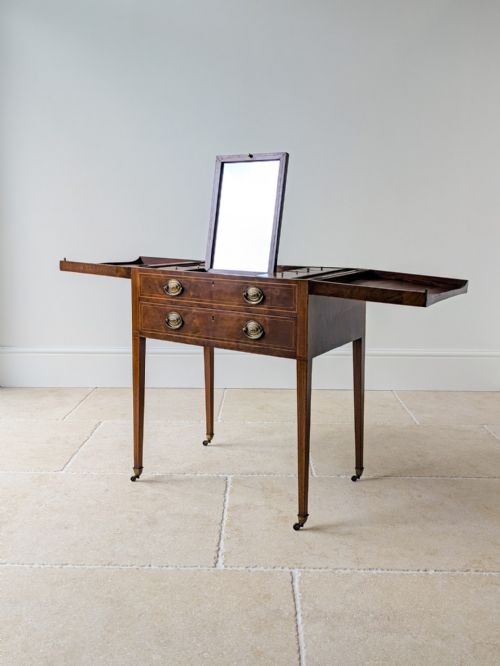


Mahogany Mechanical Writing Desk
These mahogany mechanical writing desks combine ingenious hidden mechanisms with fine cabinetmaking, offering clever solutions for writing and drawing.
Mahogany Mechanical Writing Desk
A mahogany mechanical writing desk brings together clever rising compartments, folding surfaces and adjustable tops within traditional furniture forms. When you search for a mahogany mechanical writing desk, you encounter pieces that transform from simple tables into functional workstations.
The selections span the Georgian and Regency periods through to Edwardian and later revivals, reflecting evolving tastes in domestic organisation. You find architect's tables, library tables and worktables alongside standard writing desks.
Many examples incorporate satinwood inlay, brass fittings and leather inserts, maintaining elegance while concealing their internal complexity. The forms range from compact bachelor's chests to tall riser desks designed for standing or seated work.
Materials and construction methods
Cabinetmakers utilised solid and veneered mahogany, often pairing it with contrasting satinwood stringing and panels. These woods provided a stable, durable foundation capable of housing complex internal ratchets and slides.
Internal mechanisms relied on brass ratchets, pulleys and weights to operate secret rising compartments and adjustable reading slopes smoothly. Fine hardware and leather or velvet writing surfaces completed the construction.
Secret compartments occasionally reveal tiny inkwells hidden so well that owners must search twice to find the pen.
Assessing craftsmanship and execution
The distinction between standard and superior pieces rests upon the precision of the hidden mechanisms and the fluency of their operation. Smooth movement without binding indicates skilled joinery and careful fitting of internal components.
Figure in the mahogany grain, crispness of the satinwood inlay and quality of the brass fittings further separate ordinary items from exceptional works. The integration of functional compartments without compromising the exterior proportions marks superior cabinetmaking.
J.C Vickery of London
The Mahogany Mechanical Writing Desk Glossary
- Metamorphic
- Furniture designed to transform into another form or function through folding, sliding or rising parts. This term describes pieces that shift between a table and a desk.
- Architect's Table
- A specialised form featuring an adjustable top raised on a ratchet to hold drawings at a slanted angle. These tables often include pull-out candle slides and drawer arrangements.
- Satinwood
- A light-yellow timber utilised for contrasting stringing, banding and geometric inlay upon darker mahogany surfaces. It brings brightness and decorative detail to the exterior.
- Ormolu
- Gilded bronze mounts and decorative elements applied to furniture, frequently seen on French revival pieces. This material adds metallic lustre and ornamental contrast.
- Ratchets
- Toothed metal bars and catches that hold adjustable desk tops or reading slopes at specific angles. They enable the mechanical transformation central to these designs.
Mahogany Mechanical Writing Desk: Frequently Asked Questions
How do the mechanical compartments operate?
Internal weights, brass ratchets and sliding tracks allow tops and compartments to rise or shift positions smoothly.
These hidden systems require careful handling to ensure the timber components move without jamming.
What is the difference between an architect's desk and a writing table?
Architect's desks typically feature adjustable inclined tops designed for drawing and large documents.
Writing tables focus on flat surfaces, drawers and internal compartments intended for correspondence.
Where were these desks placed in a historic home?
They sat in libraries, studies and drawing rooms where gentlemen and ladies managed correspondence or design work.
Their dual functionality allowed them to serve as decorative side tables when not in active use.
How do you identify a Georgian piece from later revivals?
Georgian construction relies on period joinery techniques, cabinet timbers and authentic period hardware.
Later Edwardian and revival pieces often exhibit different interior framing methods and machine-cut elements.