
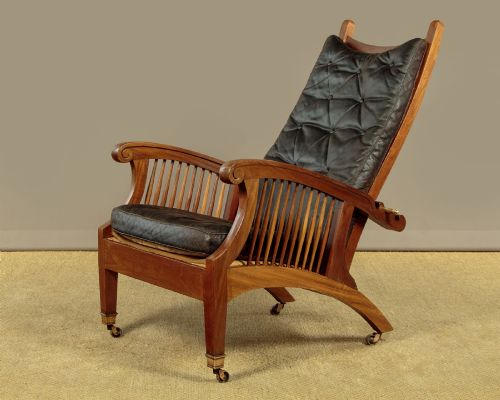
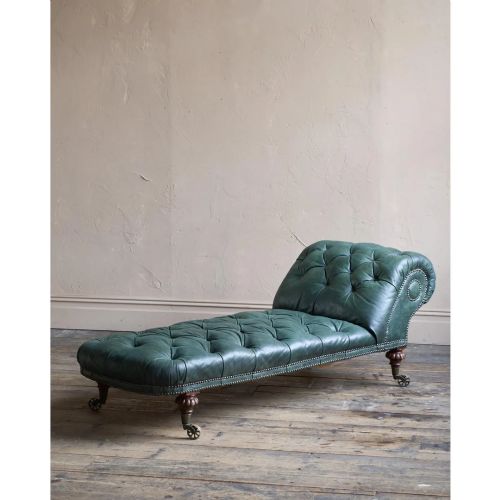
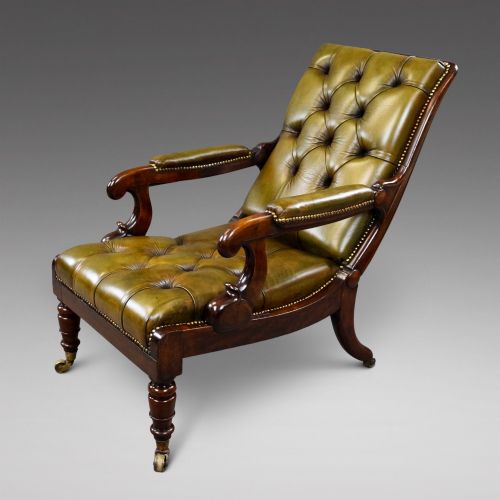
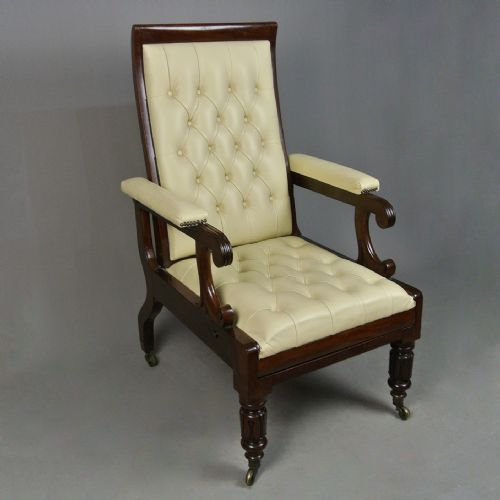


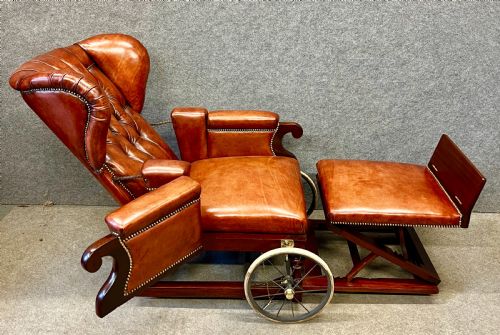
Mahogany Leather Recliner
A mahogany leather recliner offers heavy-duty mechanical comfort in a solid hardwood frame designed for nineteenth-century libraries and invalid rooms.
Mahogany Leather Recliner
When you search for a mahogany leather recliner, you are looking at nineteenth-century seating designed for adjustable comfort, libraries, and convalescent use. These pieces range from substantial library armchairs to reclining chaise longues.
The versions you are most likely to meet on this page date from the Georgian, Regency, William IV, and Victorian periods. They combine rich timber frames with buttoned or plain upholstery and mechanical actions for reclining.
Makers and inventors patented specific mechanisms to alter the angle of the back and seat. You will find forms associated with Regency innovators and Victorian manufacturers alongside colonial plantation daybeds.
How they were made
The structural framework relies on solid mahogany and hardwood, shaped to support complex reclining hardware. Metal studs often secure the leather upholstery to the wooden carcase.
Makers integrated iron and brass components into the frames to operate the mechanical reclining actions. Some variants incorporate caning panels alongside the primary leather hide.
Victorian invalids enjoyed sophisticated convalescing chairs equipped with wheels and reading desks for all-day comfort.
What varies in quality
The sophistication of the internal mechanism dictates the grade of the chair, with patented designs commanding higher regard than standard pivoting backs. Original working hardware distinguishes a superior example from a modified one.
The density of the mahogany timber and the depth of the grain patination reveal the care put into the cabinetwork. High-tier pieces feature robust frames combined with finely tooled leather hides.
Robert Daws London·John Ward
The Mahogany Leather Recliner Glossary
- Bergère
- An enclosed armchair with stuffed or caned sides and a loose cushion. The frame is typically timber.
- Chaise Longue
- An upholstered sofa in the shape of a chair that is long enough to support the user's legs. It appears in both French and colonial styles.
- Metamorphic
- Describing furniture designed to transform into another object, such as a chair converting into a bed or reclining lounge. These pieces use concealed hinges and ratchets.
- Patent
- A government licence protecting an invention, often stamped onto the metalwork of nineteenth-century reclining chairs. It names the designer and secures manufacturing rights.
- Carcase
- The underlying structural framework of a piece of furniture before upholstery and hardware are attached. In these chairs, it is built from dense hardwoods.
Mahogany Leather Recliner: Frequently Asked Questions
How do these reclining chairs operate?
Many nineteenth-century chairs rely on mechanical ratchets and adjustable iron struts hidden within the frame. Users alter the angle of the back by lifting or shifting the arm supports.
Patented designs by makers such as Daws or Ward use specific levers and pulleys to transition the chair into a reclined or convalescing position.
Are chaise longues and armchairs the same?
Chaise longues are elongated seats designed for reclining in a semi-lying position with integrated foot support. Armchairs remain upright seating units intended for reading desks and library tables.
While both share mahogany frames and leather upholstery, the chaise longue offers a continuous horizontal surface for resting.
What periods do these chairs cover?
The selection spans the Georgian, Regency, William IV, and Victorian eras of the nineteenth century. Each period brings distinct turning styles on the legs and variations in the leather buttoning.
Early nineteenth-century examples often feature solid mahogany frames with patent mechanisms, while later Victorian versions include wheel attachments for invalid use.
How do I care for antique leather?
Antique leather requires regular conditioning with appropriate balms to prevent the hide from drying and cracking around the buttoned tufts. Avoid placing the furniture near direct heat sources.
Gentle dusting preserves the original surface patination without stripping the historical finish applied by nineteenth-century upholsterers.