




Mahogany Kidney Dressing Table
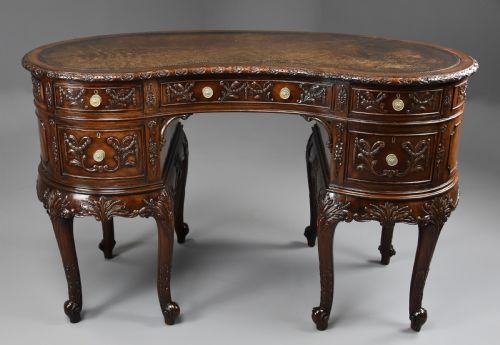
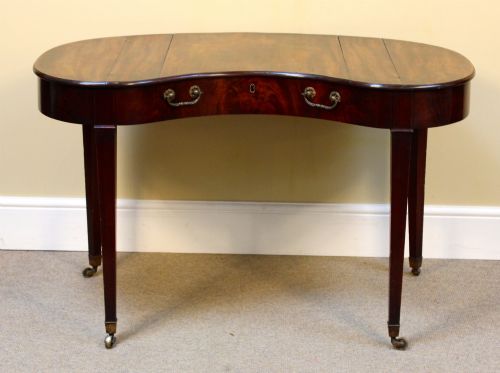
A mahogany kidney dressing table offers a sweeping serpentine curve that fits the body and brings elegance to a bedroom.
Mahogany Kidney Dressing Table
When you search for a mahogany kidney dressing table, you encounter curved writing and dressing surfaces shaped like the organ for which they are named. Most examples on this page date from the Edwardian period, though Victorian and Georgian eras also contribute to the selection.
These pieces function variously as freestanding desks, writing tables, side tables, and dressing tables. The characteristic kidney outline provides a concave front that wraps around the user.
Makers utilised rich timber foundations, often embellishing the writing surfaces with satinwood, boxwood, and fruitwood inlay. The form appears across multiple styles including French Revival and standard Edwardian cabinetmaking.
How they were made
Cabinetmakers built the carcass using solid mahogany and mahogany veneers shaped to the distinctive kidney curve. Secondary timbers provided internal framing for drawers and kneehole compartments.
Surface decoration relied on precision contrasting veneers, incorporating satinwood, boxwood, and fruitwood inlay to create delicate banding and floral motifs. Brass handles and mounts completed the construction of the drawers.
Mahogany Kidney Dressing Table Retail Price Guide 2026
Typical asking prices for mahogany kidney dressing table among the pieces listed under this phrase on Sellingantiques today, from the lower quarter to the upper quarter. They describe what is for sale here now, not the wider market.
Listings span the Edwardian period, the Victorian era, and Georgian times, all utilising mahogany.
What varies in quality
Quality rests in the precision of the curved mahogany framework and the crispness of the inlaid details. Finer pieces display meticulous alignment in the satinwood, boxwood, and fruitwood borders that trace the serpentine top.
The integrity of the structural joinery, the smoothness of the drawer action, and the preservation of the original brass hardware distinguish superior examples from simpler utilitarian versions.
Shapland & Petter
The Mahogany Kidney Dressing Table Glossary
- Kidney shaped
- A curved furniture form featuring a concave front and convex back, designed to partially enclose the user. This ergonomic shape became popular in late Victorian and Edwardian writing furniture.
- Inlay
- A decorative technique where contrasting woods such as satinwood, boxwood, and fruitwood are inserted into recesses in the mahogany surface to form patterns. It creates a flush, smooth finish unlike surface carving.
- Kneehole
- A recessed central space beneath a desk or dressing table designed to accommodate the sitter's legs. Flanking banks of drawers typically enclose this central opening.
- Freestanding
- A piece of furniture finished on all sides, including the back, allowing it to sit away from a wall in the centre of a room. This indicates higher craftsmanship as no surface is left plain.
Mahogany Kidney Dressing Table: Frequently Asked Questions
What is a kidney dressing table?
A kidney dressing table is a curved piece of furniture featuring a concave front designed to fit closely against the user. These tables often incorporate drawers and writing surfaces.
Most examples seen here date from the Edwardian era, constructed in mahogany with decorative inlay.
How do I date a mahogany table?
Dating relies on observing construction methods, timber choice, and decorative styles such as Edwardian inlay or Victorian proportions. Cabinetmaking details shift across the nineteenth and twentieth centuries.
Reference points include the use of satinwood inlay and brass hardware characteristic of specific decades.
Where should I place a freestanding desk?
A freestanding desk is finished on the back, allowing placement in the centre of a room rather than against a wall. This makes the curved mahogany outline visible from all angles.
Ensure adequate clearance around the concave front for comfortable seating.
What woods are used in these tables?
Mahogany serves as the primary timber for the structure and surfaces of these tables. Contrasting woods including satinwood, boxwood, and fruitwood provide decorative inlay.
These material combinations define the aesthetic of Edwardian and Victorian pieces.