




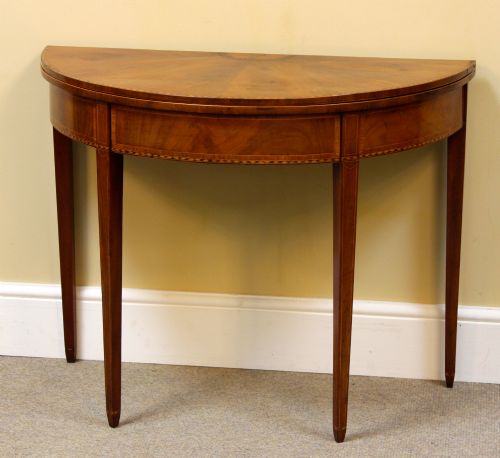


Mahogany Inlaid Demi Lune Table
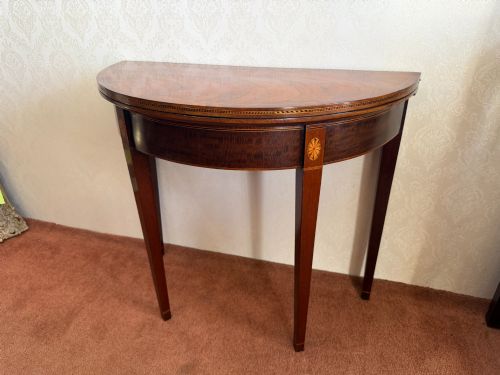
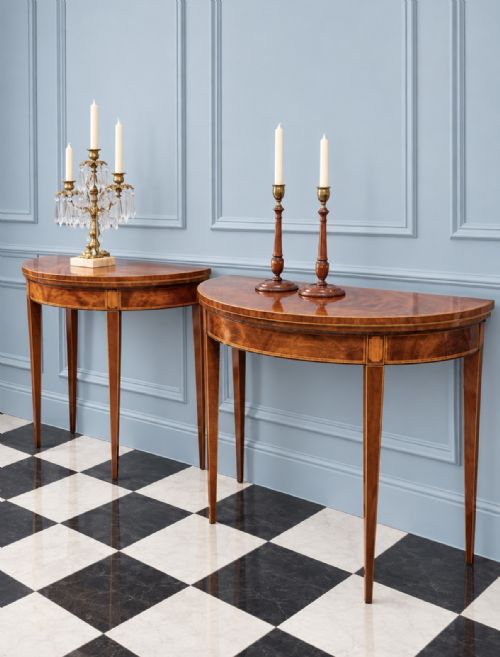
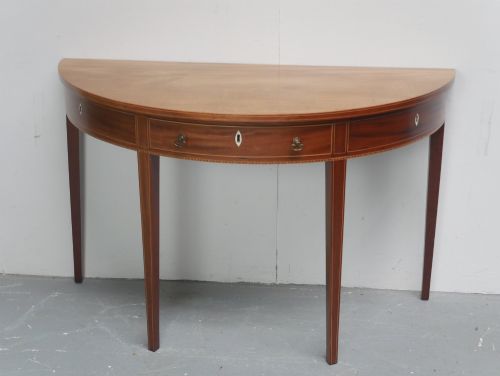
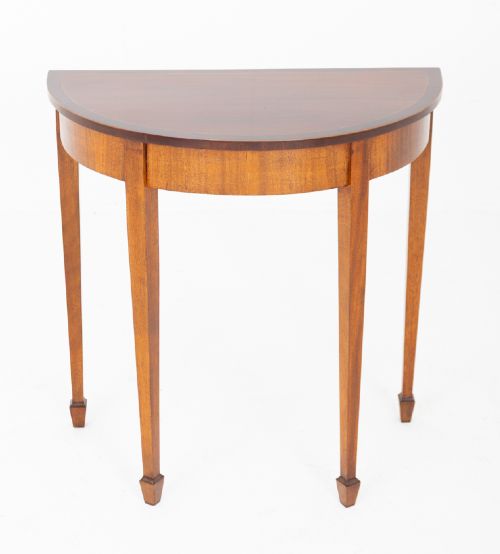
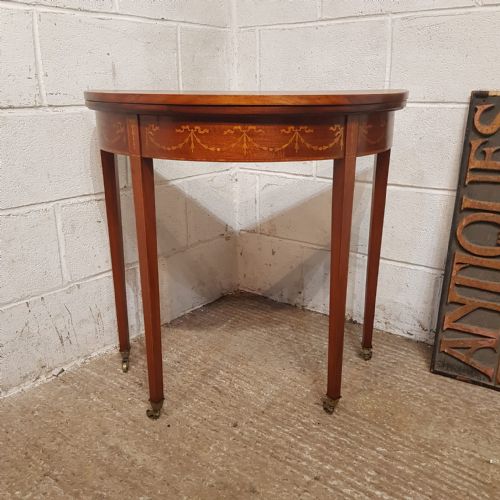
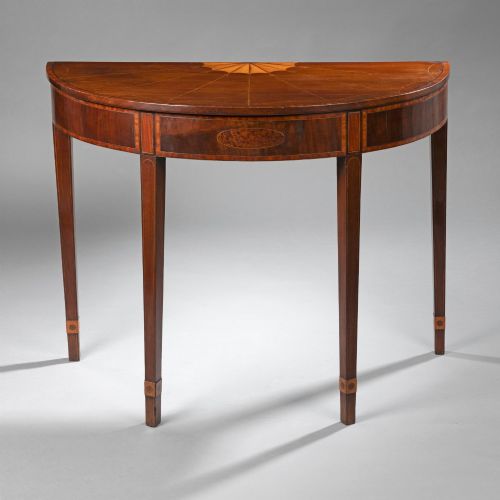
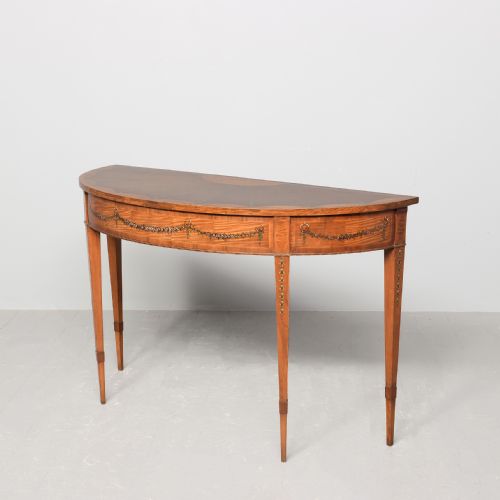
These mahogany inlaid demi lune tables are semicircular half-moon consoles and card tables designed to sit flush against a wall.
Mahogany Inlaid Demi Lune Table
A mahogany inlaid demi lune table is a semicircular piece of furniture designed primarily as a console, pier table, or fold-over games and card table. The form appears most frequently in 18th Century and Georgian pieces, particularly under George III and Sheraton influence, alongside Regency and Edwardian revivals.
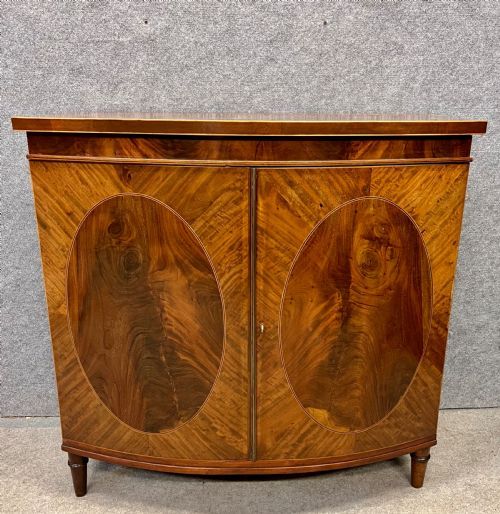
Buyers encounter these half-moon tables configured as tea tables, side tables, serving tables, and occasionally as cabinets or sideboards. The flat back edge places flat against a wall, while the curved front opens or stands as a fixed surface in a hall or drawing room.
How they were made
Cabinetmakers constructed the primary carcase and frames in solid mahogany, frequently pairing it with secondary fruitwoods for structural elements or supporting surfaces. The curved friezes and tops incorporate intricate contrasting details using satinwood, boxwood, and assorted wood inlays to create geometric stringing or neoclassical motifs.
Many examples utilise specialised folding mechanisms for dual-purpose card and tea tables, employing pivoting wooden gates or swing legs to support the hinged top when opened. Surface decoration extends to painted highlights, marquetry, and occasional brass fittings on feet or mounts.
Mahogany Inlaid Demi Lune Table Retail Price Guide 2026
Typical asking prices for mahogany inlaid demi lune table among the pieces listed under this phrase on Sellingantiques today, from the lower quarter to the upper quarter. They describe what is for sale here now, not the wider market.
Card tables often conceal secret storage wells beneath their folding tops, originally intended for hiding stray playing pieces from cheating guests.
What varies in quality
The standard of a mahogany inlaid demi lune table rests on the precision of the cabinetmaking and the crispness of the timber selection. Finer examples display tightly figured mahogany grains matched symmetrically across the semicircular top, flanked by delicate, meticulously fitted boxwood and satinwood stringing.
Construction methods determine durability and grace, notably in the execution of the fold-over hinge actions and the tapering of the legs. Superior pieces retain sharp neoclassical marquetry details and balanced proportions, whereas simpler versions rely on plain mahogany surfaces without inlay.
The Mahogany Inlaid Demi Lune Table Glossary
- Demi-lune
- A half-moon shape used to describe tables with a flat rear edge and a curved front. The profile allows the piece to fit flush against a wall.
- Console table
- A table designed to stand against a wall, often supported by brackets or legs rather than standing independently in a room.
- Card table
- A small folding table intended for gaming, featuring a hinged top that opens to reveal a baize-lined or polished wooden playing surface.
- Marquetry
- Decorative patterns formed by the insertion of various coloured woods, veneers, or shells into a solid wood background.
- Stringing
- Narrow strips of contrasting timber inlaid into shallow grooves on furniture surfaces to create delicate outlines and borders.
Mahogany Inlaid Demi Lune Table: Frequently Asked Questions
What is a demi lune table?
A demi lune table is a semicircular item of furniture built with a flat back to sit directly against a wall. They function as decorative console surfaces or practical fold-over tables for cards and tea.
The half-moon shape emerged strongly in the Georgian period and remained popular through later revival eras. Their compact footprint suits hallways and narrow reception rooms.
How do card tables work?
Card tables feature a hinged top that folds open to double the surface area for gaming or dining. A pivoting rear leg or wooden gate swings out from the frame to support the opened leaf.
Many examples conceal a small well beneath the folding top for storing cards and counters. When closed, the piece reverts to a slim console against the wall.
Where should I place a console?
Consoles fit well in entrance halls, living rooms, and dining spaces where floor space is limited. Their flat rear edge allows them to anchor a wall beneath a mirror or painting.
Pairing a semicircular table with a lamp or decorative ceramic creates a formal focal point. Fold-over versions can remain closed for daily display and open when guests visit.
How do I identify a Georgian piece?
Georgian and George III tables display proportions, hand-cut joinery, and timber characteristics typical of the late eighteenth century. They frequently incorporate fine satinwood and boxwood inlay in neoclassical patterns.
Revival pieces from the Edwardian era emulate these earlier styles using machine-cut veneers and lighter internal framing. Examining the secondary woods and construction reveals the true period of manufacture.