


Mahogany Corner Etagere
A mahogany corner etagere makes clever use of overlooked rooms, offering tiered display surfaces that turn bare angles into practical focal points.
Mahogany Corner Etagere
A mahogany corner etagere provides tiered shelving designed to fit snugly into the intersection of two walls, making efficient use of awkward corners. These pieces function primarily as display stands or open shelving units, holding decorative objects, books, or collections without dominating the floor space of a room.
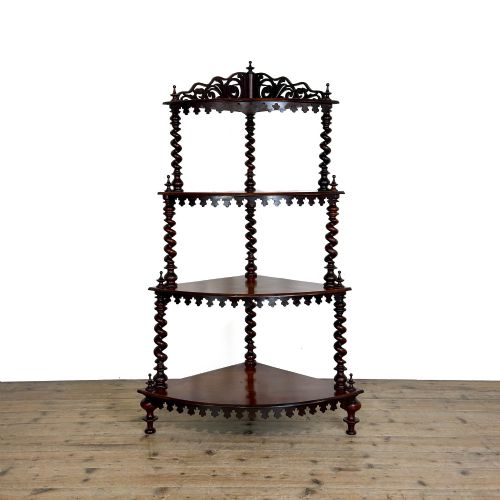
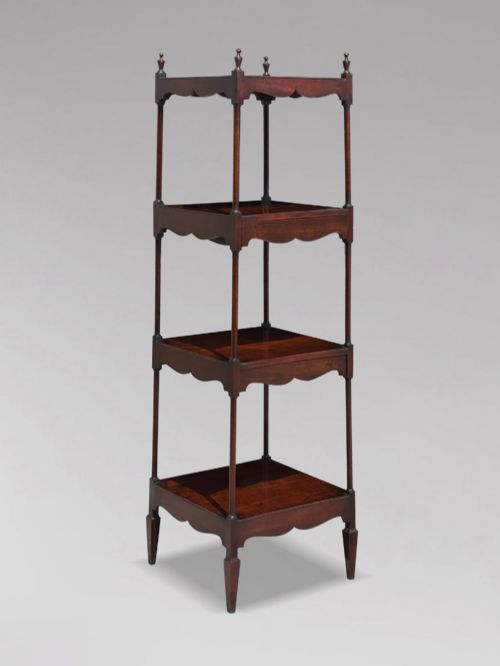
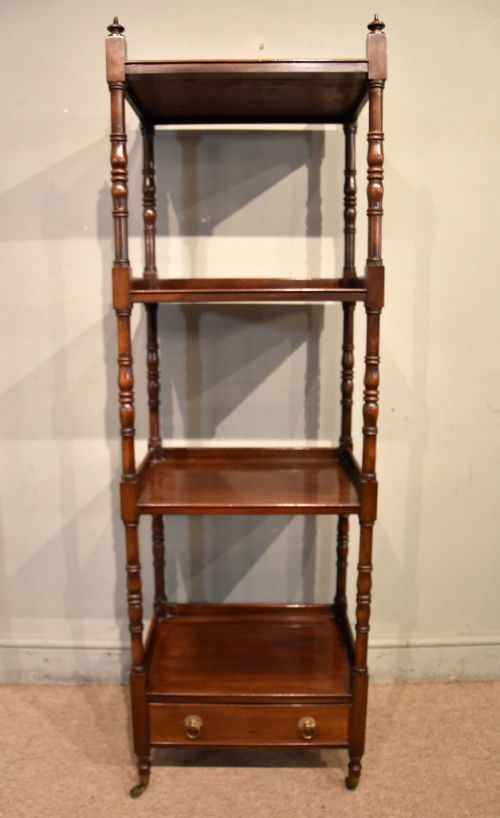
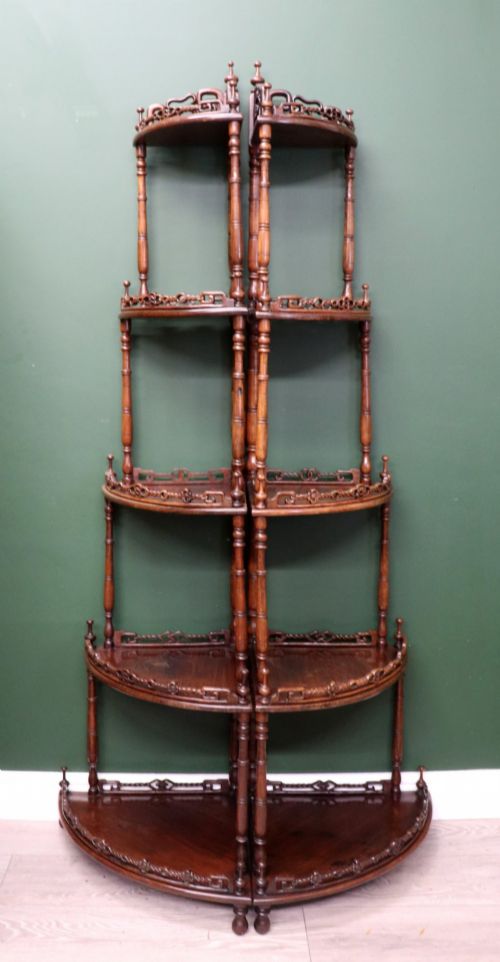
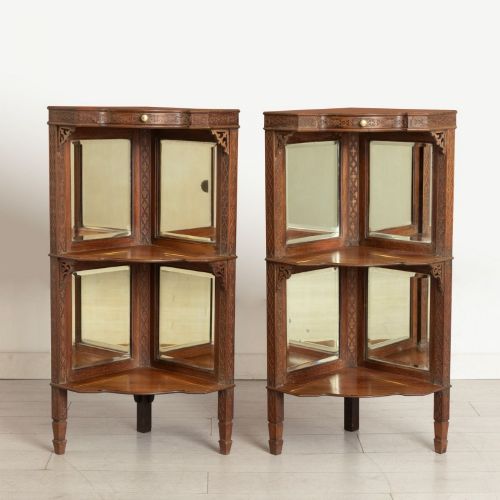
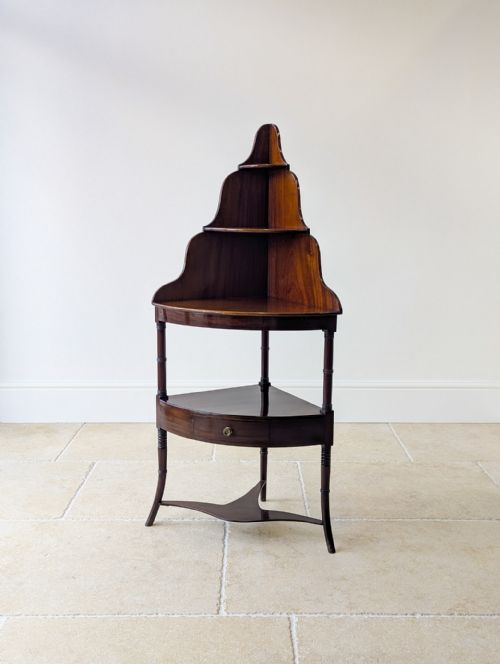
The versions met most frequently on this page belong to the Victorian and Regency periods, alongside earlier Georgian examples. Pieces span from three-tier stands to taller four and five-tier configurations, occasionally featuring enclosed cupboards at the base or glass mirror backs.
Makers and workshops of the 18th and 19th centuries constructed these units specifically for domestic interiors, producing forms that vary from simple tapering stands to elaborate carved and inlaid corner cabinets.
How they were made
Cabinet makers utilised solid mahogany and mahogany veneers as the primary timber, often combining the wood with brass details, glass, mirror glass, or cane. Certain Victorian examples incorporate ebonised wood or satinwood and walnut inlay to accentuate the tiered profiles.
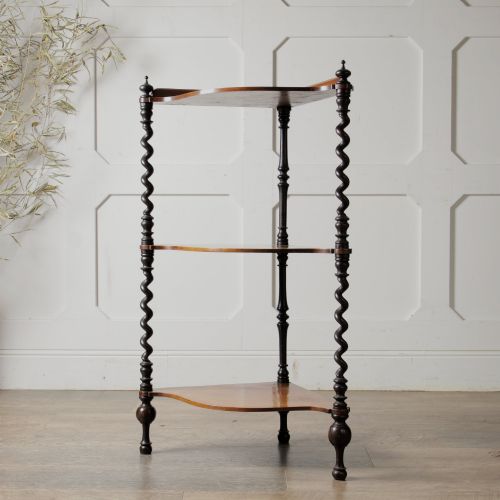
Construction techniques relied on sturdy upright supports, turned uprights like barley twists, and carefully joined shelves designed to bear the weight of displayed items. Structural elements such as A-frame bracing, bow fronts, and serpentine front edges demanded precise woodworking to ensure stability in a corner setting.
Listings span from the 18th century through the Georgian, Regency, William IV, and Victorian periods, showcasing tiered shelving in mahogany, walnut, and ebonised wood.
What varies in quality
Proportion and scale dictate the success of a piece, with smaller compact units or substantial five-tier stands showing greater design ambition than utilitarian variants. The integration of secondary materials like brass hardware and marquetry inlay further elevates the standing of an individual etagere.
Gillows·Edwards & Roberts
The Mahogany Corner Etagere Glossary
- Etagere
- An open piece of furniture with shelves for displaying small objects or ornaments. These tiered stands gained popularity during the Georgian and Victorian eras for parlour and drawing room display.
- Whatnot
- A multi-tiered shelving unit used for books, china, and decorative items. The term emerged in the 19th century to describe these versatile storage and display stands.
- Barley twist
- A carved wooden support column resembling a twisted rope or barley sugar stick. This decorative turning technique appears frequently on Victorian furniture legs and uprights.
- Serpentine front
- A furniture edge or shelf front curved in a wave shape, convex at the centre and concave at the ends. This sophisticated shaping requires skilled woodworking.
- Inlay
- A technique where pieces of contrasting wood, such as satinwood or walnut, are inserted into depressions within the mahogany surface to create decorative patterns.
Mahogany Corner Etagere: Frequently Asked Questions
What is a corner etagere used for?
These pieces provide open tiered shelving designed to fit into room corners, acting as display stands for decorative objects, ceramics, and books.
Historically, they allowed households to utilise empty vertical space in drawing rooms and parlours without obstructing pathways.
How do I date a mahogany etagere?
Dating relies on stylistic markers, timber choice, and construction methods associated with periods such as the Georgian, Regency, and Victorian eras.
Earlier pieces often show simpler tapering forms or fine A-frame construction, while later 19th-century examples incorporate elaborate turning, mirrors, and inlay.
Are all these pieces triangular?
The majority are built specifically to slot into ninety-degree room angles, featuring right-angled backs and curved or straight fronts.
Some variants incorporate bow fronts or serpentine edges to soften the profile when viewed from the room.
Did they always have open shelves?
While most listings show open multi-tiered shelving units, certain examples include enclosed storage at the base.
These hybrid pieces combine display tiers on top with a small cupboard enclosed by panelled doors below.