
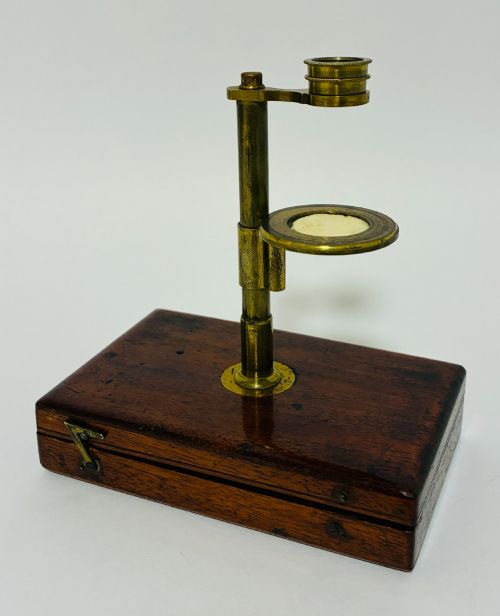


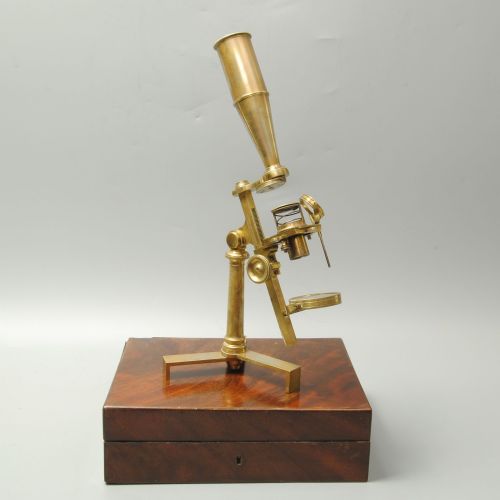


Mahogany Boxed Scientific Instrument
These mahogany boxed scientific instrument examples combine precision brass engineering with fitted timber housing for field or laboratory work.
Mahogany Boxed Scientific Instrument
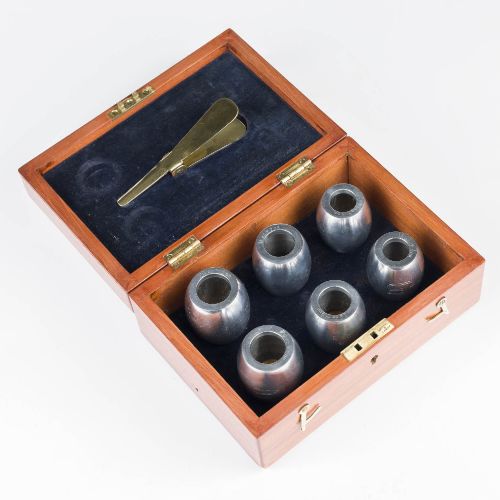
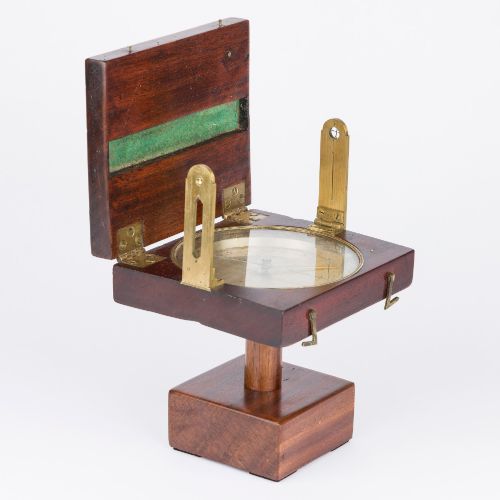
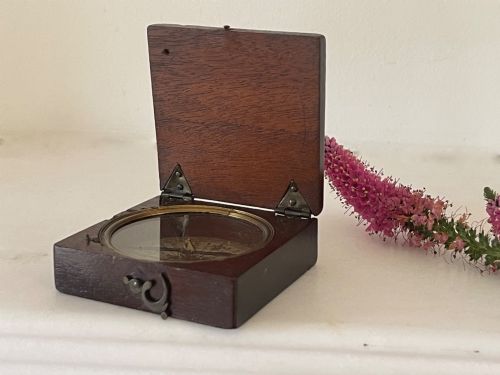
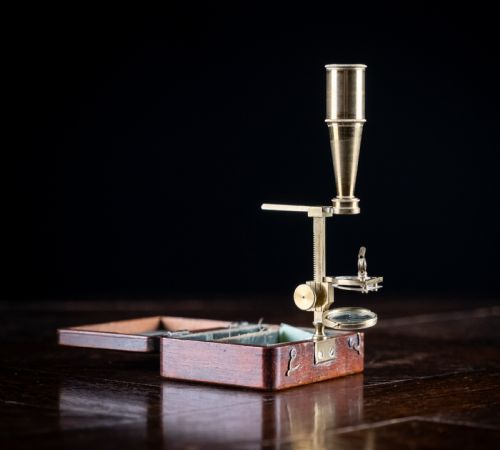
A mahogany boxed scientific instrument represents precision engineering housed in protective timber casing for travel, fieldwork, or laboratory use. Buyers seeking a mahogany boxed scientific instrument encounter field microscopes, surveyors' compasses, and specialist measuring sets spanning the Georgian, Victorian, and Edwardian periods.
The selection ranges from navigational compasses and portable chondrometers to medical examination sets and slide cabinets. Pieces originate from makers across London, Newcastle, Leeds, and international workshops, dating from the early nineteenth century through to the mid-twentieth century.
Materials and construction
Makers constructed the outer enclosures primarily from dense mahogany, often fitted with brass hinges, carrying handles, and internal velvet or paper linings to cushion delicate components. The instruments themselves combine cast and turned brass, glass lenses, steel needles, and metal scales.
Fitted interiors utilise purpose-built wooden blocks and partitions to secure each component during transport. Exterior surfaces receive a polished finish, while instrument dials feature engraved paper, silvered brass, or enamel markings.
Listings feature scientific instruments across the 1800, 1850, Victorian, 1890, 1900, 1920, 1930, and 1940 periods.
Judging quality
Quality rests in the precision of the mechanics, the integrity of the fitted wooden case, and the completeness of the original components. Superior examples retain matching serial numbers across the instrument and its housing, alongside signed maker details on dials and plates.
The sophistication of the internal layout and the weight of the brass components distinguish high-grade professional apparatus from standard trade versions. Finer cabinets feature numerous dovetailed drawers and original locking mechanisms with working keys.
De Grave Short and Co·G Davis of Leeds·Cary London·L Casella and Co·Robert Brettell Bate·Samuel Porter·Cooke Troughton and Simms·Henri de Magnac·Stanley London·Oertling·Swift and Son·F Robson Newcastle·John Lilley and Son London
The Mahogany Boxed Scientific Instrument Glossary
- Chondrometer
- An instrument used to determine the density or weight of grain. It typically includes a balance beam and a measuring cylinder housed within a fitted wooden box.
- Hydrometer
- A device for measuring the specific gravity of liquids based on buoyancy. Sikes sets include weighted brass floats and ivory or metal sliding thermometers.
- Barograph
- A recording barometer that plots atmospheric pressure over time onto a rotating drum chart. The mechanism relies on stacked metallic vacuum capsules connected to an inked arm.
- Clinometer
- A tool for measuring angles of slope, elevation, or depression with respect to gravity. Surveyors and engineers mounted these onto precision levels.
- Artificial horizon
- A device used in navigation to provide a horizontal reference plane when the natural horizon is obscured. Black glass sets reflect starlight or sunlight to calculate altitude.
Mahogany Boxed Scientific Instrument: Frequently Asked Questions
What are mahogany boxed scientific instruments?
These pieces are portable measuring, navigating, and observational devices housed in fitted wooden cases. They include compasses, microscopes, barographs, and meteorological tools.
Makers built them for professionals who required accurate readings in the field, at sea, or in the laboratory.
How do I identify the period of an instrument?
Dating relies on maker signatures, address details, material choices, and style cues. Georgian and early Victorian pieces often feature hand-engraved script and polished mahogany.
Later nineteenth and twentieth-century items introduce standardised production methods, serial numbers, and distinct industrial finishes.
Were these items used outdoors?
Many of these instruments were designed specifically for travel, exploration, and field surveys. Surveyors, doctors, and navigators carried them across remote landscapes and aboard ships.
The robust mahogany casing protected the sensitive brass and glass components from rough handling during transit.
How should I display a cased instrument?
These pieces suit placement on desks, tables, or within dedicated collector cabinets. Keeping the wooden exterior conditioned and out of direct sunlight preserves the timber and brass.
Opening the case occasionally allows viewers to examine the fitted interior and the instrument mechanics without exposing the surfaces to excess dust.