
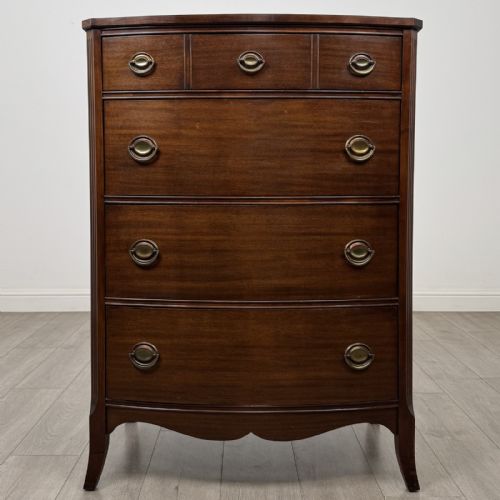
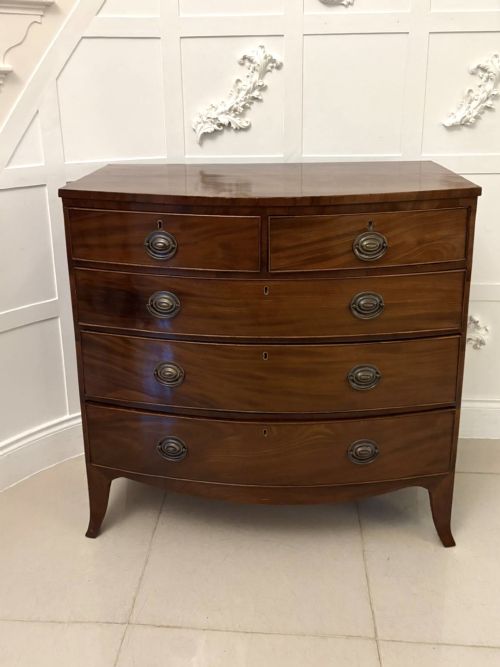
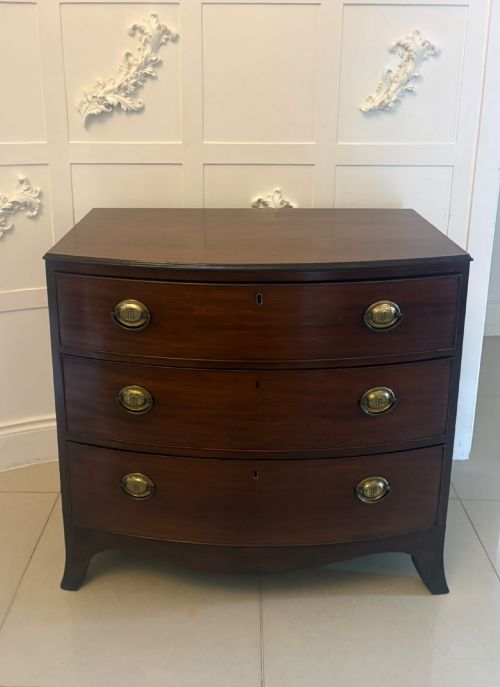
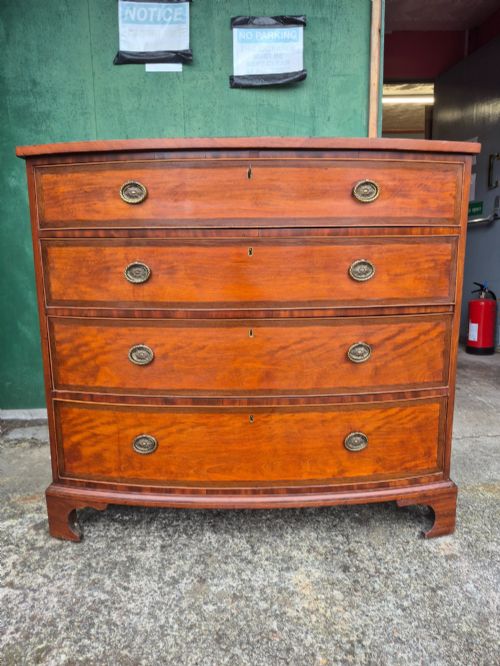
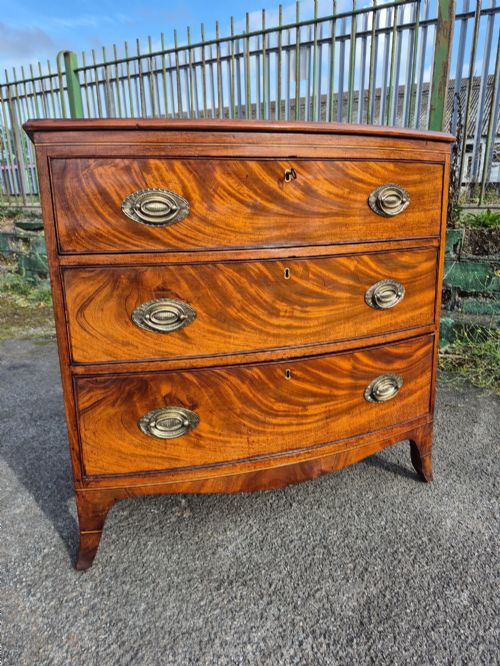
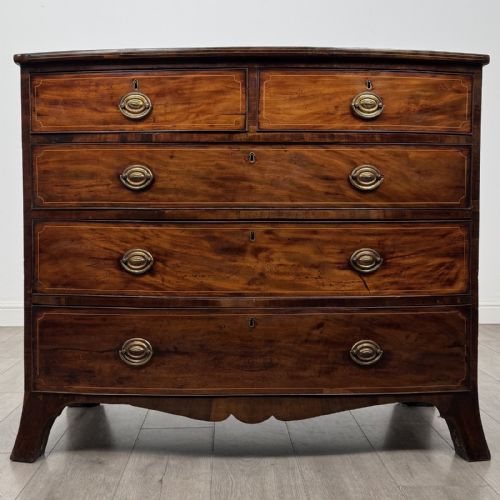
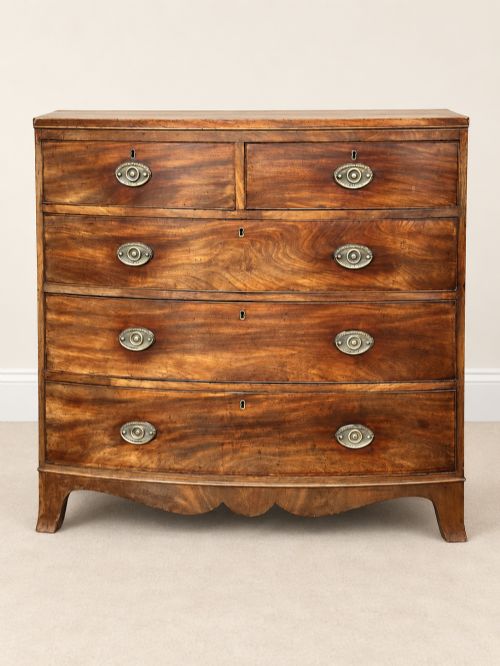
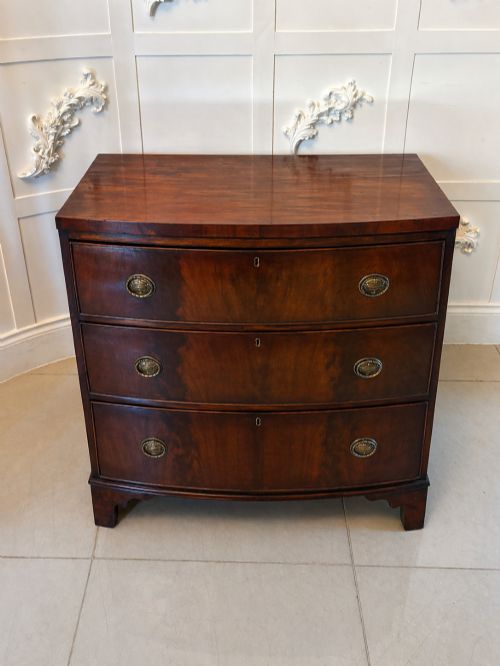
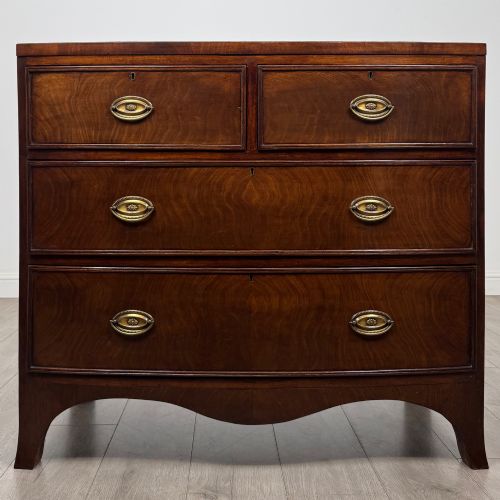
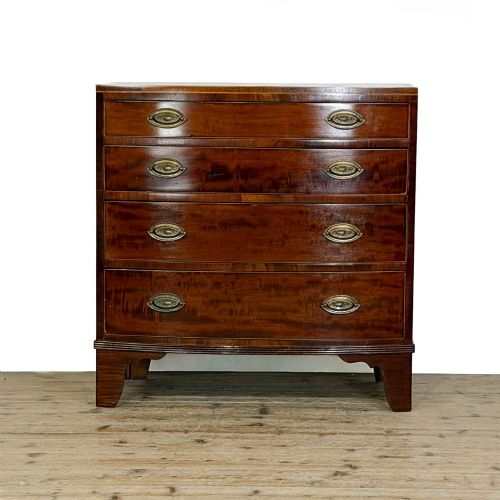

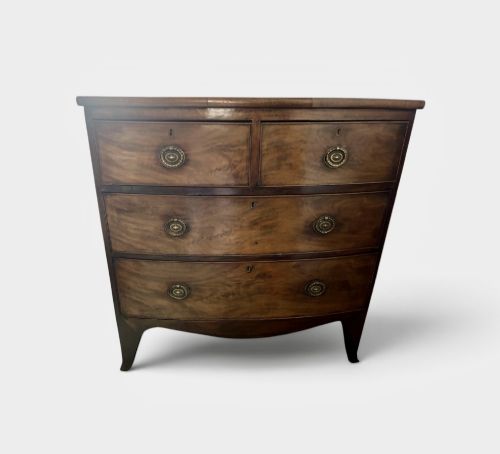
Mahogany Bowfront Chest Drawers
A mahogany bowfront chest drawers offers a curved facade and deep interior capacity, bringing practical storage and rich wood grain into a room.
Mahogany Bowfront Chest Drawers
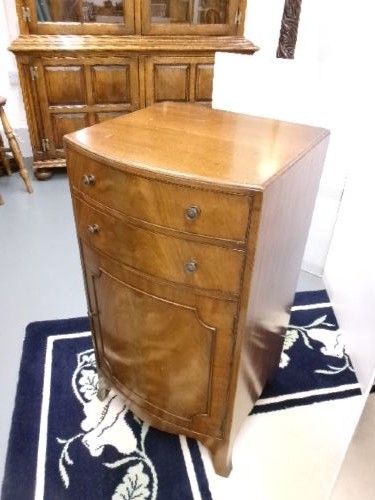
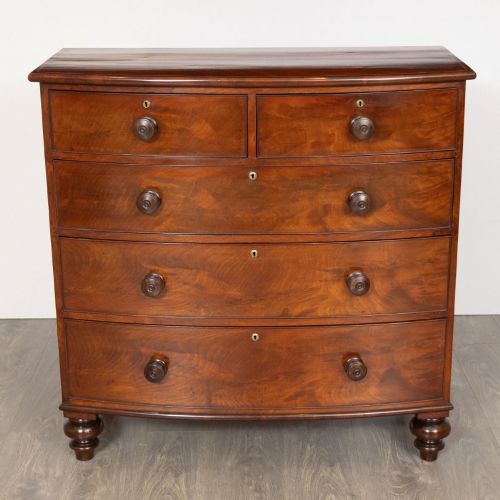
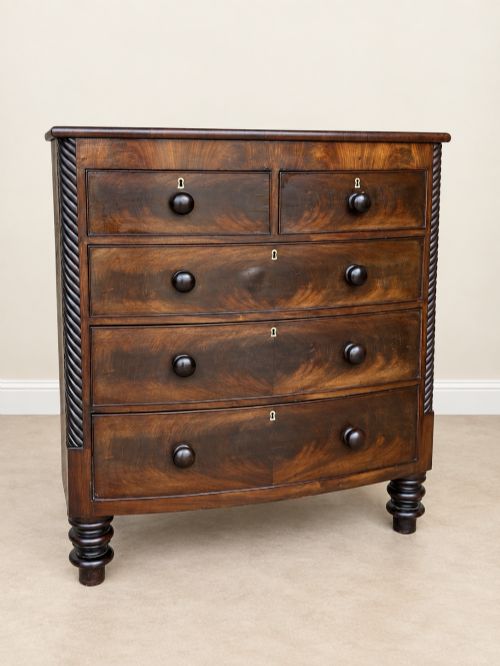
A mahogany bowfront chest drawers presents a convex curved front that projects outward, softening the rigid angles typical of standard rectangular furniture. Pieces spanning the Georgian, Regency, and Victorian periods appear regularly, alongside examples from the early twentieth century.
The most common format on this page is the compact or full-sized chest featuring stacked graduated drawers, often supported on bracket feet or short turned legs. Variations include smaller bedside versions, narrow proportions, and occasional tallboy or chest-on-chest configurations.
Origins stretch across English and Scottish workshops, with occasional regional variations such as Welsh designs featuring secret compartments. The curved profile demands precision joinery, making these items a staple of formal domestic interiors since the late eighteenth century.
Construction materials and techniques
Cabinet makers utilised solid mahogany and applied flame mahogany or satinwood veneers to the curved drawer fronts to create striking grain patterns and contrasting borders. Secondary timbers such as pine and oak commonly form the drawer linings, carcase backs, and internal framing.
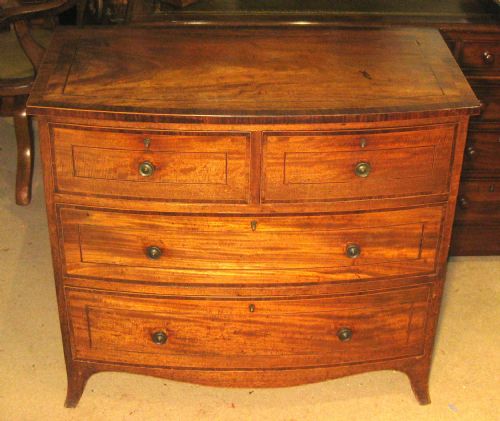
The characteristic curved drawer fronts were shaped from solid timber or built up using laminated layers, then carefully fitted to curved drawer blades to ensure smooth operation. Crossbanding and stringing lines in lighter woods like satinwood frequently accent the edges and top surfaces.
Brass hardware, including ring pulls or shaped backplates, fastens the drawers, while fine dovetail joints secure the drawer construction. Secondary woods remain hidden behind the primary mahogany facades, demonstrating traditional carcase assembly methods.
Design styles represented across the inventory include Georgian, Regency, Victorian, and Edwardian periods, alongside miniature and sideboard variations.
Evaluating craftsmanship and distinction
The choice of wood veneer dictates visual impact, with deeply figured flame mahogany and crisp satinwood banding marking out superior examples from plainer stock. Figuration that matches symmetrically across the drawer fronts indicates deliberate selection by the maker.
Proportion and scale separate standard items from finer regional or period pieces, particularly where narrow footprints or diminutive sizes are maintained without losing structural integrity. Refined details like graduated drawer depths and original brass handles elevate the overall execution.
The precision with which the curved drawer fronts meet the surrounding frame reflects the skill of the original workshop. Clean lines, tight dovetailing, and intact secondary timbers preserve the structural lineage of the piece.
The Mahogany Bowfront Chest Drawers Glossary
- Bowfront
- A convex curving front profile that projects outward from the centre, designed to soften the silhouette of a case piece.
- Flame mahogany
- A veneer cut from the branch forks of the mahogany tree, displaying a distinctive feather-like or flame-like pattern.
- Satinwood
- A hard, yellowish wood utilised for contrasting stringing, banding, and inlay work on fine cabinet furniture.
- Crossbanding
- A strip of veneer laid perpendicular to the grain of the primary surface, forming a decorative border around drawer fronts or tops.
- Graduated drawers
- A sequence of drawers that decrease in depth from the bottom to the top of the chest, improving the visual balance.
- Caddy top
- A tabletop style featuring a raised, moulded edge that echoes the profile of traditional tea caddies from the period.
Mahogany Bowfront Chest Drawers: Frequently Asked Questions
How do I date a mahogany bowfront chest drawers?
Dating relies on examining construction traits, timber selection, and hardware styles across different eras. Georgian and Regency pieces typically show hand-cut dovetails and specific leg forms, whereas Victorian and Edwardian examples introduce machine-sawn elements and different secondary woods.
Secondary timbers inside the carcase, such as oak or pine, also offer clues to origin and period. Comparing the overall proportions against known stylistic shifts helps narrow down the decade of manufacture.
Where should I place a bowfront chest in my home?
The curved profile makes these chests well-suited for hallways, landings, or bedrooms where projecting corners might obstruct narrow walkways. Their decorative grain patterns also allow them to function as focal points in living rooms or studies.
Placing the chest away from direct heat sources and strong sunlight protects the mahogany finish and delicate veneers from drying out or fading over time.
How do I care for antique mahogany veneer?
Routine maintenance involves dusting with a soft, dry cloth and avoiding silicone-based polishes that can degrade the historic finish. Maintaining stable room humidity prevents the wood veneers from lifting or cracking along the curved surfaces.
Applying a traditional beeswax occasionally helps nourish the timber and preserve the natural depth of the polished mahogany surface.