
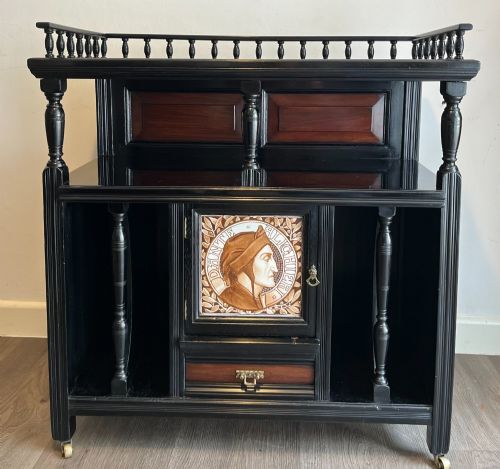
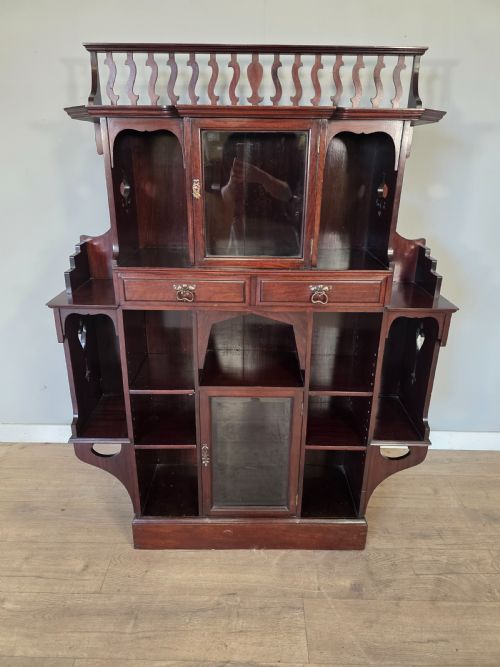
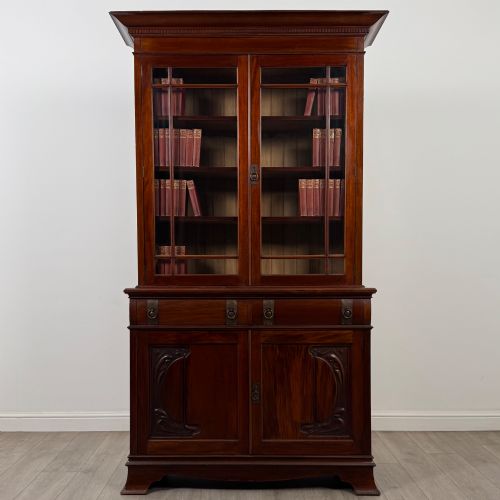
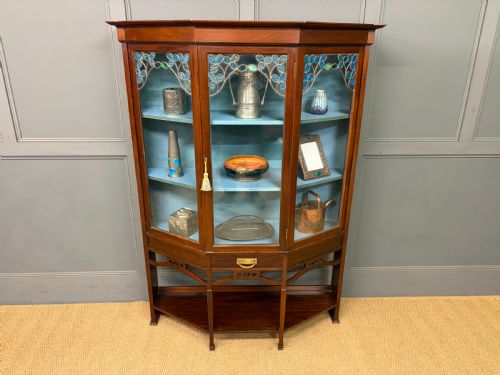


Mahogany Arts Crafts Bookcase
These mahogany arts crafts bookcase examples combine utility with honest design, offering sturdy shelving and distinct movement details for your library or study.
Mahogany Arts Crafts Bookcase
A mahogany arts crafts bookcase brings together the dense grain of traditional timber with the functional simplicity championed by late nineteenth and early twentieth century makers. When you search for this phrase, you encounter pieces ranging from compact revolving models to tall display cabinets and wall hanging shelves.
The versions most frequently met on this page date from the Edwardian era and around nineteen hundred, reflecting a period when cabinet makers moved away from heavy Victorian ornamentation towards cleaner structural lines. Alongside standard open bookcases, the selection includes side cabinets, breakfront forms, and waterfall shelving with distinct regional character.
Makers of these items utilised mahogany as a primary carcase material, often pairing it with contrasting inlays, glass panels, or brass hardware. Whether housing a modest collection of volumes or displaying ceramics behind glazed doors, these pieces serve as practical furniture grounded in historical craftsmanship.
Materials and construction methods
Cabinet makers built these pieces using solid mahogany and mahogany veneers over secondary timbers, selecting boards for rich grain patterns and deep warm tones. The construction frequently incorporates handcrafted joinery such as dovetailing in the drawer boxes and pegged mortise and tenon joints in the main framework.
Decoration relied on contrasting materials rather than excessive carving, with wood inlay, satinwood stringing, and ebonised details applied to flat surfaces. Metal accents in copper and brass appear on hinges, handles, and escutcheons, while glass is fitted into doors for display cabinets and revolving book stands.
Listings feature mahogany, brass, glass, wood inlay, copper, satinwood, ebonised wood, and ceramic elements across multiple forms.
Separating standard pieces from exceptional examples
Quality in these items rests upon the integrity of the timber selection and the precision of the cabinet maker's handiwork. Superior examples display carefully matched mahogany grain across the front elevation and refined execution in any inlaid decorative motifs.
Structural robustness distinguishes finer pieces from ordinary production, visible in tight joints, smooth operation of revolving mechanisms, and unwarped doors. The presence of documented workshop attribution or original hardware elevates an item above standard utility furniture of the period.
Lambs of Manchester·Shapland and Petter
The Mahogany Arts Crafts Bookcase Glossary
- Arts and Crafts
- A design movement spanning the late nineteenth and early twentieth centuries that emphasised handcraftsmanship, simple forms, and the quality of materials. It rejected mass production in favour of traditional guild methods.
- Revolving bookcase
- A compact shelving unit mounted on a rotating base that allows access to books from all sides. These pieces often feature slatted sides or inlaid tops.
- Waterfall bookcase
- A set of open shelves where each tier steps back progressively from bottom to top, creating a profile resembling falling water. This form was popular for display and smaller volumes.
- Breakfront
- A cabinet or bookcase whose central section projects forward from the flanking wings. This architectural arrangement adds visual depth to larger storage furniture.
- Inlay
- A technique where pieces of contrasting wood, such as satinwood, or other materials are inserted into recessed portions of the mahogany base to form decorative patterns.
Mahogany Arts Crafts Bookcase: Frequently Asked Questions
What periods do these bookcases cover?
The pieces span from the late nineteenth century through the Edwardian era up to the nineteen twenties. This encompasses Victorian Gothic, Aesthetic Movement, and Art Nouveau influences.
Most examples cluster around nineteen hundred and the Edwardian period, capturing the peak years of the movement.
How do revolving bookcases function?
Revolving book stands sit on a concealed central pivot mechanism fitted with ball bearings for smooth rotation. This allows users to access a considerable number of volumes from a stationary seating position.
They appear in both table-top and floor-standing heights, often constructed in mahogany with slatted or pierced sides.
What woods are used besides mahogany?
While mahogany serves as the primary timber, makers incorporated satinwood and ebonised wood primarily for contrasting stringing and decorative inlay work. Secondary timbers appear in internal drawer linings and hidden framing.
Metal elements in copper and brass complement the wood tones on hinges and handles.
How should I care for mahogany furniture?
Keep the wood away from direct sunlight and steady sources of heat to prevent the mahogany from drying out or fading. Dust gently with a dry, soft cloth and avoid silicone-based polishes.
Maintain consistent indoor humidity levels to preserve the stability of the timber and any inlaid decoration.