


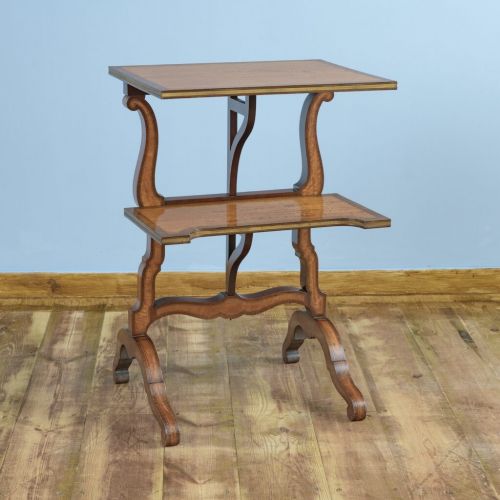


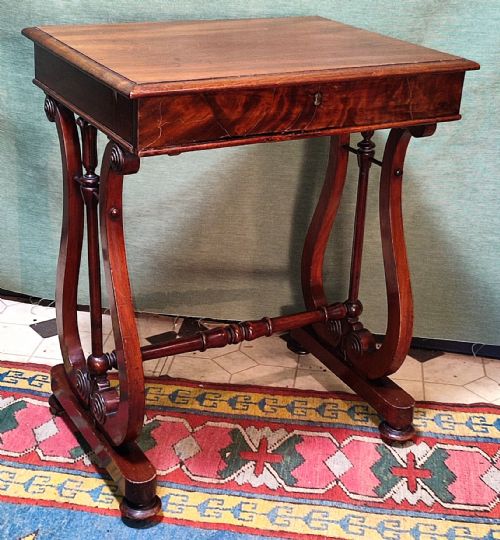


Lyre Leg Occasional Table
A lyre leg occasional table brings neoclassical grace to a room, offering functional surface space supported by characteristic scrollwork pillars.
Lyre Leg Occasional Table
When you search for a lyre leg occasional table, you encounter compact furnishings designed for flexible use in nineteenth and early twentieth century interiors. These pieces appear in forms such as sofa tables, card tables, tea tables, and nested sets, alongside standalone occasional tables.
The defining characteristic is the lyre-shaped support pillar, echoing ancient Greek musical instruments. On this page, you are most likely to meet mahogany variants from the nineteenth century and the Edwardian era, often featuring drop leaves or folding tops.
Makers and workshops utilised various aesthetic movements, ranging from Regency and William IV classicism to Biedermeier simplicity and Chinoiserie decoration. Each form serves a practical purpose while displaying the distinct scroll motif beneath the tabletop.
Materials and construction
Makers constructed these tables primarily using solid timbers and veneers, with mahogany forming the basis of many nineteenth-century and Edwardian pieces. Craftsmen applied flame mahogany veneer and birds eye maple to create striking surface patterns across table tops.
Inlaid details incorporated boxwood and satinwood to provide sharp contrast against darker woods. Specialised finishes like black lacquer appeared alongside brass mounts and Boulle-work to complete decorative schemes on specific tables.
Lyre Leg Occasional Table Retail Price Guide 2026
Typical asking prices for lyre leg occasional table among the pieces listed under this phrase on Sellingantiques today, from the lower quarter to the upper quarter. They describe what is for sale here now, not the wider market.
Listings feature pieces spanning the nineteenth century through to the early twentieth century, incorporating periods like Regency, Edwardian, and Biedermeier.
Judging quality in lyre tables
The standard of a lyre leg occasional table rests on the crispness of the carved scrollwork and the selection of timber veneers. Superior pieces display finely figured grain patterns, such as flame mahogany or burr oak, matched carefully across the surfaces.
Construction methods also separate standard production from finer cabinet work, visible in the precision of inlaid boxwood or satinwood stringing. The stability of the central lyre supports and the integration of folding or drop-leaf mechanisms reveal the original maker's skill.
Maison Giroux·Andrew Thomson & Sons
The Lyre Leg Occasional Table Glossary
- Lyre form
- A central support shaped to resemble an ancient Greek lyre instrument. This scrollwork design defines the structural silhouette of the pedestal.
- Sofa table
- A rectangular occasional table traditionally designed to stand directly in front of a sofa. These pieces typically feature drop leaves and double pedestals.
- Boulle-work
- An elaborate marquetry technique using brass and tortoiseshell inlay. It decorates surface panels on high-status nineteenth-century examples.
- Birds eye maple
- Timber figured with small circular markings resembling bird's eyes. Cabinet makers prized this wood for decorative table veneers.
- Drop-leaf
- A hinged table leaf that lowers when not in use. It allows the furniture to occupy less space in a room.
Lyre Leg Occasional Table: Frequently Asked Questions
Where did people place these tables?
These tables served various domestic functions in nineteenth-century homes, often positioned beside seating or against walls. Drop-leaf and sofa versions allowed households to expand surface area only when needed for reading or writing.
Smaller occasional tables moved easily around drawing rooms to hold lamps, tea services, or decorative objects. Nested sets provided multiple surfaces that stacked away compactly until guests arrived.
How do I identify a Regency piece?
Regency items typically display classical architectural influences, featuring dark timbers like mahogany and restrained brass detailing. The structural lines remain clean and symmetrical, drawing inspiration from ancient Roman and Greek archaeology.
True period examples date from the early nineteenth century, whereas later items often adopt these specific design motifs under the label of Regency style.
What is satinwood used for?
Satinwood provides a pale, golden-yellow timber with a natural sheen that catches the light. Cabinet makers utilised it primarily for veneers and contrasting inlay work on darker mahogany surfaces.
Its distinct grain added decorative borders and geometric patterns to table tops and friezes.
How do I care for polished wood?
Maintain polished wood surfaces by dusting regularly with a soft, dry cloth to prevent abrasive particle buildup. Keep furniture away from direct sunlight and heat sources to avoid timber splitting and veneer lifting.
Occasional application of appropriate wax preserves the lustre of antique finishes without sealing the wood permanently.