

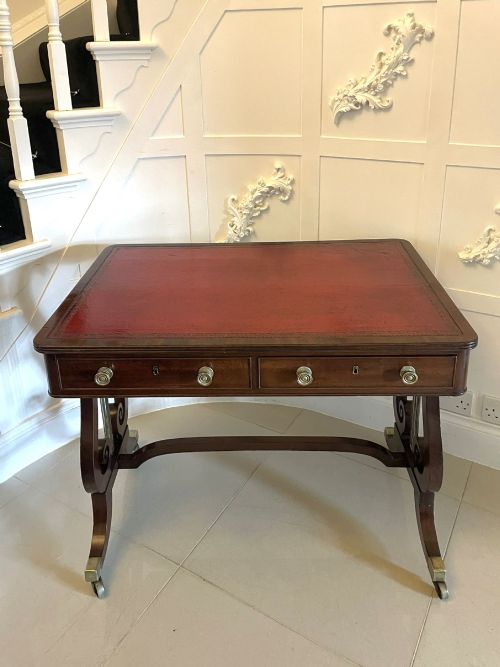


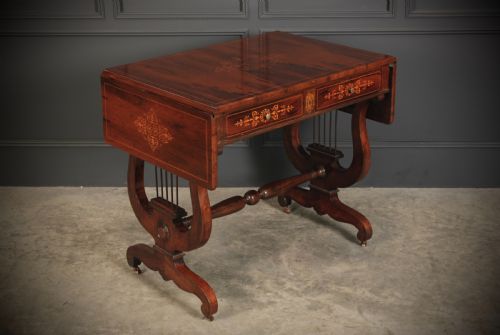


Lyre End Desk
A lyre end desk offers graceful curving supports and practical surfaces, making it a sought-after addition to a traditional study.
Lyre End Desk
A lyre end desk unites practical writing surfaces with distinctive scroll-shaped supports that evoke the classical musical instrument. When buyers search for a lyre end desk, they often encounter related forms such as sofa tables and writing tables that share these characteristic trestle ends.
The examples gathered here span several distinct eras, stretching from the Georgian and Regency periods through the Victorian age and into the Edwardian years. Mahogany and walnut dominate the selection, frequently paired with secondary timbers and inlaid details.
Most pieces function as writing tables or side tables designed to stand free within a room rather than against a wall. Their dual-drop leaves and pedestal bases reflect a tradition of refined domestic utility.
How they were made
Cabinet makers relied primarily on mahogany and walnut, selecting figured veneers to create rich grain patterns across the primary surfaces. Boxwood stringing and marquetry inlay frequently accentuate the borders and drawer fronts.
Structural stability depends on sturdy pillar supports carved into the scrolled lyre shape, often linked by a central stretcher bar. Brass castors and leather writing inserts appear regularly, combining mobility with a durable writing surface.
Some tables hide their inkwells so cleverly you might spend ten minutes looking for a place to write.
What varies in quality
The sophistication of the timber selection dictates much of the distinction between standard examples and finer works. Highly figured mahogany and intricate marquetry indicate a higher tier of craftsmanship.
The crispness of the carving on the lyre supports and the integration of secondary woods reveal the maker's dedication. Strong proportions and balanced design elevate certain pieces above purely utilitarian furniture.
The Lyre End Desk Glossary
- Lyre end
- A furniture support shaped to resemble the ancient Greek musical instrument. It provides structural stability while adding a classical decorative motif to the ends of tables and desks.
- Sofa table
- A small drop-leaf table originally designed to stand in front of a sofa. These pieces typically feature two drawers and double pedestal ends.
- Marquetry
- Decorative veneer work arranged in geometric or pictorial patterns. Craftsmen apply thin slices of varied timbers to create contrasting designs on tabletops.
- Stringing
- Thin inlay lines of a contrasting wood, such as boxwood, used to outline drawers and borders. This technique highlights the edge contours of furniture.
- Parcel gilt
- Part gilt, describing woodwork or ornaments decorated with gold leaf on specific carved details. It highlights particular motifs against the dark timber base.
Lyre End Desk: Frequently Asked Questions
What is a lyre end desk?
A lyre end desk is a writing table featuring distinct scroll-shaped supports resembling a musical lyre. These pieces combine practical workspace with classical decorative styling.
They often function as centre tables due to their finished backs and freestanding design.
How do I date these tables?
Dating relies on timber choice, construction methods, and stylistic cues from periods such as Regency, Victorian, or Edwardian. Earlier pieces often feature solid mahogany and hand-cut dovetails.
Later revival styles incorporate specific Victorian or Edwardian manufacturing techniques and varied secondary woods.
Were these desks meant for writing?
Many pieces listed under this category served as writing tables or sofa tables with integrated drawers. Their surfaces accommodated correspondence and small books.
Drop leaves offered expandable space when needed in a parlour or study.
What woods were commonly used?
Makers predominantly utilised mahogany and walnut for their rich colour and durability. Boxwood and rosewood appear frequently in inlaid borders and decorative veneers.
Secondary timbers such as pine or oak often form the interior drawer linings.