


Louis XVI Wine Table
A Louis XVI wine table brings French Neoclassical elegance to a room, offering a small, decorative surface suited for holding glasses or displaying objects.
Louis XVI Wine Table
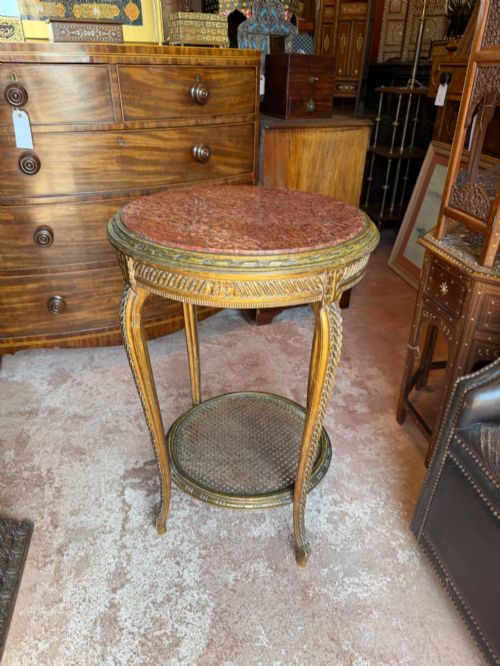
A louis xvi wine table is fundamentally a small occasional surface, often appearing as a gueridon or bouillotte table within the selection. These pieces frequently manifest with round tops made of marble or exotic woods, supported by slender legs characteristic of the French revival and Louis XVI styles.
The evidence shows forms ranging from standard wine tables and occasional side tables to jardiniere planters and wine coolers with marble or onyx tops. Examples appear across the eighteenth, nineteenth, and early twentieth centuries, with nineteenth century and nineteen-hundreds pieces dominating the selection.
Buyers will encounter items constructed in the Louis XVI style, Louis XVI revival, French chateau, and French neoclassical aesthetics. Materials such as mahogany, walnut, rosewood, and painted wood provide the structural foundation for these decorative items.
How they were made
Cabinetmakers utilised hardwoods like mahogany, walnut, and satinwood to build the frames, frequently employing marquetry and parquetry inlay for decorative surface patterns. Tops were regularly fashioned from white marble or onyx to create a durable, smooth display area.
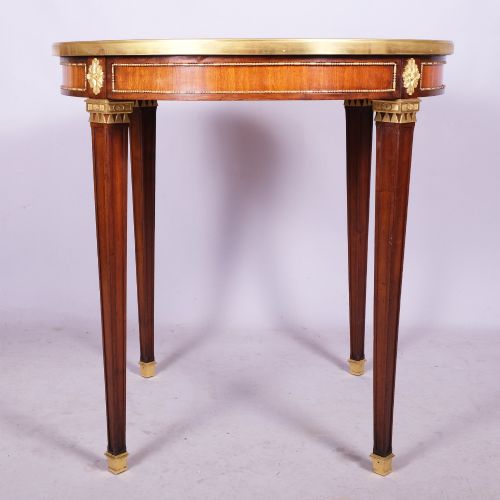
Metal ornamentation played a crucial role in the construction, with brass and ormolu mounts, gilt column supports, and brass galleries fitted around the perimeters. Some variations incorporate painted wood finishes, cane panels, or decorative flower mouldings to enhance the neoclassical appearance.
Listings feature pieces spanning the eighteenth, nineteenth, and early twentieth centuries, including Victorian interpretations of French forms.
What varies in quality
The standard of a louis xvi wine table depends significantly on the precision of its parquetry or marquetry inlay and the fineness of its wood grain. Superior examples exhibit tightly fitted brass or ormolu mounts and finely carved decorative flower mouldings that integrate seamlessly with the structure.
The choice of top material also defines the tier of the piece, with high-grade polished white marble or richly banded onyx marking out the better examples. Authenticity of period materials and the crispness of the gilt column supports distinguish standard revival pieces from finer workshop productions.
A Hugnet Paris·Weisweller
The Louis XVI Wine Table Glossary
- Gueridon
- A small French round table, typically supported by a central column or three slender legs. These small tables frequently feature marble tops and brass galleries.
- Bouillotte table
- A small French card table with a raised gallery edge around the top, designed to keep counters from sliding off during play. They often include marble tops and brass mounts.
- Ormolu
- Gilt bronze ornamentation applied to furniture and decorative objects. This technique adds metallic lustre and formal detail to the wood frame.
- Marquetry
- The art of applying pieces of veneer to a structure to form decorative patterns and pictures. Craftsmen used contrasting wood timbers like mahogany and satinwood for this work.
- Parquetry
- A geometric mosaic of wood pieces used for decorative floors and table tops. It relies on symmetrical wood arrangements to create visual depth.
Louis XVI Wine Table: Frequently Asked Questions
What is a bouillotte table?
A bouillotte table is a traditional French round occasional table featuring a raised brass gallery edge. It was originally designed for the card game of the same name.
These pieces typically incorporate marble tops and candle arms, though surviving examples often serve purely as decorative side tables.
How do I identify Louis XVI style?
Louis XVI style is defined by classical restraint, straight tapered fluted legs, and symmetrical geometric forms. This aesthetic moves away from the elaborate curves of the preceding Louis XV period.
Decoration relies on classical motifs, crisp brass mounts, and inlaid wood veneers rather than heavy carving.
Were these used for wine?
Many tables described as wine tables or wine coolers double as jardiniere planters or general occasional surfaces. Some pieces incorporate metal liners or specific top designs intended for holding bottles or glasses.
Their small footprint allowed servants to move them easily around a reception room during gatherings.
Are marble tops original?
Marble and onyx tops are a standard feature of French neoclassical tables from the nineteenth and early twentieth centuries. They provided a practical, heat-resistant surface for serving drinks.
When inspecting a piece, check that the stone sits flush within its wooden or brass gallery frame.