


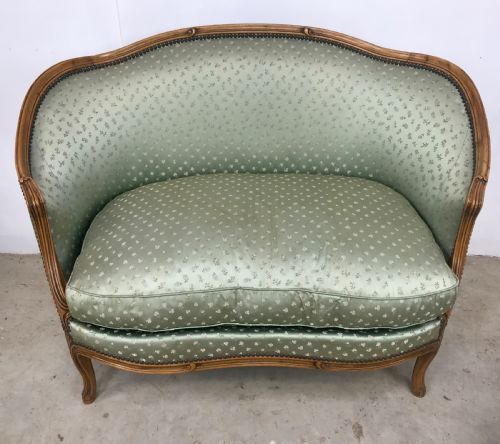
Louis XV Walnut Canape
A louis xv walnut canape brings fluid Rococo lines and rich timber warmth to a formal interior.
Louis XV Walnut Canape
A louis xv walnut canape is an upholstered seat designed for multiple sitters, drawing on French Rococo Revival styles and eighteenth-century forms. These pieces appear in configurations ranging from single two-seater sofas to larger salon suites paired with matching armchairs.
Most examples found here date from the nineteenth and early twentieth centuries, reflecting later revivals of the Louis XV aesthetic. Makers built these settees to mirror the curving silhouettes and carved ornament of earlier French seating.
The primary forms on this page include carved open-arm sofas, bleached walnut settees, and compact end-of-bed two-seater couches. Each version demonstrates the distinctive undulating frames characteristic of French provincial and revival design.
Materials and construction
Craftsmen shaped structural frames predominantly from solid walnut, often selecting timber with rich grain patterns or applying a bleached finish. This dense hardwood allowed carvers to execute deep, flowing relief ornamentation along the crest rails and aprons.
Upholstery methods utilised traditional textiles such as velvet, linen, and patterned fabrics secured with metal tacks. Many surviving examples retain antique coverings or have undergone subsequent recovering to preserve the integrity of the padded seats and backs.
One compact walnut settee is specifically proportioned to sit neatly at the foot of a bed.
Assessing quality in a louis xv walnut canape
Quality rests primarily in the crispness and depth of the hand-carving upon the walnut frame. Superior pieces display fluid, integrated botanical motifs that follow the structural curves without appearing rigid or mechanically produced.
The underlying joinery and timber selection dictate the longevity of the settee. Examples utilising well-seasoned walnut exhibit tighter joints and greater stability throughout the cabriole legs and sweeping arm supports.
The Louis XV Walnut Canape Glossary
- Canapé
- An upholstered sofa or settee, typically featuring an exposed wooden frame and an elongated seat for multiple persons. This French term distinguishes larger seating pieces from single armchairs.
- Cabriole leg
- A furniture leg that curves outward in a convex arc before tapering inward in a concave sweep toward the foot. This characteristic Louis XV shape mimics the natural joints of an animal.
- Rococo Revival
- A nineteenth-century design movement that reinterpreted the asymmetrical scrolls, shell motifs, and naturalistic curves of the eighteenth-century French style. Makers applied these decorative elements enthusiastically to walnut frame furniture.
- Bleached walnut
- Walnut timber treated to lighten its natural dark tone, creating a softer and more contemporary appearance while retaining the underlying grain. This finish appears on select nineteenth-century French seating.
Louis XV Walnut Canape: Frequently Asked Questions
What is a canape sofa?
A canape is an upholstered settee or small sofa designed during the eighteenth century and revived in later periods. It provides comfortable seating for two or more individuals.
These pieces feature exposed wooden frames, often carved with organic motifs and supported on curved legs.
How old are these settees?
Most pieces available originate from the nineteenth and early twentieth centuries, spanning revival periods up to nineteen-thirty. Occasional examples date closer to the late eighteenth century.
Construction details and timber characteristics help distinguish original period production from later nineteenth-century interpretations.
Where were they used?
Historically, a canape sat within formal salons, drawing rooms, and private chambers of French homes. They served as social seating for conversation and reception.
In modern interiors, buyers place them in living rooms, bedrooms, and hallways as statement seating.
Are original textiles common?
Many items retain antique upholstery, while others arrive ready for recovering in new fabrics. Original coverings often consist of velvet, linen, or patterned textiles fastened with metal tacks.
Buyers frequently choose to reupholster these frames to match contemporary colour schemes and interior decor.